Gates, Signs and Barriers on the Trails
Gates, signs and barriers can be easy to misread when you are focused on the ride. On West Virginia trails, they may mark a closure, a hazard, a property boundary or a route you are not allowed to enter. Knowing how to respond helps protect your group, trail access and the land behind the route.
What gates, signs and barriers mean on a trail
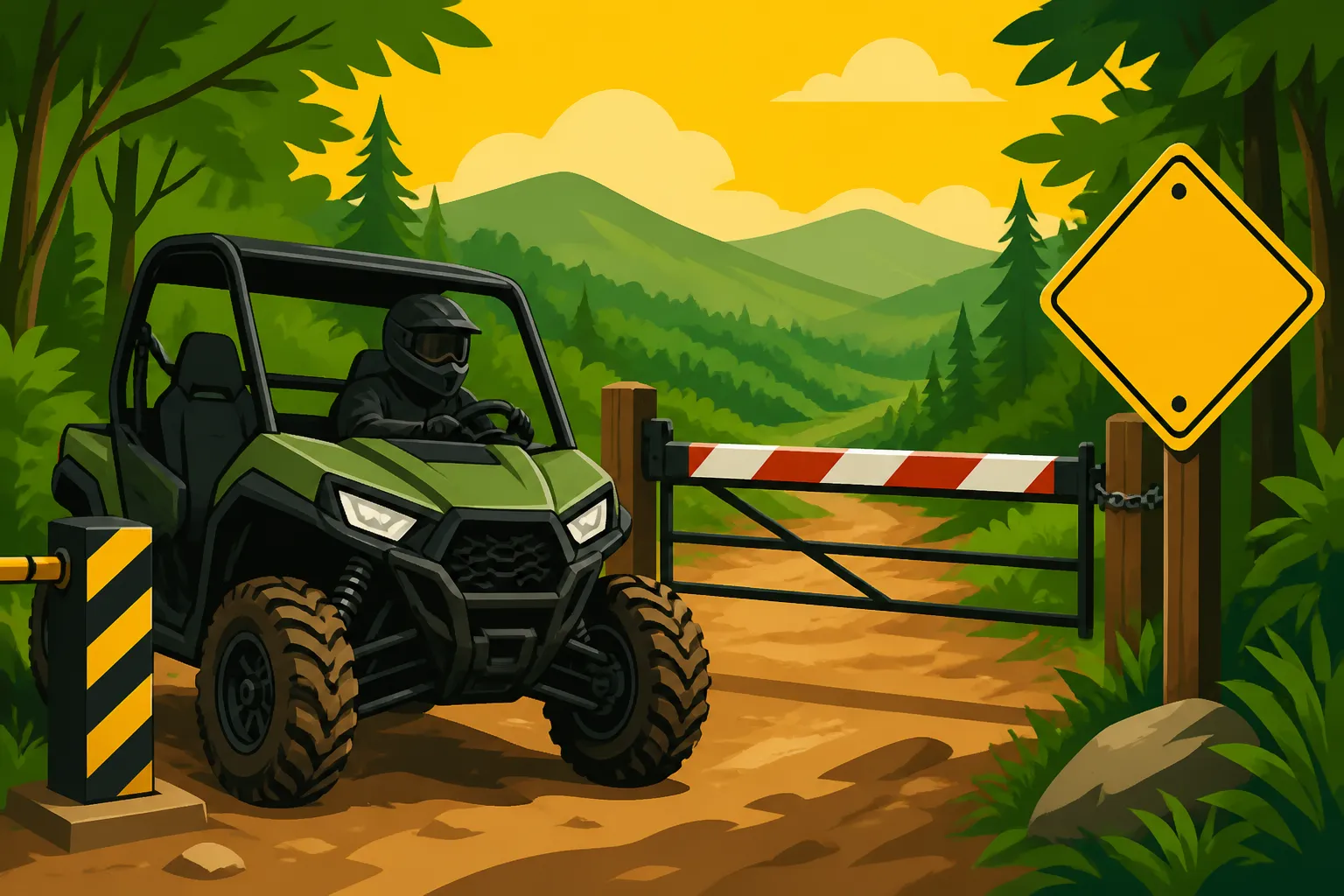
A trail gate is not just an obstacle to ride around. It may control access to a route, protect a work area or show that a section is closed. Signs and other barriers give important context, but the message can be easy to miss if you approach quickly or arrive from an unexpected direction.
On managed trail systems, follow the markings and instructions posted along the route. A permit is permission to ride where access is allowed; it does not override a closure or authorize entry onto a route marked closed. The same principle applies if you have an out-of-state registration or another credential: it does not give you permission to ignore a local closure. For background on the rules riders agree to follow, see Trail Rules Every West Virginia Rider Signs Up To.
| What you encounter | What to do | What not to assume |
|---|---|---|
| Closed gate with a closure sign | Stop, read the sign and turn around if the route is closed | That the closure applies only to full-size vehicles |
| Gate across an unsigned route | Stop and look for other signs or trail markings; do not cross until access is clear | That an open or partly open gate means the route is public |
| Temporary cones, tape or barricades | Treat the route as blocked and seek an official update or alternate route | That the barrier is only a suggestion |
| Trail-direction or route-number sign | Follow the indicated route and check that it matches your map | That every visible path is an authorized trail |
| Private-property or no-trespassing sign | Stay out, even if the route appears to connect to another trail | That a trail permit grants access to nearby land |
| Hazard warning | Slow down and follow the instruction; turn back if the route is unsafe | That the warning is out of date because the trail looks passable |
A sign’s purpose may be obvious, such as a closure notice, or it may require careful reading. Pay attention to words such as “closed,” “local access only,” “authorized vehicles,” “private property,” “no trespassing,” and “trail ends.” Also look for dates, time limits, vehicle restrictions and directions to a detour. If the sign is damaged or hard to read, do not treat that as permission to continue.
A gate can also be open when it is meant to remain open for authorized traffic, or it may be open temporarily for maintenance or landowner access. The position of a gate alone does not always tell you whether riders may pass. Use the posted information, route markings and current trail status together.
How to respond when a route is blocked
When your group reaches a gate, sign or barrier, stop before the front machine reaches it. Leave room for riders behind you to stop safely, especially on a narrow trail or a slope. Do not crowd the barrier or block a junction while your group decides what to do.
Use this process:
- Stop and read the full message. Look for the reason for the restriction, its scope, any dates and instructions for a detour. Do not rely on a quick glance from the seat.
- Check the location. Compare the sign with your trail map, route number or navigation app. Confirm whether it applies to the trail you are on or a connecting route.
- Treat a clear closure as final. If the route is marked closed, do not pass the barrier, go around it, move it or use a nearby path to get past the restriction.
- Choose an authorized route back. Use a marked trail or an official detour that is open. If you cannot confirm a safe route, retrace your path rather than improvising.
- Tell the group. Make sure every rider understands the closure and knows which route you are taking. A lead rider turning around is not enough if the rest of the group did not see why.
- Report unclear or damaged signage. If practical, record the trail location and describe the problem to the trail operator or authority. Do not remove, alter or reposition signs or barriers.
If a barrier is across a trail but there is no readable sign, stop anyway. Look around for a second sign, a route marker or a nearby notice. A barrier may be temporary, but its purpose is not always visible from one side. When you cannot confirm that passage is permitted, avoid crossing and check the current trail information or ask an authorized staff member.
Do not test whether a barrier is sturdy enough to move. It may be protecting riders from a washout, a fallen tree, unstable ground, active maintenance or a hazard around a blind bend. Even when the route looks fine from the approach, conditions can change beyond the barrier. A blocked trail is not an invitation to inspect the hazard yourself.
Some routes have gates that authorized workers, property owners or emergency crews use. A gate that is unlocked or standing open is not automatically an invitation for recreational riders. Conversely, do not close, lock or tamper with a gate unless an authorized person or posted instruction specifically directs you to do so. Gate hardware can control access for a reason, and changing it can create problems for other users or land managers.
If your machine cannot turn around safely at the barrier, do not push forward to find a wider area. Have the group stop in a safe place, communicate clearly, and work out a controlled return. On a steep or narrow trail, avoid crowding, sudden reversals and attempts to maneuver through a gap that may not be an authorized passage.
Reading signs without guessing
Trail signs can direct riders, warn of conditions, set boundaries or announce temporary restrictions. A sign that looks like a general road sign may apply only to a specific trail segment. A trail marker may show the route but not establish that every side path is open. Read each message in context and make sure the route you take remains marked.
Closure signs
A closure sign may apply to one segment, a trail connection or a larger area. Read the wording instead of assuming that a closure ends at the next junction. If the sign identifies a date or condition, follow it as written and check for a newer official notice before riding. A sign does not become irrelevant simply because other riders have passed it.
Temporary closures can follow weather damage, maintenance, landowner needs or safety concerns. For how notices may be posted and why access can change, see Why West Virginia Trails Close on Short Notice and Where Trail Closure Notices Are Posted. Check Checking West Virginia Trail Status Before You Drive before you leave, but continue to follow signs encountered on the trail. A status update you saw earlier may not reflect a new closure posted after you started riding.
Direction and route signs
Direction signs and route markers help keep riders on designated trails, especially at junctions where an unmarked track may look like a shortcut. Follow the marked route rather than choosing a path because it appears easier or connects to a familiar destination. If signs conflict with your map or device, stop and verify your position before proceeding.
A navigation app or downloaded map is useful, but it should not be treated as permission to ride every line it displays. A map may show a route that has since closed, or a line may be a road or access track rather than an open recreational trail. See West Virginia Trail Maps and Signage for more on using route information together with signs on the ground.
Hazard and vehicle restriction signs
Hazard signs may warn about steep grades, loose surfaces, water, limited visibility or other conditions. Slow down and assess whether your machine and group can continue safely. If the hazard looks worse than the sign suggests, turn back rather than treating the posted warning as a guarantee that the route is safe.
Some restrictions may apply to particular vehicles or trail widths. Do not assume that a route open to one machine is suitable for every ATV or UTV. Read the restriction and check your machine’s fit before entering. A machine that can physically squeeze through a gap may still be too wide for the authorized route.
Property and boundary signs
A marked trail may pass near private land, industrial property or other areas where riders do not have general access. A trail permit does not grant broad access to neighboring property. Stay on the designated route and respect signs that mark a boundary or prohibit entry. For a closer look at what a permit does and does not authorize, see What a Trail Permit Does Not Cover.
If a trail seems to continue beyond a boundary sign, do not follow it on the assumption that the sign must be aimed at someone else. Likewise, do not enter a side road, yard, work site or unmarked path because another rider has done so. Staying on Marked Trails in West Virginia covers why remaining on the authorized route matters.
Why you should never bypass a barrier
Going around a closed gate or moving a barrier can create risk for you and others. The restriction may protect riders from a hazard that is not visible at the entrance, such as damaged trail, unstable ground or work in progress. It may also protect a landowner’s property or keep riders away from a route that is not open to public use.
Bypassing a barrier can also make it harder for trail staff to manage access. A moved gate, displaced cone or damaged sign may leave the next rider uncertain about whether the route is open. If the barrier was placed to prevent entry during maintenance or an emergency, moving it may expose other riders to danger.
There is also a difference between finding a legal alternate route and creating one. A marked detour or another open trail may be a reasonable way around a closure. A path through the woods, across a field or over private property is not an authorized detour just because it reaches the same destination. Do not create a new route to avoid turning around.
Avoid these common mistakes:
- Riding around the end of a gate. A gap beside a barrier does not mean riders are allowed through it.
- Lifting or shifting a barrier. Do not move tape, cones, fencing, logs or signs to make space for your machine.
- Following tire tracks past a closure. Tracks show that someone went through; they do not show that passage was permitted.
- Using a neighboring road or property as a shortcut. Access to one trail does not grant access to land beyond its boundary.
- Assuming a closure is only for a different vehicle. Follow the sign’s wording; do not decide that a restriction does not apply based on appearance.
- Riding through because the closure seems old. Confirm current status through an official channel instead of relying on a guess.
- Leaving a group behind. Make sure each rider turns back and no one is separated at the closure.
Riding past a clearly marked barrier may lead to enforcement action or loss of access, depending on the circumstances and applicable rules. The consequences can be more serious if the route crosses private property or a restricted work area. For related details, see Penalties for Cutting a Trail Gate, Riding Off a Marked Trail and Trespass Beyond the Trail Boundary. The practical choice is simple: do not cross a closure unless an authorized official confirms the route has reopened.
Permits, reciprocity and closures
Permits and reciprocity questions often come up when riders travel to West Virginia from another state. They matter, but they answer different questions from a trail closure sign. A permit or accepted credential may address a rider’s eligibility to use a managed system; a closure sign tells you that a particular route or area is restricted.
Do not treat a permit as an all-access pass. It does not cancel a gate, closure notice, private-property boundary or vehicle restriction. Nor does an out-of-state title, registration or trail credential necessarily replace the permit or other requirements for the system you are visiting. Check Do Other States’ Registrations Work in West Virginia? for the separate issue of out-of-state credentials, and confirm current requirements with the relevant trail authority before traveling.
A few practical points help keep these issues separate:
- Permit status: Make sure the rider and machine meet the current requirements for the managed trail system.
- Route status: Confirm that the trail you plan to ride is open and follow posted closures during the ride.
- Machine eligibility: Check any width, type or other restrictions that may apply to a specific route.
- Land access: Stay on authorized trails; a permit does not turn adjacent land into public riding space.
- Current information: Recheck status close to departure and respond to new signs or barriers on the ground.
If you are riding with a group, do not assume every person’s permit or documentation covers every machine. Requirements may depend on the rider, machine, system or type of access. Ask the trail authority or permit provider when the rules are unclear. For permit questions beyond closures, Permits West Virginia Riders Actually Need is a useful starting point.
A trail can be open in the general system while one connector is closed. It can also be open to a category of machine that does not include yours. That is why “the trails are open” is not enough information by itself. Confirm the specific system and route, then use the signs and barriers you encounter as part of the decision.
If an official source says a route is open but a barrier clearly blocks it, do not assume the barrier is mistaken. Stop, avoid crossing and contact the responsible authority or staff if you can. If a sign seems to conflict with an official map, take the conservative option until the conflict is resolved. Riding around a barrier to test which instruction is current is the wrong way to settle a disagreement.
Before you ride and when a sign is unclear
A little preparation makes it easier to handle a closure without losing the group or getting turned around. Before departure, check the current trail status, learn the route you intend to ride and make sure your group knows how to recognize its trail markings. Carry a map or another way to review the route if a phone loses service or power.
Before leaving, confirm:
- Which trail system and trailhead you are using.
- Whether the routes you plan to ride are currently open.
- Whether your machine fits the route restrictions.
- What permit or other access requirements apply to each rider and machine.
- Where the group will turn back if the planned route is closed.
- How the group will communicate at junctions and barriers.
On the trail, slow down when approaching junctions, gates and signs. Dust, poor light, mud or a crowded group can make a sign easy to miss. Keep enough distance between machines for each rider to read the notice and stop without a sudden maneuver. The lead rider should communicate a closure promptly, and the rest of the group should not continue past the barrier while waiting for instructions.
If a sign is damaged or confusing, note the location and the wording you can still read. If it is safe and appropriate, take a photo for reporting, but do not stop in a position that blocks the trail or creates a hazard. Do not remove a sign to examine it or reposition a barrier to make the route easier to understand.
If you have already crossed a barrier before realizing the route is closed, stop as soon as it is safe. Do not keep riding farther in the hope that the closure ends nearby. Turn back carefully if the route allows it, keep the group together and follow any instructions from authorized staff. If a hazard makes the return route unsafe, seek help through the appropriate trail or emergency contact rather than attempting a risky maneuver.
Trail rules are easiest to follow when the whole group treats signs as instructions, not suggestions. A closed route may disrupt the day’s plan, but turning back is better than damaging a barrier, entering property without permission or putting riders into a hazard. A clear detour, a revised route or a shorter ride is a safer outcome than trying to make a closed trail work.
Frequently Asked Questions
Does a trail permit let me ride through a closed gate?
No. A permit does not override a posted closure, barrier, vehicle restriction or property boundary. Stop and use an authorized open route.
If a gate is open, can I assume the trail is open?
Not necessarily. Read any nearby signs and check current trail information. An open gate alone may not establish that recreational riders are allowed through.
Can I go around a gate if other riders have already done it?
No. Other riders’ tracks do not prove that the route is open. Do not bypass, move or damage a barrier.
What should I do if a sign is missing or unreadable?
Stop, look for other route information and avoid crossing a barrier or entering an uncertain route. Check with the trail authority or authorized staff when possible.
Do out-of-state credentials let me ignore a West Virginia trail closure?
No. Credential reciprocity and route access are separate issues. Even if a credential is accepted for a particular purpose, riders must still obey closures and posted restrictions.
Disclaimer
This article is for general informational purposes only and does not constitute professional advice. Laws, prices and regulations vary by location and change over time. Consult a qualified professional for guidance on your specific situation.