West Virginia ATV Title Application at the DMV
Trying to navigate the West Virginia DMV for an ATV or UTV title can feel like trying to ride a black-diamond trail blindfolded. It's not always straightforward, and the rules sometimes seem as winding as a mountain road. This guide is here to untangle that process, walking you through every form, fee, and potential pitfall so you can confidently get your machine titled in the Mountain State.
Understanding Why West Virginia Titles ATVs and UTVs
When you first bring home an ATV or UTV, especially if you're buying it used or moving from a state with different rules, the idea of getting a "title" for what's essentially an off-road toy can seem a bit strange. But in West Virginia, it's a fundamental part of responsible ownership. It's not just bureaucratic red tape; it's a system designed to protect you, other buyers, and to ensure proper legal oversight of these increasingly popular vehicles.
The Legal Mandate for Titling
West Virginia law is quite clear: any all-terrain vehicle (ATV) or utility terrain vehicle (UTV), with a few specific exceptions (like older models or those used exclusively for farm work under certain conditions), must be titled. This isn't optional; it's a requirement enforced by the West Virginia Division of Motor Vehicles (DMV). The primary reason for this mandate is to establish a clear chain of ownership. Think of it like the deed to a house or the title to your car; it's the official document that says, unequivocally, "This machine belongs to me." Without a title, proving ownership can become a significant headache, whether you're trying to sell it, insure it, or recover it if stolen. It's the state's way of tracking these valuable assets and ensuring accountability.
This legal requirement helps prevent illicit sales and provides a paper trail that benefits everyone. If you buy a machine without a title from a private seller, you're not just taking a risk, you're potentially setting yourself up for a long, frustrating battle with the DMV, or worse, finding out the machine was stolen. The title process, while sometimes tedious, creates a necessary layer of protection for consumers and allows law enforcement to trace vehicles. [West Virginia Title Rules for ATVs Sold After 1989] are particularly important to understand, as the rules changed significantly then, making titling much more widespread.
How Titling Protects Your Ownership
Beyond just being a legal requirement, having a West Virginia ATV title in your name is your ultimate proof of ownership. Imagine this scenario: you've just bought a shiny used side-by-side, spent a weekend riding the Hatfield-McCoy Trails, and then, a few months later, it's stolen from your garage. Without a title, proving to the police and your insurance company that the machine was yours to begin with can be incredibly difficult. The title serves as a deterrent to theft and an aid in recovery. It contains vital information like the Vehicle Identification Number (VIN), model year, and your name as the legal owner.
This official documentation becomes invaluable in various situations. When you go to [Insuring an ATV in West Virginia], your insurance company will almost certainly ask for proof of ownership, which the title provides. When you eventually decide to [Selling an ATV in West Virginia Without Trouble], the buyer will expect a properly signed-over title. Without it, you'll struggle to find a legitimate buyer, or you'll be forced to sell it for parts at a fraction of its value. It also protects you from potential legal disputes if there's ever a question of who rightfully owns the ATV or UTV.
Distinguishing Titling from Registration
It's crucial to understand that in West Virginia, "titling" an ATV or UTV is distinct from "registering" it. For most conventional vehicles like cars and trucks, you get a title and a registration (which includes license plates and annual renewal). However, for off-highway vehicles like ATVs and UTVs, West Virginia generally only requires a title. There is no traditional "registration" that leads to a regular license plate for general street use, as these machines are not typically street legal. This often confuses people, especially those new to the state or new to powersports.
The only exception to this "title but no registration" rule for ATVs/UTVs is if you apply for a [West Virginia's Street-Legal Special Purpose Vehicle Plate]. This is a special category that allows certain modified ATVs and UTVs to operate on public roads under very specific conditions. Even then, the "registration" is tied to that special plate and its unique set of rules, not a standard vehicle registration. For the vast majority of off-road enthusiasts, you're simply aiming for the title. You'll get your title certificate, and that's usually the end of your DMV interaction for that machine until you sell it or need to replace a lost title.
Essential Documents for Your ATV Title Application
Gathering the right paperwork before you head to the DMV is probably the single most important step in making the title application process smooth. Missing even one piece of identification or a critical form can mean being turned away and having to make another trip, which is a frustration nobody needs. Think of it as preparing your gear before a big ride; you wouldn't hit the trails without the right helmet and boots, so don't hit the DMV without your documents in order.
Proof of Ownership: Bill of Sale and MCO
The cornerstone of your title application is proving you are the rightful owner of the ATV or UTV. This typically comes in one of two forms, depending on whether the machine is new or used. If you've purchased a new ATV or UTV from a dealership, they will provide you with a Manufacturer's Certificate of Origin (MCO), sometimes called a Manufacturer's Statement of Origin (MSO). This document is essentially the "birth certificate" of your machine and is signed over to you by the dealer. It clearly states the VIN, make, model, and certifies that the vehicle is new.
For a used ATV or UTV, the primary proof of ownership is the properly signed-over title from the previous owner. They will sign the back of their existing title, transferring ownership to you. In addition to the title, a well-drafted [West Virginia ATV Bill of Sale: What Belongs in It] is absolutely critical, especially in private sales. This document, signed by both you and the seller, details the sale price, date, VIN, and names of both parties. It serves as an additional layer of proof and is vital for calculating [West Virginia Sales Tax on an ATV Purchase]. Websites like LawDepot can provide templates for a comprehensive bill of sale, ensuring you include all the necessary information. Even if the previous owner has a title, the bill of sale legitimizes the transaction from a sales tax perspective.
Verifying Your Machine: VIN Inspection and Odometer
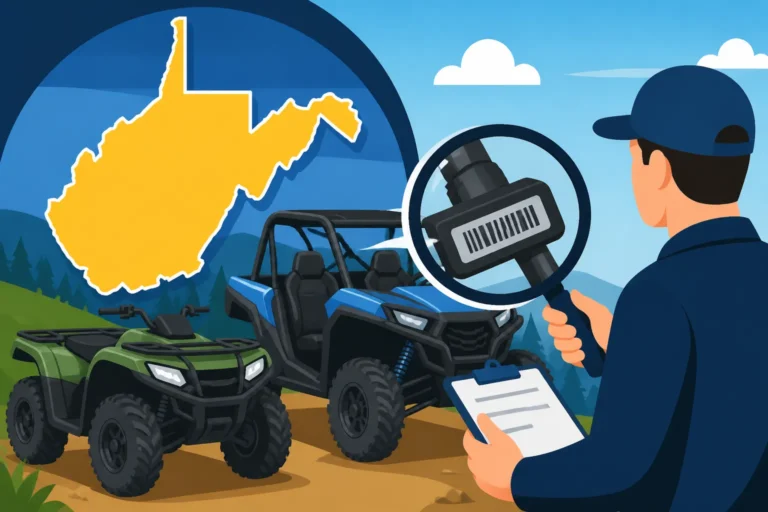
The DMV needs to verify that the machine you are titling is indeed the machine described on your paperwork. This means the Vehicle Identification Number (VIN) is paramount. The VIN is a unique 17-character code stamped onto the frame of your ATV or UTV. It's like a fingerprint for your machine. You'll need to locate this VIN (often on the left front frame rail, near the steering neck, or sometimes under the seat for UTVs) and ensure it matches exactly what's on your MCO or the previous owner's title. [Finding the VIN Stamp on an ATV Frame] can sometimes be tricky depending on the make and model, but it's a step you cannot skip.
In some cases, particularly for older machines or those without easily legible VINs, the DMV may require a physical VIN inspection by a qualified law enforcement officer or DMV official. This ensures the VIN hasn't been tampered with and matches the paperwork. While not always mandatory for every title application, it's good to be prepared. For UTVs, and sometimes ATVs, an odometer reading may also be required on the application, especially if the machine has a speedometer/odometer. Always be honest about the odometer reading, as misrepresenting it can lead to serious legal issues down the line.
Your Personal Identification and Residency
Finally, the DMV needs to verify your identity and residency. You'll need a valid, unexpired government-issued photo ID, such as a West Virginia driver's license or state ID card. If you've recently moved to West Virginia, you might also need proof of residency, like a utility bill or lease agreement, especially if your ID still reflects an out-of-state address. This is simply to confirm that you are who you say you are and that you are eligible to title a vehicle in West Virginia.
If you're titling the ATV or UTV under a business name, you'll need the proper business registration documents, such as your Articles of Incorporation or LLC formation papers, along with identification for the authorized representative of the business. The DMV takes identity verification seriously to prevent fraud, so make sure all your personal information is current and matches across all documents. [Titling an ATV Under a Business in West Virginia] has its own specific set of requirements, so be sure to check those if applicable.
| Document Type | Required For | Key Information | Where to Get It |
|---|---|---|---|
| Manufacturer's Cert. of Origin (MCO/MSO) | New ATVs/UTVs | VIN, Make, Model, Purchaser's Name | Dealership |
| Previous Owner's Title | Used ATVs/UTVs | VIN, Previous Owner Info, Odometer, Lien Info | Previous Owner |
| Bill of Sale | All Sales | Sale Price, Date, VIN, Buyer/Seller Info | Private seller, LawDepot template |
| Proof of West Virginia Residency | All | Current Address, Name | Driver's License, Utility Bill |
| Valid Photo ID | All | Name, Photo, Signature | Driver's License, State ID |
| Odometer Statement | Some ATVs/All UTVs | Current Mileage | ATV/UTV, Application Form |
The Step-by-Step Application Process at the DMV
You've gathered your documents, double-checked everything, and now it's time to face the DMV. While it can feel daunting, breaking down the application into clear steps makes it far more manageable. Remember, the DMV staff are there to process your request, and coming prepared is the best way to ensure a smooth visit.
Completing the Official West Virginia ATV Title Application Form
The core of your application is the official West Virginia ATV Title Application Form (usually Form DMV-1-TR, though always verify the current form number on the DMV website). This form requires you to fill in all the details about yourself (as the applicant) and the ATV or UTV. You'll need the VIN, make, model, year, and engine size. If it's a used machine, you'll also report the purchase price, odometer reading (if applicable), and the previous owner's information. It's critical to fill out this form accurately and completely. Even a small error can cause delays.
If you're unsure about any section, it's often best to leave it blank and ask a DMV representative when you get there, rather than guessing and having to correct it later. Many people find it helpful to download and print the form from the West Virginia DMV website in advance so they can fill out as much as possible at home in a relaxed setting. You might also find a bill of sale template on LawDepot helpful to cross-reference details with your application. Having a copy of your [West Virginia ATV Title Application Form] ready will speed up your visit considerably.
Calculating and Paying Fees and Sales Tax
This is where many people get tripped up. There isn't just one fee; there are usually a few components. First, there's the title application fee itself, which is a set amount. Then, there's the sales tax. West Virginia charges sales tax on the purchase price of your ATV or UTV, even if you bought it from a private seller. This tax is usually collected at the DMV when you apply for the title. If you traded in another vehicle, you might get a credit against the sales tax, but this needs to be clearly documented on your bill of sale. [West Virginia Sales Tax on an ATV Purchase] explains this in more detail.
It's wise to have an idea of the total cost before you go. You can find the current title fee and sales tax rate on the West Virginia DMV website. Bring a variety of payment methods – cash, check, or a credit/debit card – as not all DMV offices accept every type of payment, or their systems might be down. Don't forget, if you bought the machine out-of-state, West Virginia still expects to collect its sales tax unless you can prove you already paid an equivalent sales tax in another state. This is part of what makes [Titling an Ohio ATV in West Virginia] or [Bringing a Pennsylvania Quad to West Virginia] a bit different from a local purchase.
Submitting Your Application and What Happens Next
Once you have your completed application form, all supporting documents, and the means to pay, you'll submit everything to the DMV. A clerk will review your paperwork for completeness and accuracy. They'll check the VINs, verify signatures, and ensure all required fields are filled. This is why being meticulous beforehand saves a lot of hassle. If everything is in order, they will process your payment and provide you with a temporary receipt. This receipt serves as your immediate proof that you've applied for the title.
While you won't walk out with a physical title in hand, this receipt is important. It proves you've initiated the process and, in most cases, it means your official title certificate will be mailed to you within a few weeks. The timeframe can vary depending on DMV workload, but typically, [How Long a West Virginia ATV Title Takes] is a matter of weeks, not months. Keep your receipt in a safe place, possibly with a copy of your bill of sale, until your official title arrives.
Common Roadblocks and How to Overcome Them
It's an unfortunate truth that the ATV titling process can hit snags. Whether it's a lost document, an error, or a particularly tricky private sale situation, these roadblocks can feel incredibly frustrating. But for almost every problem, there's a solution, and knowing what to expect can save you a lot of grief.
Missing or Incorrect Documents
This is perhaps the most common reason people get turned away from the DMV. Maybe you forgot the original MCO, or the seller only gave you a basic handwritten receipt instead of a detailed bill of sale. Perhaps the previous title has a smudge over a critical number, or the odometer reading wasn't clearly stated. The solution here is almost always to go back and get the correct or missing documentation. If the original MCO is lost, you'll likely need to contact the dealer who originally sold the machine, or in some cases, the manufacturer, to request a duplicate.
If the bill of sale is inadequate, you might need to reach back out to the seller to create a more comprehensive one. LawDepot, for instance, offers templates for a proper bill of sale that includes all the details the DMV typically looks for. If the VIN on the paperwork doesn't match the machine, that's a bigger issue. First, triple-check the VIN on the machine itself. Sometimes it's just a transcription error. If the VIN truly doesn't match the previous title, you might be dealing with a problematic machine or a clerical error that requires a [Fixing a Wrong VIN on a West Virginia Title] process through the DMV.
Dealing with Liens on a Title
A lien on a title means that another party (usually a bank or financial institution) has a legal claim to the ATV or UTV because it was used as collateral for a loan. If you buy a used machine and the previous owner hasn't paid off their loan, that lien will appear on the title. The DMV will not issue a new title in your name until that lien is formally released. This is a huge red flag and a reason why checking the title carefully before purchase is essential.
If you find yourself in this situation, the previous owner is responsible for getting the lien released. This means they need to contact their lender, pay off the loan, and get a lien release document. Only once the lienholder formally notifies the DMV or provides you with a physical lien release will you be able to proceed. Always be wary of buying a machine with an active lien. If you've already bought it, you'll need to work with the seller to resolve the outstanding debt and secure the [West Virginia Lien Release on a Paid-Off UTV].
Titling a Machine Without a Previous Owner's Signature
Another common and frustrating scenario is trying to title an ATV or UTV where the previous owner either never signed the title over, their signature is missing, or they're completely unreachable. This happens in situations like inherited machines where the heirs don't know the process, or unfortunately, in some shady private sales. The DMV will not transfer a title without the proper signature from the selling party.
If the seller simply forgot to sign, you'll have to track them down and get their signature. If they are deceased, you'll need legal documentation like a will or letters of administration to prove your right to the machine. [A West Virginia ATV Title With a Missing Seller Signature] is a real problem, and it might require you to pursue options like a [Bonded Title for an ATV in West Virginia], which is a more complex process involving a surety bond to protect against claims from prior owners. This is generally a last resort and involves more time, paperwork, and cost, so avoiding it by ensuring a properly signed title at the point of sale is always best.
After the Application: What to Expect
You've done the hard part: navigated the forms, paid the fees, and submitted your application. Now comes the waiting game. Understanding what happens next, how long it takes, and what to do if there's an issue is key to finalizing the process and having peace of mind.
How Long Until Your Title Arrives
After successfully submitting your application at a [West Virginia DMV Offices That Handle ATV Titles], you typically won't walk out with your physical title. Instead, the West Virginia DMV will process your request, print the official title document, and mail it to the address you provided on your application. The good news is that this process is usually fairly efficient. Most individuals can expect their ATV or UTV title to arrive in the mail within 2 to 4 weeks.
However, keep in mind that this is an estimate. During peak times, holidays, or if there are unexpected backlogs or system issues, it could take a bit longer. If you haven't received your title after a reasonable amount of time (say, 6-8 weeks), you should contact the West Virginia DMV to [Checking a Title Status With the West Virginia DMV]. Don't panic immediately, but do follow up to ensure there wasn't an issue with mailing or an unforeseen delay. Until it arrives, your temporary receipt from the DMV is your proof that you have a title pending.
What to Do If Your Title Has an Error
Once your title arrives in the mail, the absolute first thing you should do is carefully review every single detail on it. Check your name, address, the VIN, the make, model, year, and any lienholder information. It's rare, but sometimes clerical errors happen. Imagine discovering a typo in your VIN just as you're trying to sell the machine years down the road; that could hold up your sale significantly.
If you find an error, no matter how small, don't ignore it. You'll need to contact the West Virginia DMV immediately to report the discrepancy. They will guide you through the process of correcting the error, which may involve filling out a correction form and possibly submitting your incorrect title back to them for a corrected version. Acting quickly is best, as correcting errors becomes more complicated the longer you wait, especially if you later try to transfer ownership with an inaccurate title. A common issue is a wrong VIN, which has its own specific correction process.
Keeping Your Title Safe for Future Sales
Your ATV or UTV title is a crucial legal document. Once you have it, treat it with the same care you would your car title, the deed to your house, or any other important financial paper. Store it in a safe, secure place, away from potential damage, loss, or theft. A fireproof safe, a locked filing cabinet, or a secure bank safety deposit box are all excellent choices. Avoid keeping it in the machine itself or in a glove box, as that makes it easy prey for thieves.
This document is essential when you decide to [Selling an ATV in West Virginia Without Trouble]. When that time comes, you'll need the original, physical title to sign over to the new owner. A photocopy will not suffice. If you lose your title, you'll have to go through the process of [Replacing a Lost West Virginia ATV Title] which involves more paperwork, fees, and waiting. Taking good care of your title now will save you a lot of headache and expense down the road when it's time for the next transaction.
Special Situations and Considerations
While the basic titling process covers most scenarios, West Virginia's ATV and UTV title laws have evolved, and certain situations require specific attention. Being aware of these nuances can prevent unexpected delays and ensure you comply with all regulations.
Titling a Used ATV from an Out-of-State Seller
Bringing an ATV or UTV from another state into West Virginia involves a few extra steps, particularly if that state didn't require titles for ATVs. Some states, especially historically, had very relaxed or non-existent titling laws for off-road vehicles. If you purchase a used machine from a state like [Titling an Ohio ATV in West Virginia] or [Bringing a Pennsylvania Quad to West Virginia] that might not have issued a title, you'll face a unique challenge. West Virginia still generally requires a title for these machines, even if their home state didn't.
In such cases, you will still need a robust bill of sale. It should clearly state the VIN, the full names and addresses of both buyer and seller, the purchase price, and the date. You may also be required to provide proof of prior registration in the other state, or a sworn affidavit stating why a title doesn't exist. Sometimes, a VIN inspection is more likely to be required for out-of-state machines to verify identity. The DMV needs to be satisfied that you legally own the machine and that it's not stolen, even if it comes from a non-titling state. You will also pay West Virginia sales tax on the purchase price, unless you can prove you already paid an equivalent sales tax in the state of purchase.
Titling a New ATV Purchased from a West Virginia Dealer
Buying a brand-new ATV or UTV from a licensed West Virginia dealership is usually the most straightforward path to a title. Dealers are experienced with the paperwork and often handle much of it for you. When you purchase the machine, the dealer will typically provide you with the Manufacturer's Certificate of Origin (MCO) and a bill of sale. They may even offer to submit the title application to the DMV on your behalf, collecting all the necessary fees and taxes from you at the time of purchase.
This convenience is a major advantage of buying new from a dealer. While you still need to ensure all your personal information is correct and provide your identification, the dealer acts as an intermediary, streamlining the process significantly. They will submit the MCO, your bill of sale, and the application form to the DMV, and your title will then be mailed directly to you. [Buying From a West Virginia Dealer: What They File] explains this process in greater detail and can offer peace of mind knowing the heavy lifting is handled.
Titling a UTV: The December 2010 Rule
For UTV owners, there's a specific historical note that's important: West Virginia began requiring titles for UTVs (Utility Terrain Vehicles or side-by-sides) in December 2010. This means that if you own a UTV that was purchased or acquired before that date, the titling rules can be a little different. For UTVs sold after December 2010, the process is largely the same as for ATVs, requiring an MCO for new machines or a properly signed-over title for used ones.
However, if you have a UTV from before December 2010 that has never been titled, you may need to provide additional documentation to establish ownership, much like an ATV coming from a non-titling state. This could include a strong bill of sale, old registration documents if any existed, or even an affidavit of ownership. It's critical to be prepared with as much historical paperwork as possible if you're trying to title an older UTV for the first time. [West Virginia UTV Title Rules Since 2010] and [Titling a UTV Bought Before West Virginia's 2010 Rule] delve deeper into these specific requirements.
Disclaimer
This article is for general informational purposes only and does not constitute professional advice. Laws, prices and regulations vary by location and change over time. Consult a qualified professional for guidance on your specific situation.