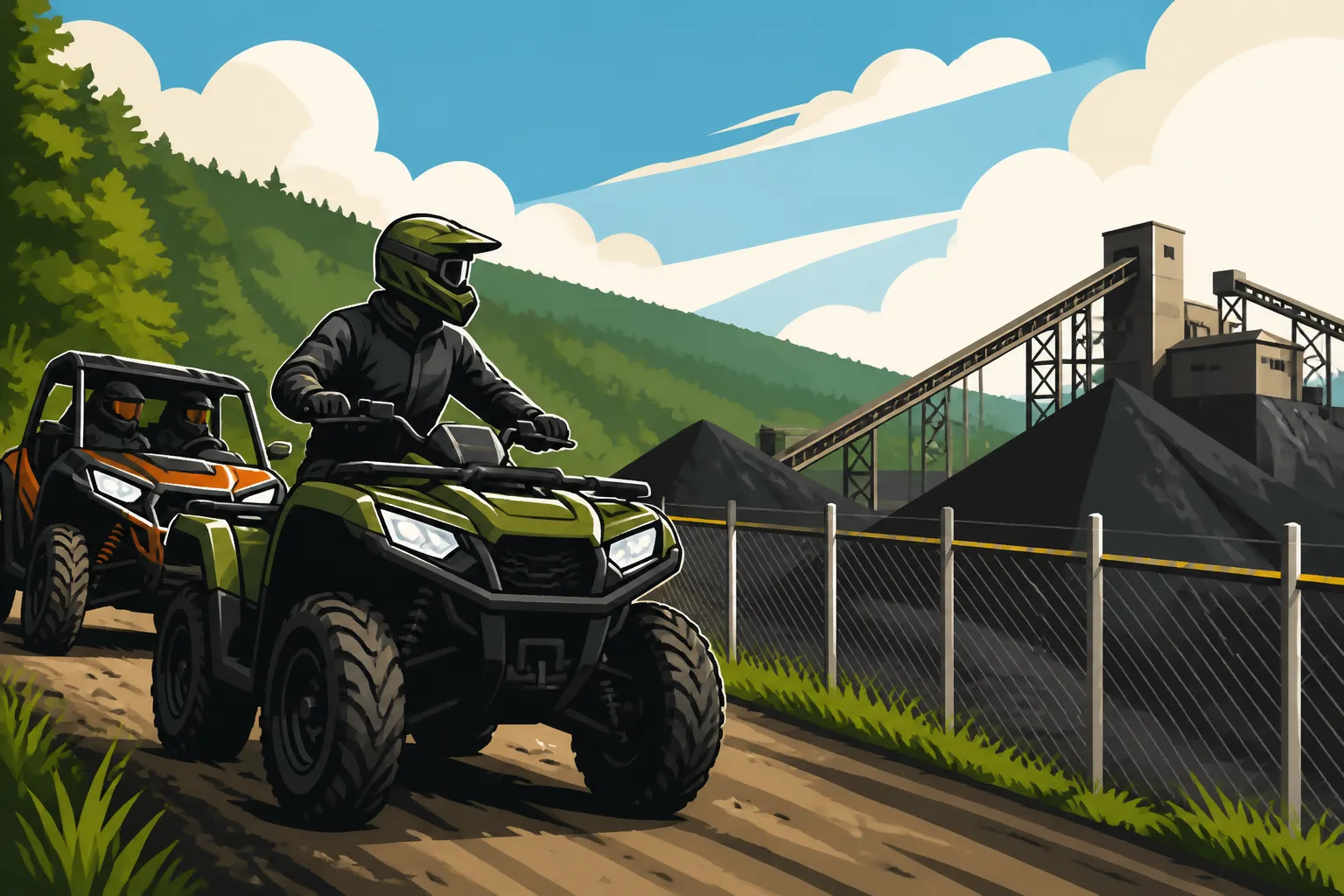
Riding Onto Private Coal Company Land
Riding onto private coal company land can seem like a shortcut between trails, a way around a closure, or an open route through familiar terrain. But a trail permit or road-riding registration does not grant access to private property. Before entering coal company land, confirm who controls it and get permission for the route you intend to ride.
A trail permit does not grant access to private land
West Virginia’s managed trails and privately owned coal company property are not interchangeable. A route that looks rideable on a map, follows an old haul road, or connects two familiar places may still cross land where riders are not allowed. The key question is not whether your ATV or UTV can travel there, but whether you have permission to enter.
The West Virginia DMV says riding a machine on any Hatfield-McCoy Trail System requires a Hatfield-McCoy Trails User Permit and a DOT- or SNELL-approved helmet. That permit applies to the managed trail system; it is not a general pass for nearby private property. West Virginia’s Hatfield-McCoy Trail Permit Explained covers the separate permit requirement, while Staying on Marked Trails in West Virginia explains why riders should remain on authorized routes.
A trail may pass through land owned or managed by different parties under agreements. That does not mean every road, spur, or adjacent parcel is open to riders. Access is limited to routes the trail system authorizes. A gate, barrier, posted notice, closure, or route that appears to leave the marked system should prompt you to stop and check rather than assume the way is open. For related context, see Landowner Agreements Behind West Virginia’s Trails and Trespass Beyond the Trail Boundary.
The same distinction applies to road use. The West Virginia DMV says riding an ATV on a roadway is allowed only after the operator has gone through the Special Purpose Vehicle registration process, subject to road restrictions. That registration concerns roadway use; it does not grant permission to ride across a coal company’s land. Likewise, the DMV says riding on Hatfield-McCoy approved roads, highways, or ATV-friendly towns requires a permit, helmet, and liability insurance. Those requirements do not turn a neighboring private road into an authorized trail.
A rider might have permission to use one section of private land but not another. Permission may also be limited to specific routes, dates, machines, or activities. Do not treat a prior trip, a local custom, or a seller’s casual assurance as continuing authorization. Ask the person or organization with authority over the property to identify the route and any limits before you ride.
Why coal company roads can be misleading
Old industrial roads and wide clearings can look like public routes, especially when vegetation has grown back or traffic has left visible tracks. Their appearance does not establish public access. A route may be private, closed, active for company work, or subject to rules that are not obvious from the trail.
A map can help you plan, but it cannot always settle ownership or permission. The WV GIS Technical Center’s map application lets users zoom to land units through categories such as National Lands, State Lands, Wildlife Management Areas, Local Lands/Parks, and Motorized Trail Systems. The center was funded to inventory recreational trails, according to the West Virginia Division of Highways. Use mapping to identify questions to verify, not as a substitute for permission from the landowner or manager.
What can happen if you ride without permission
The consequences can include a criminal trespass conviction and financial responsibility for damage. As of November 2026, the West Virginia Legislature states that riding an ATV onto private coal company land without permission is unlawful trespassing on property other than a structure or conveyance. For a first-time conviction, the offender is guilty of a misdemeanor and must be fined between $100 and $500. If property damage occurs during a willful trespass, the offender is civilly liable to the owner for twice the amount of the damage, including cleanup costs.
The potential damage is not limited to broken property. A machine can tear up a road surface, damage a gate or drainage feature, leave deep ruts, or disturb an area the owner is trying to protect. Even when a rider did not intend to cause damage, the costs of repairing a route or cleaning up can add to an already serious situation. The specific legal consequences depend on the facts and applicable law; do not assume that a quick apology or a trail permit resolves a trespass.
West Virginia law also allows local governments to create stricter ATV rules and additional restrictions, according to the West Virginia DMV. A route that is allowed in one place may be restricted in another. Before riding near a town, trail connector, or county road, check for local rules as well as land access.
Chapter 17F of the West Virginia Code covers ATVs, including prohibited operator acts and penalties, according to the West Virginia DMV. The same chapter addresses safety courses, local government authority, private-property exemptions, farm and commercial-use exemptions, and rules of operation. These provisions are not a general invitation to ride on someone else’s land. If you are relying on a particular exception, verify its requirements with an authoritative source rather than assuming it applies to your situation.
A property owner may respond to unauthorized riding by closing access, reporting trespass, or seeking compensation for damage. A closure can affect more than one rider if the route was part of a larger access arrangement. That is one reason to treat gates and posted restrictions seriously and avoid creating a conflict that could jeopardize lawful access elsewhere.
How to check a route before you ride
A reliable route check combines an authorized trail map with direct confirmation about property access. Do not rely on a single map layer, an old GPS track, or another rider’s description when a route appears to cross private land.
-
Identify the route you plan to take. Start with the current trail map or official trail information for the area. If your plan includes a connector, an unmarked spur, or a road near a coal company parcel, mark that section for confirmation. West Virginia Trail Maps and Signage can help with reading trail information, and Checking West Virginia Trail Status Before You Drive is useful when closures may affect your plan.
-
Check the land information available to you. The WV GIS Technical Center map application includes categories for several land-unit types, including Motorized Trail Systems. Use the map to understand what areas may be involved, but remember that a map display may not establish current access rights, a landowner’s rules, or temporary closures.
-
Ask the trail operator or property manager. If the route appears to leave the managed system or cross coal company property, ask the organization responsible for that land or route whether ATV or UTV access is allowed. Be specific: identify the road or trail segment, the machine you will ride, and the date or period you plan to visit. Get a clear answer about where access begins and ends.
-
Confirm the conditions of permission. If access is granted, ask whether permission covers your whole group, the machine type, parking, unloading, and the planned route. Clarify whether you may use the road to connect to another authorized section or must turn back at a particular point. Keep the instructions available during the ride, but do not mistake a saved message or map mark for permission to go beyond the approved route.
-
Check for restrictions before setting out. A route may have changed or closed since you last visited. Follow current signs and barriers on the ground, and stop if they conflict with your planned route. For managed trail status and boundaries, Why West Virginia Trails Close on Short Notice and Gates, Signs and Barriers on the Trails provide useful background.
If you cannot confirm access, choose a route that is clearly authorized. A detour can be frustrating, but it is safer than relying on the assumption that an open-looking road is open to riders.
What to do if you reach a gate or uncertain boundary
Stop before entering. Do not ride around a gate, move a barrier, or continue because another vehicle has already passed through. A gate may mark a private boundary, a closure, or a work area; its meaning may not be obvious, but it is a reason to verify access before proceeding.
If a sign names a landowner, trail operator, or contact, use that information to ask about the route. If there is no contact information, return to the last clearly authorized trail and check with the relevant trail office or property manager. Do not assume that a road is open because it is not posted at every entrance. Where Trail Closure Notices Are Posted may help you understand where managed-trail notices appear, but a trail closure notice and a private-property access decision are separate matters.
If you have already entered property and realize access is uncertain, do not continue farther or attempt another route across the land. Leave by the safest route you can use without causing additional damage, and contact the property manager or appropriate authority for instructions. If you encounter company workers, follow their directions calmly and keep clear of equipment and active work areas.
For future trips, plan a route that stays within the authorized trail system and confirm any private-road connection in advance. A Hatfield-McCoy permit is required for use of its trail system, according to the West Virginia DMV, but the permit should be treated as permission for the designated system—not as approval to explore adjoining property. What a Trail Permit Does Not Cover offers additional context on the limits of a trail permit.
Permission is the practical difference between a lawful ride across private property and an unauthorized entry. When a route touches coal company land, verify it with the party that controls the property, follow the boundaries and conditions given, and turn around if you cannot confirm access.
Sources
- West Virginia Legislature — West Virginia Code | §61-3B-3 & §61-3B-8 (checked November 3, 2026)
Disclaimer
This article is for general informational purposes only and does not constitute professional advice. Laws, prices and regulations vary by location and change over time. Consult a qualified professional for guidance on your specific situation.