Filing an ATV Theft Claim After a Break-In
Discovering your beloved ATV or UTV has been stolen is an incredibly jarring and violating experience. One minute you're planning your next trail adventure on the Hatfield-McCoy trails or a relaxing ride around the farm, and the next you're staring at an empty space where your machine should be, your heart sinking to your stomach. It's a frustrating situation that leaves you feeling helpless and angry. This guide is here to walk you through the essential steps for filing an ATV theft claim after a break-in here in West Virginia, helping you navigate the process from that awful moment of discovery to working with law enforcement and your insurance company.
The Immediate Aftermath: What to Do First After Discovering the Theft
That initial shock can be paralyzing, but acting quickly is crucial when your ATV or UTV goes missing. Before you do anything else, take a deep breath. You're going to need to be clear-headed for the next few steps.
First, confirm it's actually stolen and not just misplaced or borrowed. This might sound obvious, but in the heat of the moment, sometimes we jump to conclusions. Did a family member move it without telling you? Is it parked in an unusual spot you forgot about? Once you've thoroughly checked your property, any sheds, or other storage areas, and confirmed it's truly gone, then you know you're dealing with a theft.
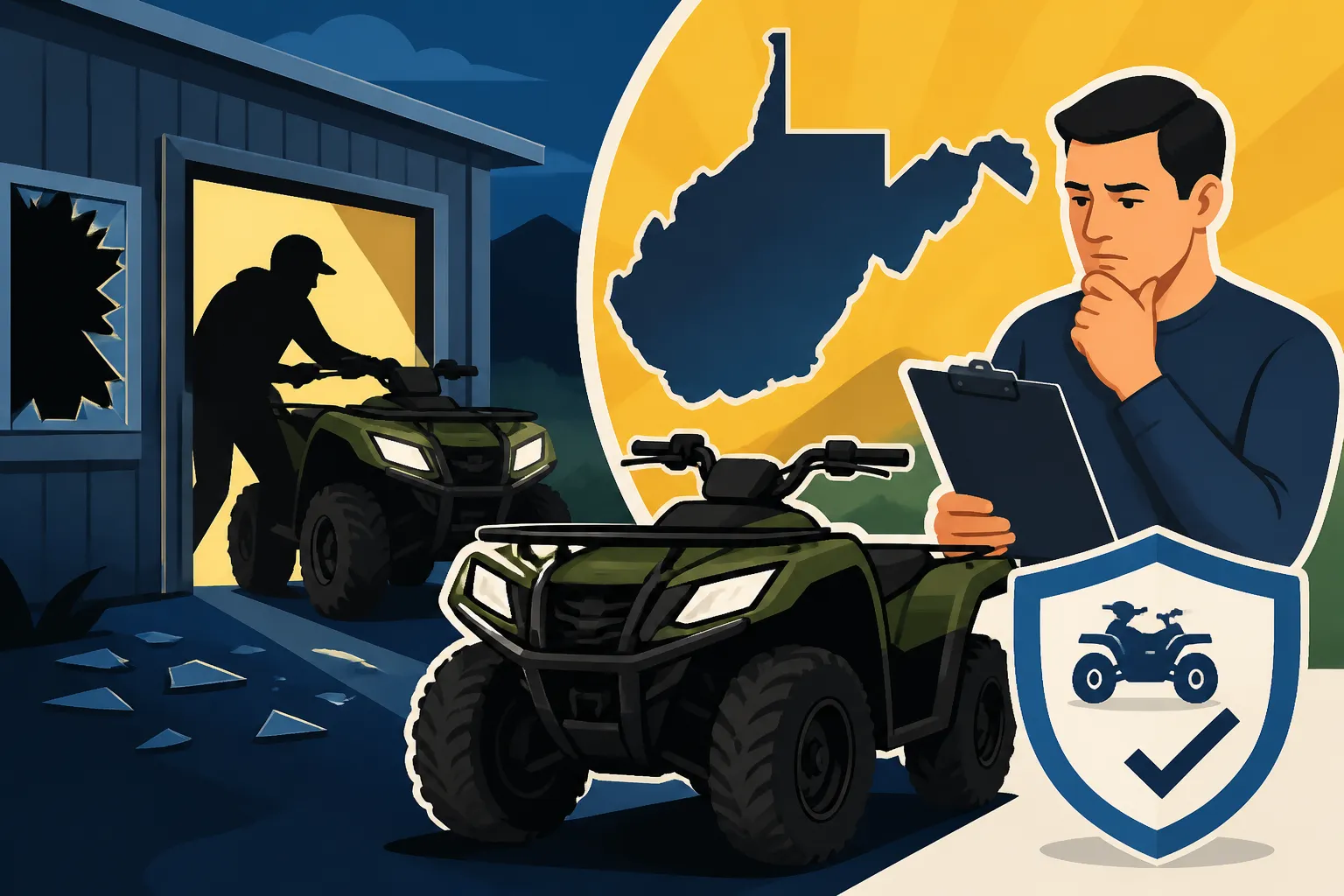
Next, and this is incredibly important, do not disturb the scene any more than necessary. If your garage was broken into, or a gate was cut, try to leave everything as close to how you found it as possible. The police will want to look for clues, fingerprints, or other evidence. If you start tidying up, you might inadvertently destroy valuable evidence that could lead to the recovery of your machine or the apprehension of the thieves. Take a moment to mentally note anything unusual you see, but don't touch or move items.
Now, while the details are fresh in your mind, make a quick mental inventory of what's missing. Was it just the ATV? Or were other items taken, like helmets, riding gear, tools, or even the trailer it was sitting on? Jotting these down, even quickly, will help immensely when you talk to the authorities. This initial assessment also helps confirm the extent of the break-in beyond just your ATV.
Reporting the Theft to Law Enforcement in West Virginia
Once you've confirmed the theft and have a general idea of what's missing, contacting the police is your very next step. Do not delay this. The sooner law enforcement knows, the sooner they can issue an alert and potentially intercept the thieves.
Calling the Authorities and Filing a Police Report
Pick up the phone and call your local police department, sheriff's office, or state police detachment, depending on where you live in West Virginia. For instance, if you're in a smaller town like Gilbert, you might call the municipal police. If you're out in a more rural area near the trails, the county sheriff or West Virginia State Police would be your contact. Explain clearly that your ATV or UTV has been stolen and that there was a break-in. They'll dispatch an officer to your location.
When the officer arrives, provide them with all the details you can remember. This includes:
- When you last saw the ATV: Provide a specific date and time.
- When you discovered it was stolen: Again, date and time.
- How the thieves gained entry: Was a lock cut? A window broken? A door pried open?
- A detailed description of your ATV/UTV: Make, model, year, color, any unique features or modifications (winch, custom tires, decals, specific accessories, lift kits).
- The Vehicle Identification Number (VIN): This is paramount. The VIN is like your ATV's fingerprint. If you don't know it off-hand, it's typically on your title, registration, or insurance documents. The officer will need this to enter the machine into national databases as stolen. You can also review [Finding the VIN Stamp on an ATV Frame] for common locations.
- Any other items stolen: Provide details for these as well.
- Any potential witnesses or suspicious activity: Did you see anything or anyone unusual in the days leading up to the theft? Did your neighbors see or hear anything?
Be patient and thorough. The officer will complete a police report, and you absolutely need a copy of this report or at least the report number. Your insurance company will demand this as proof of theft, and it's also essential if the ATV is later recovered. This report officially begins the process of [Recovering a Stolen ATV Through Its Title].
Gathering Documentation for the Police and Insurance
While the police are investigating, you should start pulling together all relevant documents about your ATV. This goes hand-in-hand with making your insurance claim.
- Your ATV's Title: This proves you are the legal owner. If you don't have the original, copies might work initially, but you'll eventually need the VIN. If your title itself was stolen in the break-in, you'll need to report that too and look into [Replacing a Lost West Virginia ATV Title].
- Proof of Purchase: A bill of sale or purchase agreement. This helps establish the value and your ownership. Even a simple document created using a template from a service like LawDepot, if you bought it privately, can serve as valuable supporting evidence.
- Insurance Policy Information: Your policy number and contact information for your insurance company.
- Photos of your ATV: Any pictures you have of your machine, especially if they show unique features or accessories. These can be incredibly helpful for identification.
- Records of Modifications or Upgrades: Receipts for any aftermarket parts, winches, tires, light bars, or other accessories you added. These add value to your machine and should be part of your claim.
- Maintenance Records: Proof that you regularly maintained the ATV can sometimes support its condition and value.
The more detailed information you can provide, the better your chances of recovery and a smooth insurance claim process. This documentation helps the police accurately list your machine as stolen and provides your insurance company with the necessary details to process your claim efficiently. Keep copies of everything you submit, and make notes of who you spoke with, when, and what was discussed.
Working with Your Insurance Company to File a Claim
Once you've filed the police report, contacting your insurance company is the next critical step. This is where your preparedness with documentation will really pay off.
Understanding Your West Virginia ATV Insurance Coverage
Not all insurance policies are created equal, and it's important to understand what your specific West Virginia ATV insurance policy covers. Most standard policies will include comprehensive coverage, which is what protects you against theft, vandalism, fire, and other non-collision events. If you only had liability coverage, which is mainly for damage you might cause to others, then theft might not be covered. You can learn more about what kind of protection you might have by reviewing [West Virginia ATV Insurance and When You Need It] and [West Virginia ATV Liability Coverage Limits].
Call your insurance agent or the company's claims department as soon as possible after filing the police report. Explain the situation clearly: your ATV was stolen during a break-in, and you have a police report number. They will open a claim and assign a claims adjuster to your case.
What the Insurance Company Will Need From You
Your claims adjuster will guide you through their specific requirements, but generally, they will ask for:
- Police Report Number: This is mandatory.
- Detailed Description of the ATV: Just like you gave to the police, but be even more thorough. Include VIN, make, model, year, color, mileage (if you know it), and all modifications.
- Proof of Ownership: Your title and bill of sale.
- Proof of Value: This could include purchase receipts, appraisal documents, or receipts for expensive upgrades. If you have a detailed inventory of your ATV's features and accessories, a formal document like one you could create through LawDepot can add credibility.
- Photos: Any pre-theft photos you have of your ATV.
- A Statement of Loss: You'll likely need to fill out forms describing the theft, the items stolen, and potentially recounting the circumstances of the break-in.
Be honest and accurate in all your statements. Providing false information can lead to your claim being denied and could have legal consequences. The insurance company will also likely conduct its own investigation to verify the details of the theft. This might include contacting the police department and possibly even visiting the scene of the break-in.
Handling Depreciation and Settlement Offers
This is often the most frustrating part for many owners. Insurance companies typically pay out based on the actual cash value (ACV) of your ATV, not what it would cost to buy a brand new one today. ACV accounts for depreciation due to age, wear and tear, and mileage. While you might have paid a certain amount for your machine, its value drops over time.
- Be prepared for depreciation: Understand that the settlement offer might be less than what you hope for, especially if your ATV is several years old.
- Negotiating the value: If you feel the offer is too low, you can try to negotiate. Provide additional evidence of your ATV's excellent condition, recent maintenance records, or receipts for high-value upgrades that might not have been fully accounted for. This is where those detailed records, perhaps organized with a [West Virginia ATV Bill of Sale: What Belongs in It] if you bought it used, or meticulous upgrade receipts, truly make a difference.
- Replacement cost coverage: Some premium policies offer "replacement cost" coverage, which pays for a new ATV of similar make and model without deducting for depreciation. Check your policy carefully to see if you have this valuable coverage.
Once you agree on a settlement, the insurance company will issue payment. This money is then yours to use towards a new ATV or for whatever you deem necessary.
What Happens Next: Recovery, Settlement, and Replacement
The waiting game after a theft is tough. You're hoping for recovery, but also preparing for the possibility that your ATV might be gone for good.
The Possibility of Recovery
Sometimes, stolen ATVs are recovered by law enforcement. If your ATV is found, the police will notify you. The condition it's recovered in can vary widely. It might be perfectly fine, or it could be damaged, stripped of parts, or even modified.
- If recovered undamaged: Your insurance company will likely want you to take the ATV back, and your claim will be closed.
- If recovered damaged: Your insurance company will assess the damage. If the repair costs exceed a certain percentage of the ATV's value (often around 70-75%), it might be declared a total loss, and you'll receive a settlement similar to if it hadn't been recovered. If it's reparable, they'll cover the repair costs, minus your deductible.
- If you've already received a settlement: If you've already been paid out by your insurance company for the total loss, and the ATV is then recovered, the ATV now belongs to the insurance company. They will likely sell it at auction or dispose of it. You won't get to keep both the settlement and the recovered ATV.
This can be a complex scenario, so communicate closely with both law enforcement and your insurance adjuster if your ATV is found. Remember, once your ATV's VIN is entered into the national database as stolen, it will flag if anyone tries to title it or if it's stopped by law enforcement. You can also monitor this process, and even consider using online tools for [Checking a Used Quad Against Stolen Records] if you ever plan to buy used again yourself.
Finding a Replacement ATV
If your claim settles and your ATV isn't recovered, the money you receive allows you to start looking for a replacement. This is a chance to consider what you liked and disliked about your previous machine and maybe even upgrade.
- Budgeting: Use your settlement strategically. Factor in not just the purchase price, but also potential sales tax (like [West Virginia Sales Tax on an ATV Purchase]), titling fees (such as the [West Virginia ATV Title Fee]), and the cost of new insurance coverage.
- New vs. Used: Decide whether a new machine with a warranty is worth the higher price, or if a used ATV offers better value for your budget. If buying used, be extra vigilant with checking the VIN to ensure you're not inadvertently buying another stolen machine. Tools from LawDepot can assist you in creating a solid bill of sale for a used machine transaction, protecting you as the buyer.
- Titling requirements: Regardless of whether you buy new or used, you'll need to go through the process of [Titling an ATV in West Virginia]. Make sure you understand all the requirements for [What the West Virginia DMV Needs to Title an ATV] to avoid any future headaches.
| Step | Action | Key Information Needed | Importance |
|---|---|---|---|
| 1. Confirm Theft | Verify ATV is truly gone, not misplaced. | Last known location, potential accidental moves. | High |
| 2. Secure the Scene | Do not disturb break-in points or surrounding area. | Not applicable (action is to avoid disturbance). | Critical |
| 3. Initial Inventory | Note what's missing (ATV, gear, tools, trailer). | List of items, brief descriptions. | High |
| 4. Call Police | Report the theft immediately to local law enforcement. | Date/time of discovery, description of ATV, VIN, how entry was gained, other missing items, suspicious activity. | Critical |
| 5. Obtain Police Report | Get a copy or report number from the responding officer. | Report number, officer's name/badge number, department contact. | Critical |
| 6. Gather Documents | Collect all proof of ownership, value, and identity. | ATV Title, Bill of Sale, insurance policy, maintenance records, photos, receipts for upgrades. | High |
| 7. Contact Insurance | File a claim with your ATV insurance provider. | Policy number, police report number, date/time of theft, detailed ATV description, list of stolen items. | Critical |
| 8. Cooperate with Adjuster | Provide all requested information and complete forms. | VIN, detailed inventory, photos, receipts, statement of loss. | High |
| 9. Review Settlement Offer | Understand and potentially negotiate the offer. | Policy terms (ACV vs. Replacement), market value research, evidence of condition/upgrades. | Medium |
| 10. Plan Replacement | Use settlement funds for a new ATV, if applicable. | Budget, desired features, new/used options, titling/registration requirements for West Virginia. | Medium |
Dealing with a stolen ATV is a nightmare, but by following these steps, you can navigate the difficult process effectively. Staying organized and proactive will greatly increase your chances of a positive outcome, whether that's the recovery of your machine or a fair insurance settlement to help you get back on the trails of West Virginia.
Disclaimer
This article is for general informational purposes only and does not constitute professional advice. Laws, prices and regulations vary by location and change over time. Consult a qualified professional for guidance on your specific situation.