Penalties for Cutting a Trail Gate
A closed trail gate can look like a short delay, but cutting it can turn a ride into a property-damage and trespass problem. The key questions are whether you had permission, whether the gate belonged to someone else, and what you do when a route is blocked. Here’s what West Virginia law says and how to respond without making matters worse.
What West Virginia law says about damaging a gate
A gate is not simply an obstacle to remove when it blocks the route you hoped to take. If it belongs to someone else, damaging it can have consequences apart from any trail or permit rules.
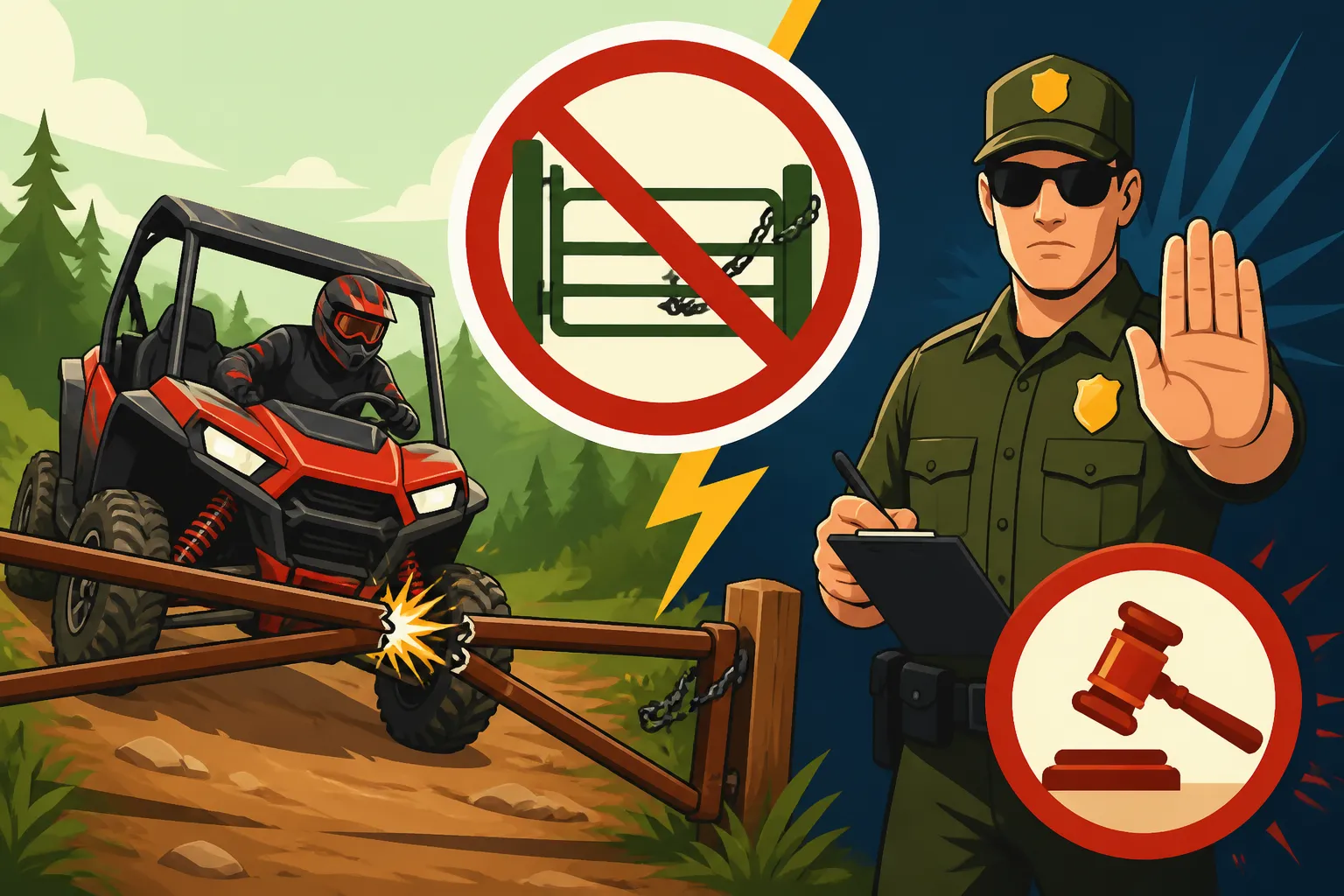
The West Virginia Legislature says a person who, without consent, pulls down, injures, or damages another person’s fence—or cuts, destroys, or damages that person’s bars or gates—while hunting, trapping, fishing, or trespassing is liable for damages and subject to misdemeanor penalties. In other words, the law described in the source covers both potential criminal penalties and responsibility for damage.
That rule is tied to the circumstances in the law: the person must act without consent, the property must belong to another, and the conduct must occur while hunting, trapping, fishing, or trespassing. Don’t assume every encounter with a gate automatically meets those conditions. But if you lack permission to be there, cutting or forcing a gate open can add a separate problem to the underlying access issue.
The West Virginia Division of Motor Vehicles says Chapter 17F of the West Virginia Code covers all-terrain vehicles, including acts operators are prohibited from doing and penalties for violations. Section 8 addresses criminal penalties related to ATVs. The facts available here do not specify a fine, jail term, or other sentence for cutting a gate, so it would be misleading to quote a set amount. The outcome can depend on the facts and the applicable law.
It also helps to distinguish between damaging a gate and merely encountering one. A closed gate does not, by itself, tell you who owns the land or whether you have permission to continue. It does tell you not to treat the gate as something you may open by force or remove. If the route is part of a permitted trail system, follow its markings and posted directions rather than assuming that a trail permit authorizes entry through every gate. For more on access limits, see Gates, Signs and Barriers on the Trails and What a Trail Permit Does Not Cover.
| Situation | What to do | Why it matters |
|---|---|---|
| A gate blocks a trail and there is no clear direction to proceed | Stop and check the route information or contact the trail operator | A permit does not necessarily authorize travel beyond a closure |
| A gate is marked closed or the route is posted as off-limits | Turn around and stay on an authorized route | Continuing may create a trespass issue |
| The gate appears damaged or is lying open | Do not assume the route is open; check current trail status | Damage or an open gate is not proof of permission |
| You have explicit permission from the property owner | Follow the permission’s terms and any applicable local rules | Permission may apply only to a particular area or use |
| You accidentally damage a gate | Stop, document what happened, and seek a responsible way to notify the owner or land manager | Prompt, factual communication can help address the property damage |
If you are unsure whether a route is authorized, the safer choice is to stop and verify before proceeding. Staying on Marked Trails in West Virginia explains why staying on the designated route matters.
A trail permit does not make a closed route open
Trail permits, road permissions, and landowner permission are different things. Having one does not automatically provide the others.
The West Virginia Division of Motor Vehicles says that riding a machine on any Hatfield-McCoy Trail System requires a Hatfield-McCoy Trails User Permit and a DOT- or SNELL-approved helmet. The agency also says that riding on Hatfield-McCoy approved roads, highways, or ATV-friendly towns requires a permit, helmet, and liability insurance. Those requirements do not say that a permit lets a rider cross a closed gate or enter land outside the authorized route.
A gate may mark a trail closure, a property boundary, a maintenance area, or another restriction. The reason may not be obvious from the rider’s side. Treat the gate and any signs as a reason to pause and confirm access, not as an invitation to find another way through. If you need to change your route, use a clearly authorized connection rather than cutting across land or around a barrier.
West Virginia law also allows county commissions and other local governments to create stricter ATV rules and additional restrictions, according to the West Virginia Division of Motor Vehicles. That means a route that seems usable under general state rules may still be subject to local limits. Check local directions and current trail information before riding, especially when the route runs near a town, road, or property boundary. See West Virginia Trespass Law for ATV Riders for more on access and trespass concerns.
For a trail system, a closure can also change after you have planned your ride. Before setting out, check the current status and route information rather than relying only on an old map, a prior trip, or what another rider says. Checking West Virginia Trail Status Before You Drive can help you plan around a closure, while Riding Off a Marked Trail covers the risks of leaving the designated route.
What to do when you reach a closed or damaged gate
The best response is usually straightforward: stop, do not damage or bypass the gate, and verify whether there is an authorized route forward.
-
Stop before reaching the barrier. Give yourself room to turn around safely. Avoid pushing into the gate with the ATV or UTV, trying to lift it, or moving nearby fencing.
-
Read the signs and identify the route. Look for closure notices, trail markers, property warnings, or directions to an alternate route. A missing sign does not, by itself, establish that you have permission to pass.
-
Check current trail information. If you are on a managed system, use its current status information or contact the relevant trail operator. If you cannot confirm access, turn back rather than guessing.
-
Do not cut a lock, chain, fence, or gate. A permit or a desire to reach a destination does not substitute for the owner’s consent. Cutting or damaging property can raise the legal issues described above.
-
Report a problem through an appropriate channel. If the barrier appears damaged, unsafe, or inconsistent with the route information, provide a factual description to the responsible trail operator or property manager if you can identify one. Avoid changing the scene or making claims about who caused the damage unless you know.
-
If you caused damage, stop and document the facts. Note what happened and when, take a clear photo if it is safe and appropriate, and make a reasonable effort to identify the owner or manager to notify. Do not leave the damage hidden or attempt a repair that could create another safety problem.
These steps are practical precautions, not a substitute for legal advice. If someone accuses you of damaging a gate or trespassing, stick to what you know, preserve relevant photos or messages, and consider getting advice from a qualified professional. Do not assume that a trail permit, a gate standing open, or another rider’s direction will settle the question.
How to avoid the problem before a ride
A little route planning can prevent a costly and stressful stop. Confirm where your ride is allowed, check for closures, and make sure everyone in the group understands that a trail route does not grant access to every connected road or piece of property.
For Hatfield-McCoy riding, the West Virginia Division of Motor Vehicles says a machine needs a Hatfield-McCoy Trails User Permit to be ridden on any Hatfield-McCoy Trail System. The agency also says riders on approved roads, highways, or ATV-friendly towns need a permit, helmet, and liability insurance. Keep those requirements in view, but check route-specific restrictions separately.
If you are riding outside a managed trail system, confirm who controls the land and whether you have permission to enter. The West Virginia Legislature’s gate-damage rule specifically concerns conduct without consent in the circumstances it describes, including trespassing. When permission is unclear, do not treat the absence of a locked gate or a warning sign as permission.
Local restrictions matter, too. According to the West Virginia Division of Motor Vehicles, county commissions and other local governments may adopt stricter ATV rules and additional restrictions. A route can therefore be affected by local rules even when it appears to connect to a trail or road.
Finally, avoid planning a ride around the assumption that every visible connector is usable. Keep a map or route information available, check for changes before leaving, and agree on a turnaround plan with your group. If a gate blocks the way, the sensible choice is to verify access or turn back—not to cut it open.
Disclaimer
This article is for general informational purposes only and does not constitute professional advice. Laws, prices and regulations vary by location and change over time. Consult a qualified professional for guidance on your specific situation.