What to Carry on a Remote West Virginia Ride
A remote ride in West Virginia can turn from a scenic run into a long wait when a tire goes flat, a storm rolls into a hollow, or your phone loses service. The right gear helps you handle small problems, stay oriented, and call for help when possible. This guide explains what to carry, how to pack it, and how to prepare for changing trail conditions.
Plan for the route before you pack
Check the trail, weather, and access details
A day ride near Gilbert, Logan, or Matewan may include steep grades, muddy sections, rock, and stretches where cell service is unreliable. Conditions can change quickly: a route that felt manageable on a dry morning may become slick after rain, and a creek crossing can be very different after a storm. Check the trail system’s posted status and conditions before leaving, and look for closures or restrictions that affect your planned route.
For Hatfield-McCoy riding, review the current trail map and the system information for the area you plan to visit. A map is more useful when you know how it marks intersections, trail difficulty, and closed routes. If you are riding a different public or private area, confirm its access rules separately; a map does not grant permission to use a road, trail, or parcel. For a closer look at navigation basics, see [West Virginia Trail Maps and Signage] and [West Virginia Trail Conditions After Rain].
Build your route around the least experienced person in the group, not the rider who wants to cover the most miles. Choose a reasonable turnaround point and leave room for stops, mechanical trouble, and slower progress on technical sections. If someone at home knows your route and expected return time, tell them what to do if you do not check in. That simple plan can matter when your group is beyond reliable phone coverage.
Prepare for navigation without cell service
Do not make a phone’s data connection your only navigation plan. Download the map and any route information you will need before heading out, and confirm that the files remain accessible when the phone is in airplane mode or otherwise offline. Apps such as onX Offroad can help riders review routes and save map information for offline use. Learn the app’s controls at home, while you have a good connection and time to troubleshoot—not at a confusing junction.
Carry a paper map as a backup, ideally protected from rain and mud. A paper copy is useful if a phone battery dies, a screen cracks, or the device becomes difficult to operate with gloves on. Mark your planned route and a few obvious landmarks before departure, then keep the map somewhere you can reach without unloading the machine. The practical advantage of having both digital and paper navigation is that each can cover for the other. See [Downloading Hatfield-McCoy Trail Maps] and [Carrying a Paper Trail Map in West Virginia] for more map-planning considerations.
If your group uses onX Offroad, make sure everyone knows which map or route is the shared reference. One rider should not be following a saved route while another assumes the group is taking a different branch. Agree on a simple rule: stop at confusing intersections and regroup before continuing. That avoids a common remote-ride headache—discovering that the group has split up because everyone thought someone else was leading.
Pack for common breakdowns and injuries
Carry a machine-specific repair kit
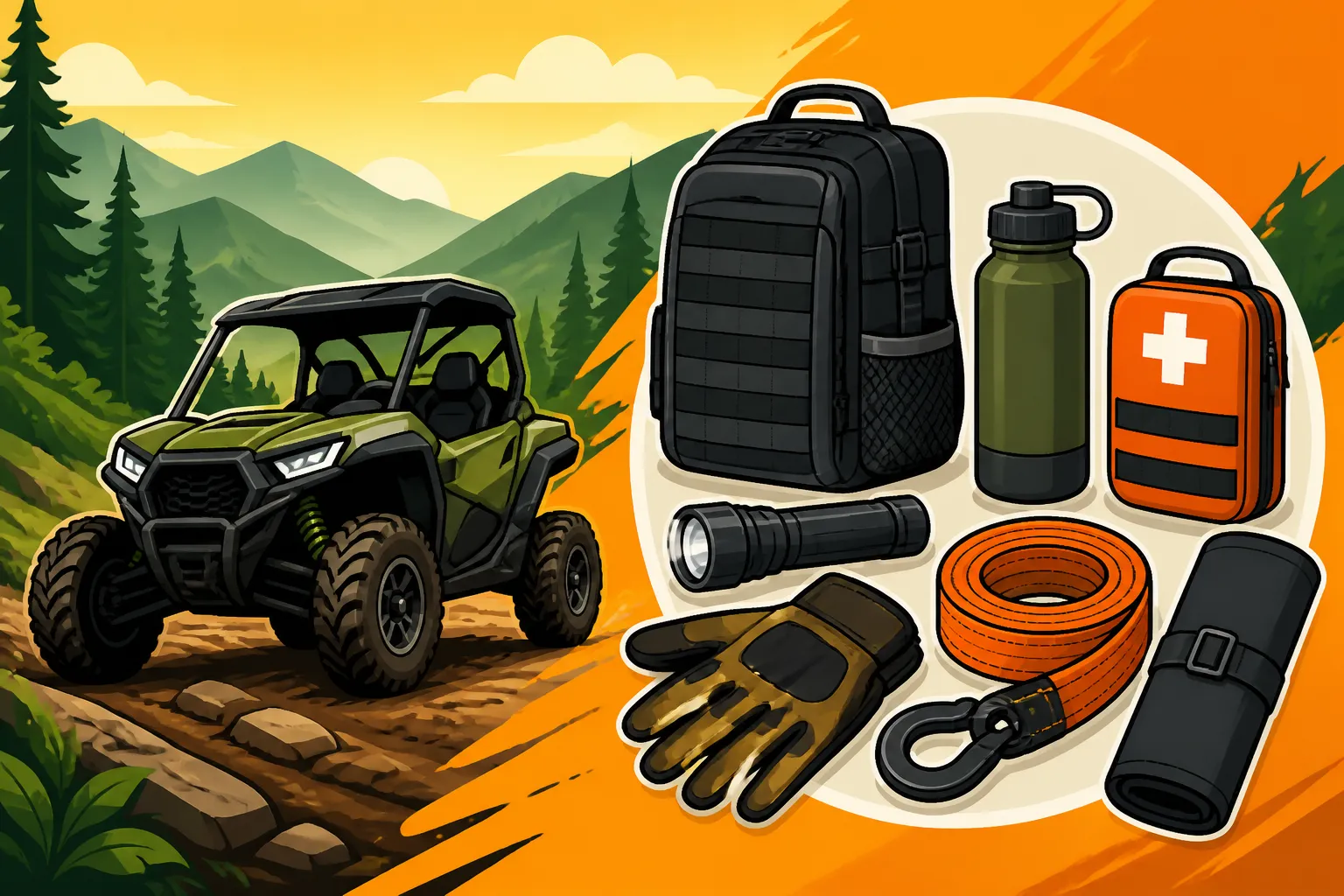
A good repair kit is not a random collection of tools. It should match your ATV or UTV, the terrain, and the kinds of problems you can reasonably fix on the trail. Start with the machine’s tool kit, then add tools that fit its fasteners and components. A multi-tool, adjustable wrench, pliers, screwdrivers, tire pressure gauge, and a compact flashlight are useful starting points, but check your owner’s manual and learn how to use each item before your trip.
For tire trouble, consider carrying a tire plug kit and a compact inflator or a suitable way to add air. Practice using the kit at home, and confirm that the repair supplies fit your tire type. A spare belt may be useful for some side-by-sides, but only if you know how to replace it and can carry the correct one safely. A small assortment of fuses, zip ties, electrical tape, and durable tape can help with minor issues, but these are not substitutes for proper repairs.
Pack the essentials where they are protected from dirt and water, and secure them so they cannot bounce around or interfere with the controls. Before heading out, check tire condition, fluid levels, brakes, lights, and the condition of any recovery points. It is far easier to discover a loose connection in your driveway than halfway through a ride. If your group is new to remote routes, start with a shorter outing and learn what your machine and kit can handle before committing to a full day.
Bring first aid, water, and weather protection
Carry a first-aid kit that is appropriate for your group and know where it is stored. Include basic wound-care supplies, gloves, and any personal medication a rider may need. Bring a way to clean and cover minor cuts, but do not treat a compact kit as a replacement for professional medical care. If someone has a serious injury, prioritize getting help and avoid moving them unnecessarily unless staying put presents an immediate danger.
Water should be planned for the whole ride, not just the first few hours. Pack more than a single bottle per person and keep it where riders can reach it without unpacking the machine. Add food that can withstand heat, cold, and movement, such as packaged snacks that do not need preparation. If a ride runs long or a machine becomes disabled, extra water and food can make the wait safer and less stressful.
West Virginia weather can shift between exposed ridgelines, shaded woods, and low-lying hollows. Pack a rain layer, an insulating layer, and dry socks or another dry base layer in a waterproof bag. A small emergency blanket can add warmth if someone is stuck or injured. Do not assume that a warm parking area means the same conditions will hold throughout the route; wind, rain, and reduced movement can make riders cold quickly.
| Situation | Useful items to carry | Why they help |
|---|---|---|
| Navigation problem | Offline map, paper map, compass | Gives you alternatives if a phone or signal fails |
| Flat tire | Tire plug kit, inflator, pressure gauge | May help with a repair that is suitable for the tire |
| Minor injury | First-aid kit, gloves, personal medication | Supports basic care while you decide what help is needed |
| Sudden rain or cold | Waterproof layer, dry clothing, emergency blanket | Helps protect riders from exposure |
| Long delay | Extra water, food, headlamp | Makes an unexpected stop more manageable |
| Weak or absent service | Charged phone, power bank, emergency communication device | Offers more options for contacting help |
Prepare for communication and emergencies
Do not assume a phone will work everywhere
A charged phone is still worth carrying for maps, photos, and emergency calls, but reception can be inconsistent in remote areas. Save important information before you leave: the trail system or land manager’s contact details, your lodging address, and the route or trailhead where you began. If you are riding with others, exchange phone numbers and agree on a meeting point if the group gets separated.
A power bank and charging cable can help keep a phone usable through a long day. Store both where they will stay dry, and do not wait until the battery is nearly empty to connect the power bank. If you use onX Offroad for offline navigation, charge the phone before departure and test the saved map before you lose service. Consider bringing a second navigation device only if you know how to use it; extra electronics are not very helpful if they are unfamiliar or uncharged.
For rides where being out of contact would create a serious concern, consider an emergency communication device designed for areas without dependable cell coverage. Learn its operation and subscription requirements before relying on it, and make sure someone in your group knows how to use it. A device is only useful if it is charged, accessible, and understood. Keep it on your person or in a place that remains with you if you need to leave the machine.
Make a simple group emergency plan
Before riding, make sure everyone knows who is leading, who is bringing the repair kit, and what to do if the group becomes separated. Agree on a meeting point at trail junctions and decide how long to wait before taking the next step. In a larger group, do not let the last rider disappear out of sight without a plan for check-ins. A brief conversation in the parking area can prevent confusion later.
Tell someone who is not riding where you expect to go and when you expect to return. Include the trail system, trailhead, vehicle description, and a contact number for the group. If your plans change, update that person when you can. If you are riding alone, be especially deliberate about this step, and think carefully about whether the route and your experience level justify going solo. [Riding Alone on a Hatfield-McCoy Trail] and [Cell Service on the Hatfield-McCoy Trails] cover related planning concerns.
If there is an injury or breakdown, pause before everyone scatters to solve the problem. Check for immediate hazards, assess whether anyone needs medical attention, and keep the group together where practical. Use your communication options, share your location as clearly as possible, and follow instructions from emergency responders or trail staff. Knowing [Trail Rescue in West Virginia and Who Responds] can help you understand why a clear location and calm communication are so important.
Pack and ride with the group in mind
Organize gear so you can find it quickly
Separate equipment by purpose: navigation and communication, first aid, repairs, and food and clothing. Use waterproof bags or cases for items that must stay dry, and label bags if several riders are sharing the load. Keep frequently needed items—such as a map, water, basic first aid, and a flashlight—easy to reach. A kit buried under luggage is technically packed, but not very useful when you need it quickly.
Avoid carrying so much that gear shifts, blocks visibility, or affects how the machine handles. Secure bags according to the machine manufacturer’s guidance, keep weight balanced, and make sure nothing can contact hot or moving parts. In a UTV, keep the cabin floor and passenger space clear enough for riders to sit securely and exit if needed. In an ATV, be particularly careful not to interfere with steering, braking, or your ability to shift your body.
Do a quick check before leaving the trailhead: water, map, first aid, repair kit, charged phone, weather layers, and any communication device. Ask each rider to confirm their own personal essentials rather than assuming one person has everything. Shared tools are fine, but every rider should have access to water and appropriate clothing. For a family outing, review [Riding West Virginia Trails With Kids] and make sure children’s gear fits properly and can be reached by an adult.
Match your kit to the ride instead of packing blindly
A short, familiar loop close to a trailhead does not require the same load as a long ride through unfamiliar terrain. Scale your preparation to distance, remoteness, weather, group size, and rider experience. A group heading out after heavy rain should be ready for slower travel and changing trail conditions. A ride with children or first-time riders needs more frequent breaks, extra water, and a more conservative turnaround plan.
Before each trip, check the machine and repack consumables that were used last time. Replace a spent tire plug, restock first-aid items, recharge batteries, and remove anything that has become damaged or expired. Keep a simple checklist with your riding gear so you do not have to remember everything while loading in a hurry. If the ride is part of a weekend stay near the trails, separate your trail kit from camping or cabin supplies; that makes it less likely you will leave a critical item in a vehicle or lodging room.
Finally, let the conditions guide your decisions once you are out there. Turn around if weather, fatigue, a mechanical problem, or a trail closure makes continuing a poor choice. Carrying more gear can improve your options, but it cannot make every route safe in every condition. Good preparation is not about proving you can push through; it is about having a plan, recognizing when the plan needs to change, and getting everyone back safely.
Disclaimer
This article is for general informational purposes only and does not constitute professional advice. Laws, prices and regulations vary by location and change over time. Consult a qualified professional for guidance on your specific situation.