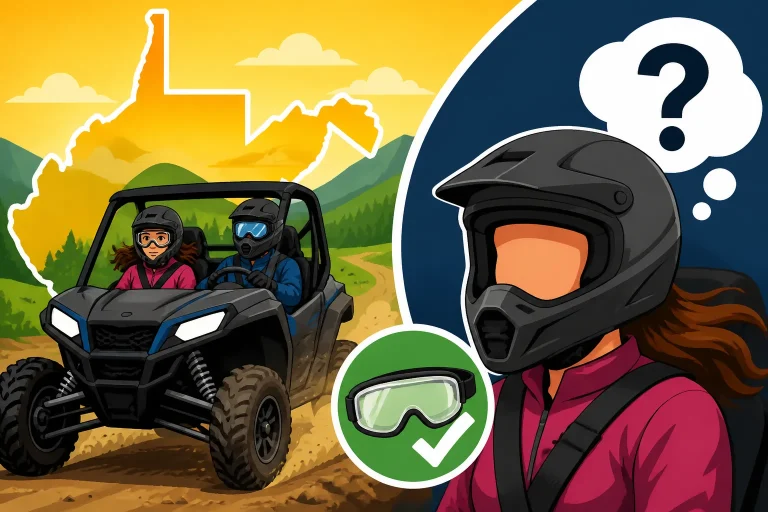
DOT Versus Snell Helmet Approval
A helmet label can be confusing when you are getting an ATV or UTV ready for a West Virginia ride. DOT and Snell are different kinds of approval, and neither label replaces a good fit or the rules for your route. Here’s how to read the markings, choose a helmet for trail or road use, and avoid relying on a seller’s claim alone.
What DOT and Snell approval mean
DOT refers to the U.S. Department of Transportation’s Federal Motor Vehicle Safety Standard for motorcycle helmets, commonly called FMVSS 218. A helmet that meets the standard is certified by its manufacturer. The DOT marking on the back is the manufacturer’s statement that the helmet complies; it is not a government seal showing that officials individually tested and approved that helmet before it went on sale.
Snell is a voluntary helmet-testing program run by the Snell Memorial Foundation. A manufacturer can submit helmet models for testing against a Snell standard. When a model qualifies, it can carry the applicable Snell certification label, commonly found inside the helmet. The exact standard and model matter: a brand’s general claim that it makes “Snell helmets” does not establish that every helmet it sells has been certified.
The two labels therefore indicate different routes to helmet safety information:
| Marking | What it indicates | What to check |
|---|---|---|
| DOT | The manufacturer certifies the helmet meets the applicable U.S. federal helmet standard | Look for the DOT marking on the helmet and check the label and product details |
| Snell | A specific helmet model has passed the foundation’s voluntary testing program | Look for the actual Snell label inside the helmet and confirm the model |
| Both | The manufacturer claims DOT compliance and the model also has Snell certification | Verify both markings; one does not automatically prove the other |
A DOT mark and a Snell label are not interchangeable. A helmet may carry both, but a Snell label does not itself show DOT compliance, and the DOT mark does not establish that a helmet passed Snell testing. If your ride requires a particular standard, make sure the helmet bears the marking that the relevant rule calls for.
It is also worth separating certification from fit and condition. A helmet with the right label can still be a poor choice if it is the wrong size, damaged, or unsuitable for the way you ride. Certification gives you one useful piece of information; it does not guarantee that a helmet fits your head or will remain protective after a serious impact.
For a broader look at local helmet terminology and requirements, see West Virginia Helmet Standards: DOT, Snell and ANSI. The central point is simple: identify what the marking means, then check whether it matches the rule for your particular ride.
Which helmet approval matters in West Virginia
West Virginia helmet rules can depend on where you ride, what kind of machine you operate, and the rider’s age. A route on a public road is not necessarily governed the same way as a managed off-road trail or private property. Trail operators may also set conditions of access that are stricter than the minimum rule that applies elsewhere.
Before choosing a helmet, identify the setting:
- Public-road riding: Check the current state requirements for your vehicle and the rider’s age. Do not assume that rules for motorcycles or street-legal machines automatically apply to every ATV or UTV.
- Managed off-road trails: Check the trail system’s current rider rules. A requirement may apply to everyone in a group, even when some riders might not be subject to the same age-based rule on another route.
- Private land: The legal requirements can differ from public-road or managed-trail rules, but protective gear remains important. Landowner instructions may also apply.
- A ride crossing different settings: Follow the requirements for each part of the route, and use the more protective gear standard if the trip’s rules are not clear.
The Helmet and Eye Protection Rules in West Virginia and Helmet Requirements on West Virginia Trails are useful starting points for distinguishing statewide rules from trail-specific requirements. Confirm current details with the relevant state or trail authority before riding, especially if you are bringing visitors or taking a child.
Permits and helmet rules are separate issues. Having a permit, an out-of-state registration, or permission to use a trail does not necessarily mean your helmet meets that route’s equipment requirements. Riders coming from another state should check the West Virginia rules rather than assuming that a helmet accepted at home will automatically satisfy every local requirement. Out-of-State Riders on West Virginia Trails explains the separate question of riding access and permits.
If the rule says a helmet must meet a stated standard, read the requirement closely. “DOT-approved” is common shorthand, but the relevant marking is the manufacturer’s DOT compliance marking. If a trail operator names a standard or lists an equipment rule, follow that wording and ask the operator if it is unclear.
How to choose and check a helmet
Start with the ride, not the label
Pick a helmet designed for the type of machine and riding you plan to do. ATV and UTV riding can involve branches, dust, loose rock, mud, and impacts that differ from ordinary road travel. A full-face helmet offers more coverage than an open-face design, but coverage, ventilation, visibility, comfort, and compatibility with goggles all matter. Choose a helmet that suits the route and the operator’s rules rather than buying based on a label alone.
For off-road riding, consider how the helmet works with eye protection. A visor may help block sun and debris, while goggles can provide a close seal against dust. The combination should fit without gaps that expose your eyes or interfere with your view. A helmet that fogs badly or shifts when you move your head may be unsafe in practice, even if its markings are correct.
Verify the markings and model
Before buying, look for the DOT marking on the helmet itself and check the manufacturer’s label and product information. For Snell, look for the certification label inside the helmet and confirm that the exact model is covered. If a retailer’s listing says “DOT” or “Snell” but the product details do not identify the model or show the required marking, ask the seller or manufacturer before relying on the claim.
Be cautious with unusually vague listings, especially when product photos do not clearly show labels. A marketplace listing on Amazon, for example, is not itself proof that a helmet meets either standard. Check the actual helmet and its manufacturer information, and review the seller and return policy before ordering. Do not treat a description, decorative sticker, or brand-level claim as a substitute for verifying the specific helmet.
Check fit and condition
A properly fitting helmet should feel snug and even around the head, without painful pressure points. It should not rock freely when you move your head, and the retention strap should fasten securely. Use the manufacturer’s sizing instructions; head shape varies, so a size that works for one person may not fit another.
Inspect a helmet before each ride. Look for cracks, crushed areas, loose or damaged straps, worn padding, and missing or altered labels. A helmet that has taken a significant impact may need replacing even if damage is not obvious. Follow the manufacturer’s guidance on impact damage, care, and replacement.
Used helmets require extra caution. You may not know whether they have been dropped, struck, stored improperly, or involved in a crash. A clean exterior does not show whether the protective liner has been compromised. When the helmet’s history is uncertain, buying a new one is the safer choice.
For a shopping checklist and more on reading labels, see Buying a Helmet That Meets DOT or Snell. If the rider is an adult, do not assume age alone tells you whether a helmet is optional on a particular route; check Helmet Rules for Riders Over 18 alongside the rules for that location.
Common mistakes to avoid
Treating DOT as a government pre-approval sticker. The DOT marking represents the manufacturer’s certification. It is not the same as an individual government approval of each helmet. Check the helmet’s labeling and manufacturer information, not just a retailer’s shorthand.
Assuming Snell is always required or always “better.” Snell is a voluntary testing program, not a universal requirement for every West Virginia ride. A helmet carrying both markings may offer additional assurance to some buyers, but the correct choice still depends on the rule, fit, condition, and intended use.
Assuming every helmet from a certified brand qualifies. Certification applies to the particular helmet model, not automatically to every product made by that company. Verify the model number and label.
Confusing an ATV helmet rule with a motorcycle helmet rule. Similar equipment may be used, but legal requirements can depend on the vehicle and setting. Verify the specific ATV or UTV rule instead of borrowing assumptions from motorcycle regulations.
Ignoring eye protection or the rest of the equipment. A helmet does not protect eyes from dust and debris. Check the applicable eye-protection rules and use gear that works with the helmet. Eye Protection Requirements on West Virginia Trails covers that separate requirement.
Relying on a permit as proof of compliance. A trail permit addresses access; it is not a substitute for checking safety gear. Before leaving, confirm the trail’s current rules, make sure each rider has a helmet that fits, and check that the required markings are present and readable.
When the rules are unclear, ask the trail operator or the appropriate state authority before the trip. That is easier than discovering at the trailhead that a helmet lacks the required marking or that a rider has misunderstood which rules apply.
Disclaimer
This article is for general informational purposes only and does not constitute professional advice. Laws, prices and regulations vary by location and change over time. Consult a qualified professional for guidance on your specific situation.