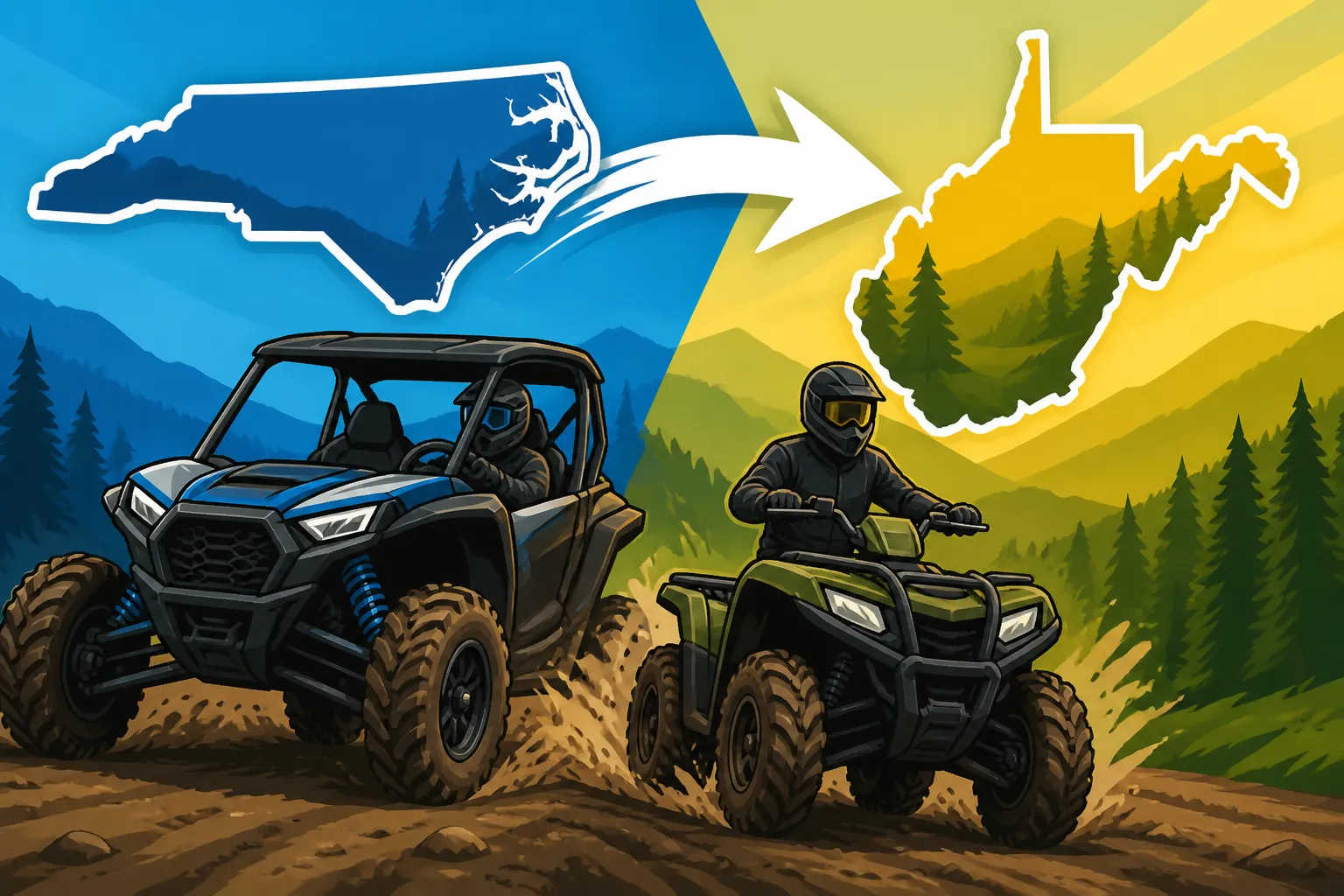
North Carolina Riders Heading to West Virginia
Bringing an ATV or UTV from North Carolina to West Virginia can involve more than hauling it to the trailhead. You need to know when West Virginia requires temporary registration, whether your ride includes Hatfield-McCoy Trails, and what rules apply to road sections. Here’s how to sort out the paperwork and safety requirements before you travel.
Sort Out Registration and Trail Permits Before You Ride
A North Carolina title or registration should not be assumed to cover road riding in West Virginia. For nonresidents, the West Virginia Division of Motor Vehicles offers an Out of State Special Purpose Vehicle Temporary Registration online for a 14-day period. West Virginia law also allows ATVs on roadways when the operator has completed the Special Purpose Vehicle registration process, according to the West Virginia Division of Motor Vehicles.
This temporary registration is relevant when your riding plan includes roads where the West Virginia SPV process applies. A trail ride that stays off public roads is a different situation, but you may still need a separate trail permit. The out-of-state temporary registration is not a Hatfield-McCoy Trails permit.
| Riding plan | What to check before leaving North Carolina |
|---|---|
| Riding a West Virginia public road or designated road | Check whether the machine and route require the temporary SPV registration. The West Virginia Division of Motor Vehicles says nonresidents can obtain it online for a 14-day period. |
| Riding the Hatfield-McCoy Trail System | Obtain a Hatfield-McCoy Trails User Permit for each machine being used on the system, and check the trail rules and safety requirements. |
| Using Hatfield-McCoy approved roads, highways, or ATV-friendly towns | Confirm that you have the required permit, helmet, liability insurance, and any applicable SPV registration. |
| Riding elsewhere in West Virginia | Check rules for the specific trail, land unit, road, and local area; requirements can differ by location. |
For Hatfield-McCoy, the West Virginia Division of Motor Vehicles says riding a machine on any part of the system requires a Hatfield-McCoy Trails User Permit and a DOT- or SNELL-approved helmet. That trail permit is separate from the temporary SPV registration. If your trip includes approved roads, highways, or ATV-friendly towns connected with the system, the West Virginia Division of Motor Vehicles also requires a permit, helmet, and liability insurance for those rides.
Read West Virginia’s Hatfield-McCoy Trail Permit Explained before planning a trip around the trail system. It helps clarify what the permit covers and why you should not treat it as a substitute for road-use registration. If your route may use public streets, Do Out-of-State Riders Need a West Virginia Title? can help you separate title questions from the temporary road-use process.
The practical takeaway: map out your ride before you decide which paperwork applies. A route that stays on trails may have different requirements from one that uses an approved road or passes through an ATV-friendly town. Ask the relevant trail operator or local authority about the exact route, and verify current DMV instructions before traveling.
Know Which Rules Apply to Safety and Helmets
Safety-course rules depend on the rider and where the machine is being used. According to the West Virginia Division of Motor Vehicles, no person under the age of 18 may operate an ATV without a certificate of completion from a vehicle rider safety awareness course. The agency also says ATV operators aged 18 and under must obtain safety instruction to receive an ATV safety card and helmet sticker.
There is an important exception for Hatfield-McCoy: according to the West Virginia Division of Motor Vehicles, riding on its trails does not require the safety course when the area is operated by an entity with its own safety program. That exception is specifically tied to the managed area’s safety program. Don’t assume it applies to every West Virginia trail, public road, or other riding location. Check the rules for the place where you plan to ride, especially when a trip includes more than one riding area.
The West Virginia Division of Motor Vehicles offers a free ATV rider safety awareness course. ATV safety instructions can also be obtained through WVU Extension Offices, according to the agency. The course and instruction information is useful for families preparing young riders, and for anyone who wants to confirm what completion documentation is needed. For details on the course, see West Virginia DMV ATV Safety Awareness Course.
Helmet requirements also vary by context. The West Virginia Division of Motor Vehicles requires a DOT-approved helmet for people under the age of 18 riding an ATV. On Hatfield-McCoy Trails, riders must wear a DOT- or SNELL-approved helmet. If the group includes riders of different ages, check that each helmet meets the rule for the rider and the place they’ll be riding; a helmet that satisfies one requirement may not satisfy another.
For gear shopping, the useful step is to confirm the helmet’s approval marking and suitability before buying, whether you shop locally or through a marketplace such as Amazon. Don’t rely only on a product title or a seller’s description. If the approval status is unclear, choose another option or verify the marking with the manufacturer.
The West Virginia Division of Motor Vehicles publishes ATV rules under Chapter 17F, including safety-course provisions, rules of operation, and penalties. That’s a reason to treat course and helmet checks as part of trip planning, not as details to figure out at the trailhead. If a young rider is joining, confirm the required safety instruction and helmet before travel, then ask the specific trail operator whether its program changes the course requirement for that location.
Understand What Changes When Your Ride Uses Roads
West Virginia’s public-road rules are not the same as trail rules. According to the West Virginia Division of Motor Vehicles, ATVs may be ridden on roadways when the operator has completed the Special Purpose Vehicle registration process. For nonresidents, the DMV provides an online temporary SPV registration for a 14-day period. If your plan involves road riding, arrange the applicable registration before relying on a road connector or town route.
Registration alone does not make every road available. The West Virginia Division of Motor Vehicles says ATVs may not be operated on a road or highway with a center line or more than two lanes except to cross it. A crossing must be made at a 90-degree angle, where no obstruction prevents a quick and safe crossing. That means you should not assume a road is usable simply because it appears to connect two trails on a map.
West Virginia has a street-legal SPV category that includes ATVs, UTVs, minitrucks, pneumatic-tired military vehicles, and full-size special purpose-built vehicles, according to the West Virginia Division of Motor Vehicles. The relevant registration and road rules depend on the machine and its use. If you intend to use roads rather than only off-road trails, review West Virginia’s Street-Legal Special Purpose Vehicle Plate and West Virginia SPV Plate Requirements List before setting off.
Equipment matters too. According to the West Virginia Division of Motor Vehicles, an SPV must have a windshield unless the operator wears compliant eye protection, and its tires must have at least 2/32 inches of tread depth. These requirements are part of road-use preparation, not a replacement for checking whether your machine is allowed on the specific road.
There are also road restrictions beyond the general crossing rule. The West Virginia Division of Motor Vehicles says street-legal SPVs are prohibited from controlled-access highways, including interstate systems. They cannot be driven on roads where prohibited by a county, municipality, or the Division of Natural Resources. Minitrucks registered as street-legal SPVs also cannot be driven on roads constructed under a federal highways program.
Local restrictions deserve particular attention. County commissions and other local governments may create stricter ATV rules and additional restrictions under West Virginia law, according to the West Virginia Division of Motor Vehicles. A route that is allowed in one area may not be allowed in another. Before riding through a town or using a road connector, check local rules rather than relying on a statewide summary alone.
For more detail on choosing a road route, see Which West Virginia Roads Allow ATVs. The key is to treat the state’s general rules as a starting point, then confirm whether the specific road is open to your machine and whether local restrictions apply.
Make a Route Plan That Matches the Paperwork
A little route research can prevent a mismatch between your registration, permit, and intended ride. Start by identifying where you will unload, which trail system or riding area you plan to use, and whether any part of the route depends on public roads, approved highways, or an ATV-friendly town. Then verify the rules for each part of the trip.
The West Virginia Division of Highways says the WV GIS Technical Center at West Virginia University was funded to inventory recreational trails. Its map application allows users to zoom to a land unit by selecting categories such as National Lands, State Lands, Wildlife Management Areas, Local Lands/Parks, and Motorized Trail Systems, according to the WV GIS Technical Center. A map can help you identify the area you are looking at, but it should not be treated as proof that a road or trail is open to ATVs. Check posted restrictions and current information from the land manager or trail operator. West Virginia Trail Maps and Signage is a useful next step for preparing to navigate.
Before departure, use this checklist:
- Define the ride area. Decide whether you will ride Hatfield-McCoy, another managed trail, designated roads, or a combination.
- Check registration needs. If your plan includes West Virginia road riding, verify the temporary SPV registration process for nonresidents with the West Virginia Division of Motor Vehicles.
- Get the trail permit if needed. If riding the Hatfield-McCoy Trail System, obtain its separate User Permit and check where and how it must be displayed.
- Review insurance requirements. For Hatfield-McCoy approved roads, highways, and ATV-friendly towns, the West Virginia Division of Motor Vehicles requires liability insurance as well as a permit and helmet.
- Confirm rider safety requirements. Check course, certificate, and helmet rules for each rider and location, including the managed-trail exception where it applies.
- Verify local road access. Ask about restrictions imposed by the county, municipality, or land manager, and do not assume an ATV-friendly route is open to every machine.
- Inspect road-use equipment. If your machine will be used as an SPV, check the applicable equipment rules, including windshield or eye protection and tire tread.
Keep your paperwork and key information accessible, but don’t carry the assumption that one document covers every activity. A West Virginia temporary SPV registration, a Hatfield-McCoy User Permit, an insurance policy, and a safety certificate address different requirements. If you’re renting rather than bringing your own machine, ask the rental provider what is included and what you still need to arrange; the answer may differ from a trip with your own ATV or UTV.
The safest planning approach for North Carolina riders is to verify the requirements against the actual route and machine. Get the SPV temporary registration if your road use calls for it, buy the separate Hatfield-McCoy permit if you’re riding that system, and check local rules before using connectors or town streets. That keeps paperwork aligned with the ride instead of relying on assumptions about reciprocity.
Sources
- WV Division of Motor Vehicles — ATV | WV Division of Motor Vehicles (checked November 3, 2026)
- West Virginia Division of Motor Vehicles — Special Purpose Vehicles | WV Division of Motor Vehicles (checked November 3, 2026)
Disclaimer
This article is for general informational purposes only and does not constitute professional advice. Laws, prices and regulations vary by location and change over time. Consult a qualified professional for guidance on your specific situation.