Bonded Title for an ATV in West Virginia
It's incredibly frustrating when you've got an ATV or UTV that you love, perhaps even ride regularly, but you can't seem to get a clear title for it. Maybe you bought it from a friend years ago with just a handshake and a bill of sale, or the previous owner lost the original title and then vanished. Without a proper title, you can run into all sorts of legal hurdles, from selling the machine to even just proving you own it. This guide is here to demystify the process of obtaining a bonded title for your ATV or UTV in West Virginia, offering a legitimate path to securing legal ownership when the standard route just isn't an option.
What Exactly is a Bonded Title and Why Would You Need One?
Imagine buying a fantastic side-by-side that seems perfect, only to realize later that the original title is missing, or perhaps the seller gave you a title that wasn't properly signed. You’re left in a bind, holding a machine that feels like yours, but without the crucial piece of paper to prove it. This is a common scenario in West Virginia, and it's exactly where the concept of a bonded title steps in.
The Core Problem: Missing or Defective Proof of Ownership
You know the feeling: you’ve invested your hard-earned money in an ATV, maybe a trusty Polaris Ranger or a fun-to-ride Can-Am Outlander, but when you go to the DMV to get it titled in your name, you hit a brick wall. The most common reason folks look into a bonded title is because they simply don't have a valid, clear title in hand. This could be due to a lost or stolen original title that the previous owner never replaced, or perhaps you bought the machine with just a basic bill of sale, and the original owner is now nowhere to be found. It can also happen with inherited machines where the deceased owner's paperwork is incomplete, or even with abandoned vehicles that you've legally acquired through a local process.
It's a huge headache, right? You've got this awesome machine sitting in your garage, ready for the trails around Logan or down at the Hatfield-McCoy system, but it feels like it's not truly yours in the eyes of the law. Without a clear West Virginia title, you're severely limited. You can't legally sell it to someone else without passing on the same problem, which significantly reduces its value. Insuring it can become a nightmare, as many insurance companies require proof of ownership, and even if they do insure it, any claims could be complicated without a clear title. Plus, if you ever face a question of ownership, perhaps after a theft or an accident, your lack of a title leaves you vulnerable. That's why resolving this paperwork puzzle is so critical.
How a Surety Bond Steps In to Protect Everyone
So, if you don't have a clear title, how does West Virginia help you establish ownership? This is where a surety bond comes into play. A bonded title is essentially a title issued by the West Virginia Division of Motor Vehicles (DMV) when the original title is missing, has never been issued (in very rare cases for older machines), or has a defect that prevents a standard transfer. What makes it "bonded" is that it's backed by a surety bond. Think of the surety bond as an insurance policy, but not for your ATV's physical damage. Instead, it's a financial guarantee.
This bond acts as a safeguard. It assures the DMV, and anyone else who might have a legitimate claim to the ATV, that if a rightful owner comes forward within a specific timeframe (usually three years in West Virginia) and proves they own the machine, they can be compensated financially. The bond protects the state from potential liability for issuing a title to the wrong person, and it protects any previous, rightful owners who might surface with their own valid claims. It's important to understand that while it allows you to get a title, the bond itself isn't protecting you from someone else's claim; it protects the potential claimant and the state. You, as the applicant, are ultimately responsible if a valid claim arises. The bond amount is typically determined by the DMV and is often 1.5 or 2 times the fair market value of your ATV or UTV, reflecting the potential liability.
The Step-by-Step Journey to Getting Your Bonded Title
Getting a bonded title for your ATV or UTV in West Virginia isn't like picking up a gallon of milk; it requires persistence and attention to detail. It's a multi-step process that involves thorough documentation, direct interaction with the DMV, and working with a surety company. But don't worry, we'll walk you through it.
Step 1: Gathering Your Existing Paperwork and Proof
Before you even think about applying for a bonded title, your first mission is to gather every single piece of documentation you have related to your ATV or UTV. This includes any bill of sale you might possess, no matter how informal it seems. Did you write it on a napkin? Still bring it. Did you get an old registration card from a previous owner, even if it's expired? Bring that too. Any insurance documents, repair receipts, or even maintenance logs that list the Vehicle Identification Number (VIN) are incredibly helpful. Photos of the machine, especially close-ups of the VIN plate, can also support your claim. The more evidence you have that you've been in possession of and caring for the machine, the stronger your case.
The VIN is absolutely crucial here. It's your ATV's unique fingerprint, and it's how the DMV will track its history and ensure it's not a stolen vehicle. You'll need to know [Finding the VIN Stamp on an ATV Frame] on your specific machine. Sometimes it's on the frame near the steering head, or on a cross-member. If you can't find it, a local dealership or an experienced mechanic can usually help. Additionally, make a sincere effort to contact the previous owner, if possible. Document every attempt you make, whether it's phone calls, emails, or certified letters. Even if you don't succeed, showing the DMV you tried demonstrates due diligence. This is also the stage where you should seriously consider running a VIN check to see if the ATV is reported stolen or has any outstanding liens. Knowing [Checking a Used Quad Against Stolen Records] upfront can save you a lot of grief and expense.
Step 2: Applying to the West Virginia DMV for a Title Determination
This step is a bit different from simply walking into the DMV with a completed application form. You're not just applying for a title; you're applying for a title under unusual circumstances. Your first visit to a [West Virginia DMV Offices That Handle ATV Titles] should be to explain your situation. Don't expect to walk out with a title that day. You'll need to clearly articulate why you don't have a traditional title and present all the proof you gathered in Step 1. The DMV representative will evaluate your specific circumstances and guide you on whether a bonded title is indeed the appropriate route for your situation.
The DMV will thoroughly check their records to confirm that there's no existing clear title in someone else's name, and more importantly, no active liens on the ATV. If there's a lien, that usually needs to be satisfied before any new title can be issued, bonded or otherwise. If the DMV agrees that a bonded title is the correct path, they will likely provide you with specific instructions and possibly a form or a letter outlining their requirements for the surety bond itself. They will also determine the value of your ATV, which dictates the required bond amount. This valuation might be based on a NADA guide, or they might ask for an independent appraisal, especially for older or heavily modified machines. It’s essential to follow their specific directives precisely to avoid delays.
Step 3: Securing Your Surety Bond
Once the West Virginia DMV has given you the green light and specified the required bond amount, your next task is to secure that surety bond. You can't get this bond directly from the DMV. Instead, you'll need to approach a licensed insurance agency or a dedicated surety bond company. Many of the larger insurance providers that offer auto or home insurance also deal in surety bonds, or they can direct you to a reputable broker.
When you contact a surety company, they will ask for details about your ATV, its value, and the DMV's requirements. You will pay a premium for the bond, which is typically a small percentage of the total bond amount (e.g., 1-5%). This premium is a non-refundable fee for the surety company's service; it's not a deposit that you get back. For instance, if your ATV is valued at $5,000, and the DMV requires a bond for $7,500 (1.5 times the value), your premium might be a few hundred dollars. The bond will specify the term, usually three years, during which it remains active. While many folks find templates for things like bills of sale or general contracts on sites like LawDepot, for a surety bond, you'll need to work directly with a licensed surety provider who understands West Virginia's specific requirements. Make sure the bond explicitly names the West Virginia DMV as the obligee.
Step 4: Finalizing Your Bonded Title Application at the DMV
With your shiny new surety bond in hand, you're ready for the final push! Head back to the West Virginia DMV office where you initiated the process. Make sure you bring everything with you: your driver's license, the original surety bond document, all the proof of ownership paperwork you gathered initially, and the completed [West Virginia ATV Title Application Form] (Form DMV-1-TR or whatever specific form the DMV advised). This is also the point where you'll pay the applicable [West Virginia ATV Title Fee].
Don't forget about sales tax. If you purchased the ATV from a private seller, and you haven't yet paid the [West Virginia Sales Tax on an ATV Purchase], you'll likely be required to pay it now, based on the purchase price or the ATV's fair market value, whichever is higher. Be prepared for this additional cost. The DMV representative will review all your documents one last time, verifying that the bond meets their specifications and that all other requirements have been satisfied. If everything is in order, they will process your application, and in due course, you will be issued a new title for your ATV or UTV. This title will typically have a notation indicating that it is a "bonded title," acknowledging the surety bond backing it. This step effectively transitions your machine from questionable ownership to legal, albeit conditional, possession.
Important Considerations and Potential Hurdles
The path to a bonded title isn't always smooth, and it's essential to understand the potential costs, timelines, and limitations involved. This isn't a shortcut; it's a process designed to protect all parties when traditional title procedures can't be followed.
The Cost and Time Commitment Involved
Let's be realistic: getting a bonded title isn't free, nor is it instant. You'll incur several costs along the way. First, there's the premium for the surety bond itself, which, as mentioned, is a percentage of the bond's face value. This can range from a few dozen to several hundred dollars, depending on the ATV's value. Then there are the standard [West Virginia ATV Title Fee] and, if not previously paid, the West Virginia sales tax on the ATV's purchase price or appraised value. If the DMV required an appraisal to determine the ATV's worth for the bond, that's another fee. And don't forget the cost of your time, gas, and perhaps even lost wages from multiple trips to the DMV.
Speaking of time, this is not a quick process. You'll need to dedicate time to gather all your paperwork, make initial inquiries at the DMV, seek out and secure a surety bond, and then return to the DMV for final processing. Each stage can involve waiting periods, especially for DMV appointments or processing times. It's not uncommon for the entire process to take several weeks, or even a couple of months, depending on how quickly you can gather documents and if there are any unforeseen complications. Patience is definitely a virtue here. While resources like LawDepot can streamline basic legal document creation, the bonded title process is more complex and requires direct interaction with state agencies and bond providers.
What Happens During the Bond Period?
Once you receive your bonded title, you're usually looking at a standard three-year bond period in West Virginia. During this time, the surety bond remains active. This is the window during which a previous legitimate owner could potentially come forward with a claim to the ATV. If such a claim arises, the surety company will investigate its validity. If they determine that the claim is legitimate and the original owner truly has superior rights to the ATV, the surety company would compensate that claimant up to the amount of the bond. Crucially, if the surety company pays out, they will then seek reimbursement from you, as you are the principal on the bond. This means you would effectively have to pay back the surety company for any compensation they provided.
However, if no one comes forward with a legitimate claim during the entire three-year bond period, then the bond simply expires. At this point, the "bonded" designation on your title can typically be removed. While sometimes this process is automatic, it’s often a good idea to contact the West Virginia DMV after the three years to inquire about getting a standard, clear title issued, effectively converting your bonded title to a clean one. This final step solidifies your ownership without the underlying financial guarantee hanging over it.
When a Bonded Title Might Not Be an Option
It's important to understand that a bonded title isn't a magic bullet for every situation where an ATV lacks a clear title. There are specific circumstances under which the West Virginia DMV will likely deny a bonded title application. The most significant hurdle is if the ATV is currently listed as stolen in any national or state database. This is why running a [Running a VIN Check Before You Buy] early on is so crucial; you absolutely cannot obtain a bonded title for a stolen vehicle. Trying to do so could even lead to legal trouble for you.
Another major roadblock is the presence of an active, unsatisfied lien on the ATV. If a bank or finance company still has a recorded lien against the machine, they are the rightful legal owner until that debt is paid off and the lien is released. The DMV won't issue a bonded title that bypasses an existing lien. In such cases, you'd need to either get the lien released by paying off the debt or contacting the lienholder to clear their interest. Finally, if the DMV determines there's a more straightforward or traditional path to establishing ownership – for example, if the original seller can be found and simply needs to apply for a [Replacing a Lost West Virginia ATV Title] and then sign it over – they will typically require you to pursue that avenue first. A bonded title is generally a last resort when all other conventional methods have been exhausted or are genuinely impossible. It's always a good idea to ensure all your ownership documents are in order, and services like LawDepot can provide templates for secure bills of sale, helping you avoid a bonded title situation in the future.
Preventing the Need for a Bonded Title in the Future
While it's good to know there's a solution like a bonded title, the best scenario is to avoid needing one in the first place. A little foresight and diligence during purchase can save you a world of headaches down the road.
Best Practices for Buying a Used ATV in West Virginia
The vast majority of title problems stem from how an ATV or UTV is purchased in the first place. When you're looking to buy a used machine, especially from a private seller, the golden rule is to always insist on a clear, signed title from the seller. This means the seller's name must match the name on the title, and they must sign it over to you correctly. Do not accept excuses like "I'll mail it to you later" or "I just can't find it right now." If there's no title, or the title isn't clean and easily transferable, reconsider the purchase entirely, or at least be fully prepared for the bonded title process. Review our guide on [Buying a Used ATV in West Virginia: The Title Steps] for a comprehensive checklist.
Even if you get a clear title, always secure a detailed [West Virginia ATV Bill of Sale: What Belongs in It]. This document should include the full names and addresses of both buyer and seller, the date of sale, the purchase price, and a complete description of the ATV, including its VIN and odometer reading (if applicable). This bill of sale provides crucial backup proof of your transaction. Before you hand over any cash, always, always, always run a [Running a VIN Check Before You Buy] to verify the machine isn't stolen and doesn't have any hidden liens. Meeting the seller in a safe, public location, perhaps even at a local police station or DMV office parking lot, adds an extra layer of security to the transaction. Finally, if you lose your own title once you have it, don't wait – promptly apply for a [Replacing a Lost West Virginia ATV Title].
Safeguarding Your Title and Proof of Ownership
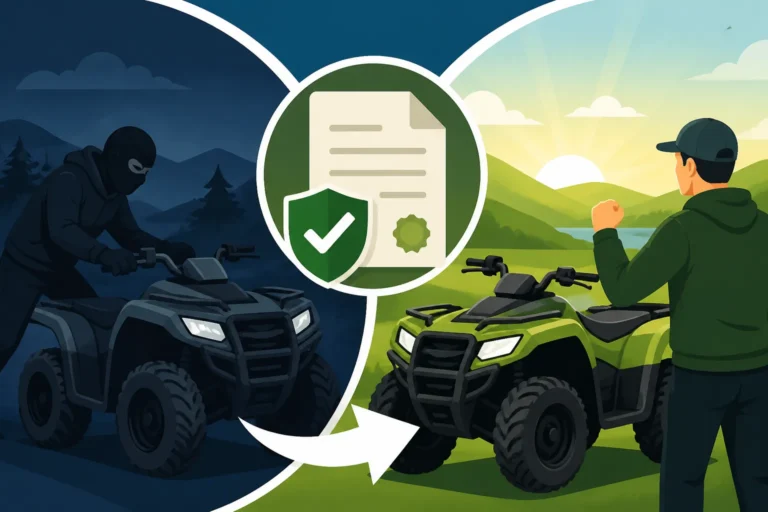
Once you've gone through the effort of securing a clear or bonded title for your ATV, protecting that document becomes paramount. Your title is a legal document proving your ownership, so treat it as such. Never keep the original title on your ATV or UTV itself. If the machine is stolen, the thief would then also have the document they need to legally transfer it, making recovery much harder. Instead, store your title in a secure location, like a fireproof safe at home or in a bank safe deposit box, separate from where you keep the machine.
It's also a smart practice to make several copies of your title and your bill of sale. Keep digital copies stored securely on a cloud service or an external hard drive, and perhaps a physical copy in a separate safe location. These copies can be invaluable if the original is ever lost, stolen, or damaged. If you do find yourself needing to transfer the title in the future, whether selling or gifting the machine, ensure you understand all the requirements for [Who Signs a West Virginia ATV Title] to avoid creating a new title issue for the next owner. When creating legal documents like a bill of sale or promissory note for a private sale, tools like LawDepot can help ensure you have all the necessary clauses and information to protect yourself and streamline any future transactions. Being proactive with your paperwork is the best defense against future title troubles.
| Feature | Standard Title (Clear Title) | Bonded Title |
|---|---|---|
| Origin | Issued directly by DMV with clear ownership history | Issued by DMV when original title is missing/defective |
| Proof of Ownership | Original title or Manufacturer's Certificate of Origin | Surety bond + available proof (bill of sale, affidavits) |
| Risk to Buyer | Minimal, clear chain of ownership | Potential for a claim against the ATV during bond period |
| Cost | Title fee, sales tax | Title fee, sales tax, bond premium, potential appraisal |
| Duration of Title | Indefinite, full ownership | Usually 3 years (bond period), then converts to standard |
| Transferability | Easy to transfer to new owner | May be harder to sell during bond period |
| Common Scenarios | New purchase, private sale with clear title | Lost title, purchased without title, abandoned machine |
Disclaimer
This article is for general informational purposes only and does not constitute professional advice. Laws, prices and regulations vary by location and change over time. Consult a qualified professional for guidance on your specific situation.