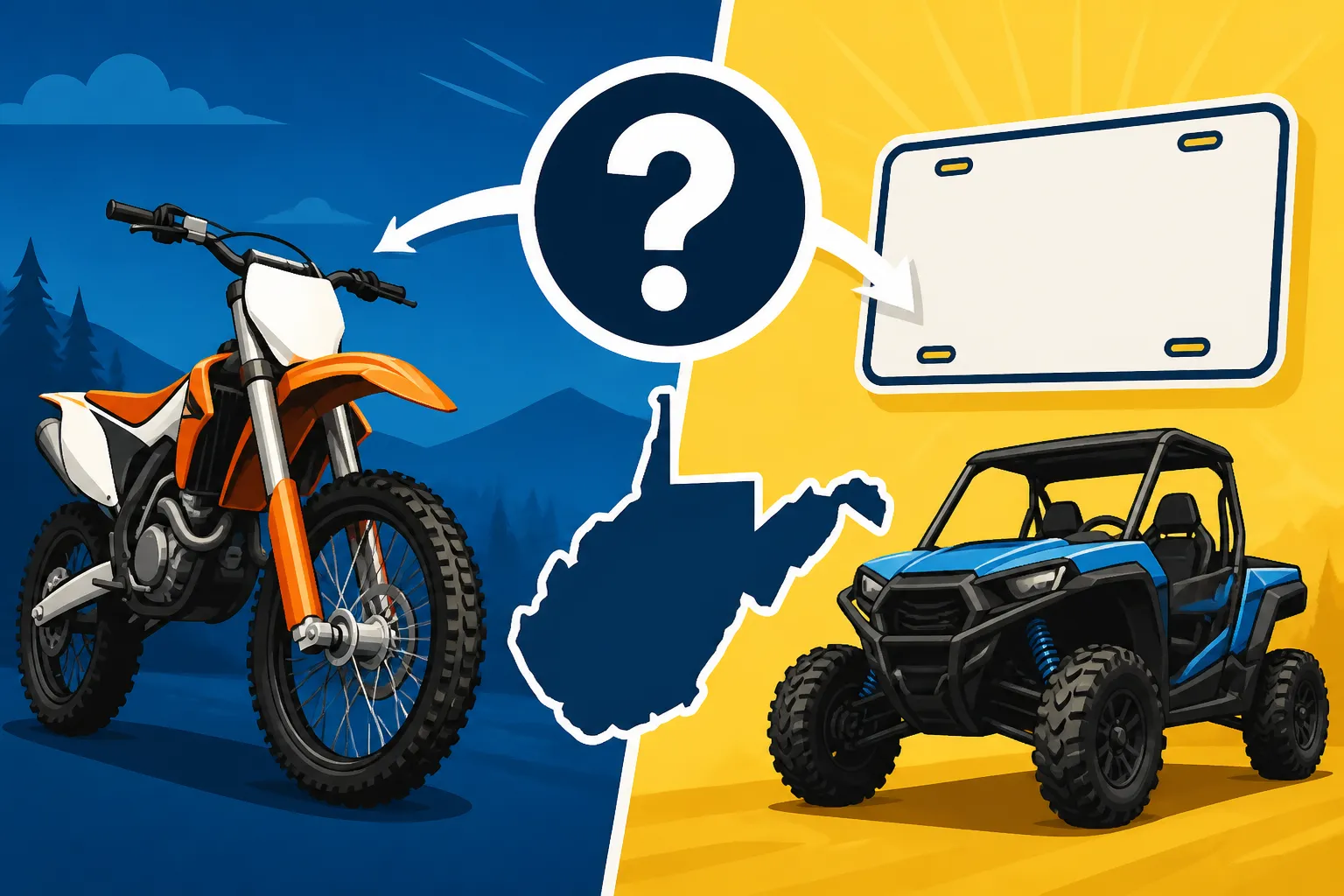
Can a Dirt Bike Get a West Virginia SPV Plate?
It's a common dream for many dirt bike enthusiasts in West Virginia: imagine being able to ride directly from your garage to the trailhead, or to pop into town for a quick bite without trailering your machine. The idea of getting a "street legal" plate for your beloved dirt bike in the Mountain State often leads people to think about the Special Purpose Vehicle (SPV) plate. Unfortunately, the reality for traditional dirt bikes is often a frustrating dead end, and this guide is here to explain exactly why.
Understanding the West Virginia Special Purpose Vehicle SPV Plate
Let's clear up some common misunderstandings right off the bat. West Virginia does have a Special Purpose Vehicle (SPV) plate, and it does allow certain off-road machines like ATVs and UTVs to operate on public roads with specific restrictions. The problem for dirt bikes, however, lies in the fundamental design and a strict set of requirements.
What an SPV Plate Actually Means for Off-Road Machines
The West Virginia SPV plate was created to provide a pathway for larger, multi-wheeled off-road vehicles – think your side-by-sides and ATVs – to gain limited street legality. This was a game-changer for many riders, especially those who frequent trail systems like Hatfield-McCoy, allowing them to connect trail sections or access amenities in trail-friendly towns. The intent was never really for two-wheeled dirt bikes. An SPV isn't a free pass to treat your machine like a regular car or motorcycle. It comes with crucial limitations, such as the [West Virginia's 20-Mile Centerline Limit for an SPV], meaning you're generally restricted to roads with a centerline speed limit of 25 mph or less, for up to 20 miles. There are also specific rules about crossing major highways and a general speed cap.
For an ATV or UTV owner, this plate offers incredible convenience. You can ride directly from your cabin to a restaurant, or move between trailheads without having to load and unload your machine every time. But for dirt bike owners, the path to an SPV plate is significantly more challenging, if not entirely impossible, for most traditional models. The regulations are designed with the larger, more stable four-wheeled machines in mind, which inherently come closer to meeting the safety and equipment standards of a road-going vehicle. It's a pragmatic solution for a specific type of off-road vehicle, one that unfortunately leaves many dirt bikes out in the cold.
Key Eligibility Requirements for Any SPV
The crux of the matter for dirt bikes is that the West Virginia DMV has a stringent list of equipment and design features that any vehicle must possess to qualify for an SPV plate. These aren't suggestions; they are hard requirements designed to ensure a basic level of road safety and visibility. Any off-road machine hoping to get an SPV plate needs to be equipped with a whole host of components that a standard dirt bike simply doesn't have from the factory, and often can't easily or safely accommodate. You're looking at things like proper headlights, taillights, and brake lights (that activate from both front and rear brakes), turn signals, rearview mirrors, a functional horn, and DOT-approved tires.
Beyond these individual components, there are also implied structural requirements. An SPV must be able to securely mount all this equipment in a way that is safe and legal. This often means having an integral body structure that can house wiring, provide stable mounting points for mirrors and turn signals, and accommodate a windshield. For more details, you can look up the [West Virginia SPV Plate Requirements List]. While a determined individual might try to bolt on every single item to a dirt bike, the fundamental design differences often create insurmountable hurdles, making the process not only difficult but potentially unsafe and certainly not what the regulations envision for a dirt bike. This isn't about arbitrary rules; it's about ensuring that a vehicle operating on public roads meets minimum safety and visibility standards.
Why Dirt Bikes Struggle to Meet SPV Criteria
It boils down to design. Dirt bikes are purpose-built for off-road performance – lightweight, agile, and often minimalist in their construction. These very characteristics, which make them so thrilling on the trail, are precisely what make them incompatible with West Virginia's SPV requirements.
The Frame and Body Design Mismatch
Think about the fundamental structure of a dirt bike versus a UTV or even an ATV. A dirt bike is designed around a narrow, open frame, with the rider straddling the machine. There's no enclosed cab, no substantial bodywork beyond fenders and shrouds, and certainly no factory-installed windshield. An SPV, by definition, implies a certain level of integrated structure to support road-going features. How do you securely mount a full-sized rearview mirror, turn signals, and a substantial horn on a dirt bike in a way that's stable, visible, and won't be easily damaged or interfere with riding? It's a huge challenge. Many riders also forget about the critical importance of a proper windshield or, at a minimum, safety glass. A dirt bike, by its very nature, offers no such protection, and trying to adapt one often leads to unstable, makeshift solutions that wouldn't pass muster with the DMV or a law enforcement officer.
Then there's the tire situation. Dirt bikes come with knobby tires designed for maximum traction in dirt, mud, and rocks. These tires are absolutely not designed or rated for highway speeds or prolonged pavement use. They wear out incredibly fast, offer poor grip on asphalt, and critically, are not DOT (Department of Transportation) approved. Obtaining [DOT Tires for a Street-Legal Side-by-Side] is a significant step for UTVs, and finding equivalent, compliant tires for dirt bike wheel sizes that are also suitable for off-road use is a rare and often compromise-filled endeavor. The whole design ethos of a dirt bike simply doesn't align with the structural and accessory integration required for an SPV.
Equipment and Safety Feature Gaps
Beyond the frame, the individual safety equipment requirements present a gauntlet for dirt bikes. Take brake lights, for instance. A standard dirt bike often has a rear brake light, but it might only activate when the rear brake is applied. SPV rules often imply or explicitly require activation from both front and rear braking controls, a feature rarely found on stock dirt bikes. Turn signals are another major hurdle; they're almost universally absent on dirt bikes. Adding aftermarket signals means not only finding a robust kit but also figuring out how to integrate them into the bike's electrical system and mount them so they are clearly visible from front and rear. This often requires significant electrical work and custom fabrication.
Mirrors and horns are similar challenges. While you can certainly buy aftermarket [Mirrors and Horns on a Street-Legal Build] for a dirt bike, ensuring they are positioned legally, remain stable during vibrations, and provide adequate visibility is a different story. Many dirt bike handlebars aren't designed for robust mirror mounting, and a standard horn often requires a separate power source and secure mounting that doesn't obstruct the rider's controls. The sheer volume and complexity of these required modifications often push the cost and effort beyond what most riders consider reasonable, and still leave them with a machine that looks and feels cobbled together, rather than a factory-designed road-legal vehicle. It’s not just about having the parts; it’s about having them integrated safely and effectively, which a dirt bike's minimalist design simply doesn't facilitate.
Are There Any Exceptions or Alternatives for Dirt Bikes?
So, if a traditional dirt bike can't get an SPV plate, does that mean all hope is lost for riding on West Virginia roads? Not entirely, but it requires a very clear understanding of what kind of "dirt bike" you actually have and what limitations still exist.
The Difference Between a Dirt Bike and a Street-Legal Enduro
This is the most crucial distinction. A "dirt bike" in the context of an off-road-only machine, purchased with a manufacturer's statement of origin (MSO) indicating "off-road use only," is inherently different from a "street-legal enduro" or "dual-sport" motorcycle. A true street-legal enduro is manufactured from the factory to meet all federal and state motorcycle safety standards. It comes with DOT-approved tires, full lighting (headlight, taillight, brake light from both controls, turn signals), mirrors, a horn, and a proper VIN that designates it as a motorcycle. These machines are titled and registered as motorcycles from day one.
The SPV plate, on the other hand, is specifically for off-road vehicles (like ATVs and UTVs) that are converted to limited street use. You're not converting a dirt bike into a motorcycle via an SPV plate. If your machine started life as an off-road dirt bike, simply adding lights and mirrors won't magically make it an SPV in the eyes of the West Virginia DMV. It still lacks the fundamental design elements and manufacturer's certification that an SPV-eligible machine (like a UTV) possesses, or the factory compliance of a true dual-sport motorcycle. It's a common point of confusion, and unfortunately, many riders spend a lot of time and money trying to force a square peg into a round hole.
Exploring Limited Road Use Options Beyond SPV
For traditional, off-road-only dirt bikes, the options for legal road use are extremely limited, bordering on non-existent, unless that road is specifically designated as an OHV route or part of a managed trail system. Unlike ATVs and UTVs, which have a specific provision allowing them to operate on certain roads under [West Virginia's 10-Mile, 25 mph Road Rule] (without needing an SPV plate, provided they meet basic equipment), dirt bikes generally do not fall under this exception. That rule is explicitly for Class I and Class II ATVs, which are distinct from motorcycles.
This means that for most dirt bike riders, your primary avenues for riding will remain dedicated off-road trails, private property with permission, or sanctioned events. West Virginia boasts incredible trail systems, like the Hatfield-McCoy Trails, which offer hundreds of miles of thrilling riding. These trails are designed for the machines you own, and you can ride them knowing you're fully compliant with the rules. Trying to find loopholes for road use often leads to frustration, potential fines, and even safety hazards. For those looking to ride, focusing on legitimate off-road areas is usually the most straightforward and enjoyable path. To find suitable places to ride, you might check resources like [Where to Ride an ATV in West Virginia], which often includes information relevant to dirt bikes on multi-use trails.
The Path for True Dual-Sport Motorcycles
If what you actually have is a factory-built dual-sport motorcycle, then you're already in a completely different category. These machines are titled and registered just like any other motorcycle in West Virginia. They don't need or qualify for an SPV plate because they are already street-legal vehicles. The SPV plate is intended for off-road vehicles that do not meet full motorcycle or automobile standards but are being adapted for limited road use. Your dual-sport will have its own motorcycle title, likely acquired through a dealership that handled all the paperwork. If you purchased it used, you would follow the standard process for [Titling an ATV in West Virginia], but for a motorcycle – which is a distinct process.
The key takeaway is this: if your machine was sold as an "off-road only" dirt bike, adding aftermarket parts will not allow it to be titled as a street-legal motorcycle in West Virginia, nor will it qualify for an SPV plate. The West Virginia DMV differentiates clearly between motorcycles, ATVs, UTVs, and then the special category of SPVs. A dirt bike, in its pure off-road form, doesn't fit the SPV definition because of its design and the inherent lack of necessary safety features for road use. The best advice is to embrace your dirt bike for its intended purpose: ripping up the trails! If you really want a street-legal machine that handles like a dirt bike, your best bet is to invest in a factory-built dual-sport motorcycle designed for that exact purpose from the ground up. You'll avoid a lot of headaches, ensure compliance, and be able to hit the road (and the trails) with confidence. When it comes to ensuring your documentation is always in order, whether it's for a true dual-sport or an off-road machine, using reliable document templates can be a huge help. Sites like LawDepot offer templates for things like bills of sale or general agreements, which can be useful when buying or selling any kind of vehicle.
Conclusion: Dirt Bikes and the SPV Plate – A No-Go for Most
In summary, for the vast majority of traditional dirt bikes, obtaining a West Virginia Special Purpose Vehicle (SPV) plate is simply not possible. The strict equipment, design, and structural requirements for an SPV are geared towards larger, multi-wheeled off-road vehicles like ATVs and UTVs, which can more realistically be converted for limited street use. Dirt bikes, with their lightweight, minimalist, and open-frame design, fundamentally lack the integral body structure, integrated safety features, and manufacturer certifications needed to satisfy these rules.
While the desire to ride a dirt bike on public roads is understandable, attempting to modify an off-road dirt bike to meet SPV standards often leads to a vehicle that is neither truly compliant nor safely designed for road operation. If you possess a factory-built street-legal enduro or dual-sport motorcycle, that machine is already classified as a motorcycle and follows standard motorcycle registration, entirely separate from the SPV program. For everyone else, the best course of action is to stick to designated off-road trails and private property. It's important to know the rules upfront to avoid disappointment, wasted effort, and potential legal issues when navigating West Virginia's diverse landscape with your dirt bike.
Disclaimer
This article is for general informational purposes only and does not constitute professional advice. Laws, prices and regulations vary by location and change over time. Consult a qualified professional for guidance on your specific situation.