Golf Carts and Low-Speed Vehicles in West Virginia
Navigating the rules for riding golf carts and low-speed vehicles (LSVs) on public roads in West Virginia can feel like trying to solve a puzzle with missing pieces. Many folks assume that if it has four wheels and goes slow, it must be okay for a quick run to the corner store, especially in smaller towns or communities. But the reality is far more complex, with specific state laws and local ordinances dictating exactly what you can drive, where you can drive it, and what equipment it needs to have. This comprehensive guide is here to untangle that confusion, offering clear, actionable information so you can understand the distinctions, requirements, and possibilities for operating golf carts and LSVs legally and safely across the Mountain State.
Understanding the Differences: Golf Carts vs. Low-Speed Vehicles (LSVs)
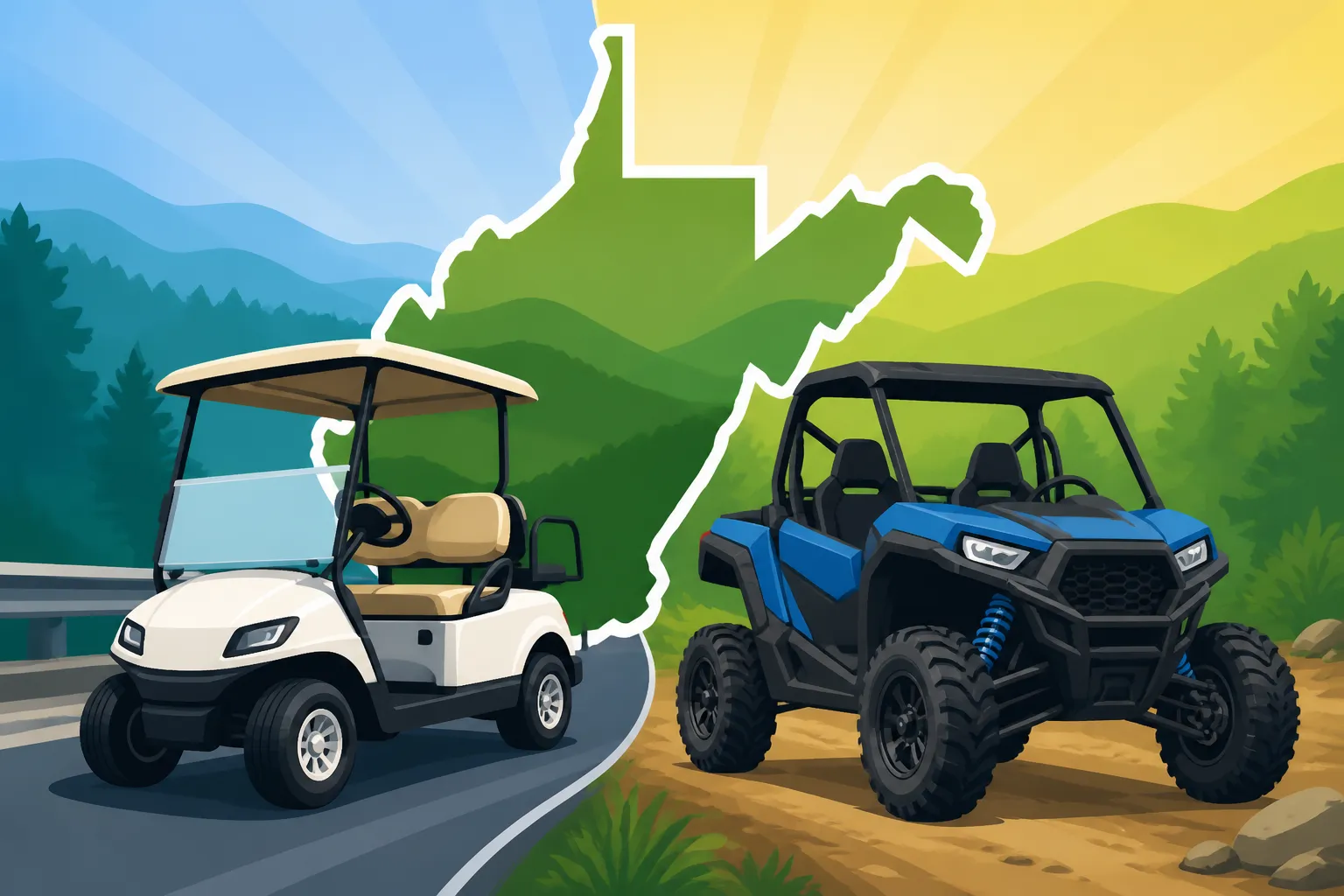
Before we even begin talking about hitting the pavement, it's absolutely crucial to understand that West Virginia law sees golf carts and Low-Speed Vehicles (LSVs) as distinct entities. This isn't just a matter of semantics; it has huge implications for where you can drive them and what equipment you'll need. Mistaking one for the other can lead to serious fines or even accidents. You really need to know what you're working with from the get-go.
Defining a Golf Cart in West Virginia
In West Virginia, a golf cart is generally defined by its primary purpose and its limited speed. Think of the typical vehicle you'd see zipping around a golf course, a campground, or maybe a large private property. These machines are designed for short-distance travel, often on private land or within designated recreational areas. Their top speed is usually a dead giveaway – they're not built to keep up with even slow-moving traffic.
Legally speaking, West Virginia Code categorizes golf carts as vehicles specifically designed and manufactured for operation on golf courses. The key characteristic is usually a maximum speed of no more than 20 to 25 miles per hour (mph). They typically lack many of the safety features you'd find on a standard automobile, such as advanced lighting, robust braking systems for road speeds, or even proper turn signals. They are, by design, simple vehicles for simple tasks.
Because of this specific definition and their inherent limitations, golf carts are generally restricted from most public roads. While some local communities or municipalities might have specific ordinances that allow golf carts on certain low-speed, low-traffic streets, these are exceptions rather than the rule. Without such an ordinance, operating a standard golf cart on a public highway or street is typically illegal. It's not like an ATV which has its own set of distinct rules, but the underlying principle of limited road access is similar.
What Qualifies as a Low-Speed Vehicle in WV
Now, an LSV is a whole different beast. While it might look somewhat similar to a golf cart, especially some of the souped-up versions you see these days, an LSV is specifically manufactured to meet certain federal safety standards that allow it to be driven on public roads. These vehicles are designed for use on public roads with speed limits typically under 35 mph, making them a fantastic option for getting around smaller towns or specific communities.
For a vehicle to be classified as an LSV in West Virginia, it must adhere to federal safety standards established by the National Highway Traffic Safety Administration (NHTSA). This means it must have a top speed greater than 20 mph but not exceeding 25 mph. More importantly, it must come equipped from the factory with a range of safety features that a typical golf cart often lacks. We're talking about things like headlamps, tail lamps, stop lamps, turn signal lamps, reflex reflectors, an exterior mirror mounted on the driver's side and either an exterior mirror mounted on the passenger's side or an interior mirror, a parking brake, a VIN, and seat belts.
Because LSVs meet these stringent safety requirements, they are eligible for titling and registration in West Virginia, much like a regular car or motorcycle. This opens up a lot more possibilities for street use, which is a huge benefit for those living in or visiting our numerous trail towns or other areas where you want to get around without constantly loading up a truck. The process is similar to what you might encounter when [Registering a Low-Speed Vehicle in West Virginia], requiring documentation and a visit to the DMV.
Key Distinctions in Speed and Safety Features
The most immediate and obvious distinction between a golf cart and an LSV boils down to speed and the safety equipment mandated for each. A traditional golf cart is capped at a lower speed, generally around 20 mph, and lacks the full suite of safety features required for street legality. It’s built for the fairway, not the highway. This is a critical point that many people overlook, thinking that a couple of added lights make their golf cart road-ready. That's a dangerous assumption.
An LSV, by contrast, is engineered to go slightly faster (20-25 mph) and, crucially, comes from the manufacturer with all the necessary safety gear to comply with federal motor vehicle safety standards (FMVSS). This includes things like proper lighting (headlights, taillights, brake lights, turn signals), mirrors, a windshield (often made of safety glass), seat belts, and a vehicle identification number (VIN) that allows it to be titled. These are non-negotiable items that transform a recreational vehicle into a street-legal one.
Think of it this way: if you're pulling a golf cart out of storage for a quick ride across the neighborhood, you probably don't need much more than a fully charged battery. If you're planning to take an LSV out on a public road, even a low-speed one, you're expected to have all the safety equipment fully functional and meet all the legal requirements for registration and insurance. The rules are in place for a reason, to protect you and others sharing the road.
| Feature / Category | Golf Cart (Typical) | Low-Speed Vehicle (LSV) |
|---|---|---|
| Max Speed | ~20 mph (often less) | 20-25 mph |
| Purpose | Golf courses, private property, campgrounds | Short-distance public road travel (under 35 mph speed limits) |
| Titling/Registration | Not typically eligible for public road title/registration | Required for public road use |
| VIN | Often lacks a standard VIN (may have serial #) | Required, issued by manufacturer |
| Headlights | Optional, basic | Required (DOT-compliant) |
| Tail/Brake Lights | Optional, basic | Required (DOT-compliant) |
| Turn Signals | Optional | Required |
| Mirrors | Often one or none | Required (driver's side, and either passenger side or interior) |
| Windshield | Often none or non-safety glass | Required (safety glass) |
| Seat Belts | Optional or lap belts only | Required (DOT-compliant) |
| Horn | Optional | Required |
| Insurance | Optional (homeowner's may cover on private property) | Required for public road use |
| Driver's License | Not typically required on private land | Required for public road use |
West Virginia's Laws for Golf Cart Operation
It's tempting to think that a golf cart is just a fun little vehicle that can zip around anywhere, especially if your neighborhood or community has a lot of them. However, West Virginia has specific laws governing golf cart use, and these laws are quite restrictive when it comes to public roads. Ignoring these rules can lead to tickets, fines, or even more serious consequences if an accident occurs. It's vital to know where you stand, legally.
Where Golf Carts Can and Cannot Be Driven
Generally speaking, golf carts in West Virginia are not permitted on public streets or highways. Their design, limited speed, and lack of safety features mean they simply aren't equipped to safely share the road with full-sized motor vehicles. This is the default rule across the state, and it’s a crucial one to remember. You can certainly drive your golf cart all day long on a golf course, within a private, gated community that has its own internal road network, or on your own private property. That’s what they are built for, and that’s where they belong.
However, there's a very important caveat: local ordinances. West Virginia state law does allow individual municipalities, counties, or governing bodies of planned communities to create their own ordinances that permit golf cart operation on specific public roads within their jurisdiction. These roads are typically low-speed, low-traffic routes, and the ordinances will almost always stipulate specific operating hours, safety equipment requirements (even if not full LSV standards), and sometimes even a permit system. If you live in an area where you see golf carts on public roads, it's almost certainly due to one of these local rules.
The key takeaway here is: do not assume. Just because you see a golf cart on a road somewhere else in West Virginia doesn't mean it's legal in your area. Always check with your local city hall or county commission office to understand the specific rules that apply to your exact location. This is especially true if you’re visiting a new town; what’s allowed in one "trail town" for example might be completely different just a few miles down the road.
Local Ordinances and Their Impact
Local ordinances are truly the game-changer for golf cart owners in West Virginia. Without a local ordinance specifically allowing it, driving your golf cart on a public road is illegal, full stop. These ordinances are passed by local governing bodies and essentially carve out exceptions to the broader state law. They're designed to address the unique needs and traffic patterns of specific communities, allowing for golf cart use where it can be done safely.
When a town or county passes such an ordinance, it will detail the exact parameters for golf cart operation. This might include: specific streets where golf carts are allowed (often those with speed limits of 25 mph or less), specific times of day, requirements for certain safety features like headlamps, taillights, reflectors, and a slow-moving vehicle emblem, and sometimes even a local registration or permit. Some ordinances might require a valid driver's license for operation, even if the state law doesn't explicitly require it for golf carts on private land.
The impact of these ordinances is significant. They provide a legal pathway for residents to use their golf carts for local errands, to connect with neighbors, or to access community amenities, transforming them from purely recreational vehicles into practical local transportation. However, it also means that compliance is entirely on the owner/operator. You must know and abide by all the rules of that specific ordinance, or you risk being cited by local law enforcement. It's often worth a quick call to the municipal office or a look at their website before you get behind the wheel on a public thoroughfare.
Equipment Requirements for Golf Carts
Even in areas where local ordinances permit golf carts on public roads, there will almost always be specific equipment requirements. These are put in place to enhance safety, particularly when sharing any space with other vehicles, even if traffic is minimal. Don't confuse these requirements with the more extensive federal standards for LSVs; they are usually a simpler, more basic set of additions.
Common equipment requirements mandated by local ordinances for golf carts include: working headlamps and taillamps for visibility, particularly during dawn, dusk, or nighttime hours; turn signals to indicate intended movements; a rearview mirror (or often multiple mirrors) for situational awareness; and a slow-moving vehicle emblem (the orange triangle) to warn other motorists of the golf cart's limited speed. Some ordinances might also specify the need for seat belts, even if the golf cart wasn't originally equipped with them.
While these might seem like minor additions, they are critical for safety. For example, being able to signal a turn drastically reduces the risk of a collision. Having adequate lighting ensures that your golf cart is visible to drivers of larger vehicles, especially in less-than-ideal lighting conditions. If you're considering using your golf cart on public roads in a town with a local ordinance, invest in these upgrades. Companies like SuperATV offer a range of aftermarket lighting kits, mirrors, and turn signal kits that can help you meet these local requirements, making your ride safer and compliant without needing to convert to a full LSV. Ignoring these requirements, even in an area where golf carts are otherwise allowed, can still result in a ticket and put you at risk.
Making Your LSV Street Legal in West Virginia
Unlike golf carts, Low-Speed Vehicles (LSVs) are designed with public road use in mind, but they still need to go through the proper channels to be truly street legal in West Virginia. This isn't just about having the right equipment; it's about formalizing its status with the state, ensuring it's properly identified, insured, and operated by a licensed driver. It’s a bit more involved than just driving it off the lot.
Required Equipment for LSV Registration
For an LSV to be legally registered and driven on public roads in West Virginia, it must meet specific federal safety standards, and by extension, the state recognizes these. This isn't a checklist you can selectively ignore; every item is crucial for both legality and your safety. If you're buying a new LSV from a reputable dealer, it should come from the factory with all of these features. If you're buying used or attempting a conversion, this is your mandatory list.
The essential equipment includes headlamps (DOT-compliant, meaning approved for highway use), tail lamps, stop lamps (brake lights), and turn signal lamps (front and rear). You also need reflex reflectors to ensure visibility from all angles, and an exterior mirror mounted on the driver's side. Additionally, you need either another exterior mirror mounted on the passenger's side or an interior mirror. A parking brake is a must-have, as is a vehicle identification number (VIN) stamped by the manufacturer. Finally, seat belts must be installed for all seating positions, ensuring that occupants are restrained in case of a sudden stop or collision. These are all part of the [Equipment West Virginia Requires on a Road Ride] for any street-legal machine.
It’s important to remember that these aren't suggestions; they are federal requirements that West Virginia adheres to for LSV classification. If your vehicle lacks any of these features, it simply cannot be titled and registered as an LSV for public road use. Trying to bypass these requirements is not only illegal but also incredibly unsafe, putting yourself and others at unnecessary risk. Always confirm that your LSV, or the one you're considering, has every single one of these safety features in good working order.
The West Virginia Titling Process for LSVs
Once your LSV is properly equipped, the next crucial step is getting it titled and registered with the West Virginia Division of Motor Vehicles (DMV). This process is very similar to titling any other motor vehicle, such as an ATV or a car, and it's what formally acknowledges your LSV as a legitimate, road-worthy vehicle in the eyes of the state. You can't just slap a "street legal" sticker on it and hit the road.
You'll need to gather several documents. This typically includes the Manufacturer's Certificate of Origin (MCO) if it's a new vehicle, or the existing title if you're buying a used LSV. You'll also need a completed West Virginia Application for Certificate of Title and Registration, which you can usually find on the DMV website. Proof of West Virginia residency and identification will be required, and if you purchased the vehicle, a bill of sale or purchase agreement showing the sale price is necessary for calculating sales tax. Just like other vehicles, if it’s an out-of-state LSV, you may need a VIN inspection as part of the process.
After submitting your paperwork and paying the appropriate fees (title fee, registration fee, and sales tax if applicable), the DMV will issue you a West Virginia title and license plate. This license plate must be affixed to the rear of your LSV, and your registration card should be kept with the vehicle. Without these, even a fully equipped LSV is not legally allowed on West Virginia's public roads. The process isn't overly complicated, but it does require attention to detail and a visit to a DMV office or sometimes certain authorized agents.
Insurance and Licensing for LSVs
Just like any other street-legal motor vehicle in West Virginia, an LSV requires both insurance and a licensed operator to be driven on public roads. This isn't an optional extra; it's a fundamental requirement for anyone operating a vehicle that has the potential to be involved in an accident with other traffic. Ignoring these can lead to severe penalties.
For insurance, you'll need to carry the state-mandated minimum liability coverage. This typically covers damages and injuries you might cause to others if you're at fault in an accident. While the specific figures can change, West Virginia requires a certain amount for bodily injury per person, bodily injury per accident, and property damage. It’s always a good idea to check with your insurance provider for the most current figures and to discuss your options. Some people opt for more than the minimum coverage for added peace of mind. Your standard auto insurance company should be able to provide a policy for your LSV. Understanding [Insurance Required for a West Virginia SPV Plate] is a good parallel, as SPVs also require specific liability coverage.
Regarding licensing, anyone operating an LSV on a public road in West Virginia must possess a valid driver's license. This means a standard Class E driver's license, just as you would need to drive a car or truck. A learner's permit or a junior operator's license might have restrictions that prohibit LSV operation on public roads, so confirm your license status. The rules for [West Virginia ATV Road Riding Age Minimum] often have similar driver's license requirements for those eligible to ride on certain public roads. The reason is simple: an LSV is sharing the road with other traffic, and the operator needs to understand traffic laws, signs, and safe driving practices. No license, no legal street driving, even if you’re only going 25 mph.
Navigating Roads: Where You Can Ride Golf Carts and LSVs
Once you understand the distinction between golf carts and LSVs and have taken the steps to make your LSV street legal, the next question is crucial: where can you actually ride them? West Virginia has specific rules about road types, speed limits, and even who can operate these vehicles on public thoroughfares. It's not a free-for-all, and understanding the nuances will keep you on the right side of the law and safe.
Permitted Road Types and Speed Limits
This is where the distinction between a golf cart and an LSV becomes critically important again. For golf carts, as discussed, they are generally prohibited from public roads unless a specific local ordinance explicitly allows them on very specific, low-speed, low-traffic roads within that municipality or community. These are rare exceptions. If such an ordinance exists, it will strictly define which roads are permissible, often capping the speed limit at 25 mph or less for golf cart access.
LSVs, on the other hand, have broader access to public roads, but with significant limitations. In West Virginia, a titled and registered LSV is generally permitted on public roads where the posted speed limit is 35 mph or less. This makes them ideal for navigating residential streets, downtown areas of smaller towns, or designated community roads. You are not permitted to drive an LSV on any road with a posted speed limit exceeding 35 mph, such as major arterial roads, state routes, or highways. Even if you're only going 25 mph, if the speed limit for other traffic is 45 mph, your LSV cannot legally be there.
This speed limit restriction is a safety measure. LSVs, by design, are not built to withstand the impacts or keep pace with faster-moving traffic. Operating them on higher-speed roads creates a dangerous situation for both the LSV operator and other motorists. Always pay attention to the posted speed limits. Many West Virginia towns have invested in creating environments where LSVs can thrive, especially in our popular ATV-friendly regions, but even there, the 35 mph rule is generally a hard limit.
Crossing Highways and Major Roads
While LSVs are restricted to roads with speed limits of 35 mph or less, there are often situations where you might need to cross a higher-speed road or a multi-lane highway to get from one permissible street to another. West Virginia law does make some allowances for this, but it's crucial to understand the rules and exercise extreme caution. This is not a casual maneuver; it requires your full attention and adherence to traffic laws.
Generally, a properly registered and equipped LSV may be permitted to cross a highway or major road with a speed limit greater than 35 mph at an intersection, provided the crossing is made in a safe and expeditious manner. This means you must come to a complete stop, yield to all approaching traffic, and proceed across the roadway only when it is safe to do so. You cannot drive along the higher-speed road, even for a short distance; the allowance is strictly for direct crossing at an intersection. This applies to scenarios like [West Virginia's 10-Mile, 25 mph Road Rule] for ATVs, where limited road access might require crossing, but not driving on, higher-speed segments.
Always look both ways, and then look again. Remember that an LSV is smaller and slower than most vehicles, making it potentially harder for other drivers to spot, especially if they are traveling at a higher speed. If you have any doubt about the safety of a crossing, it's always better to find an alternative route, even if it adds a few minutes to your journey. Your safety, and the safety of others, is paramount.
Age and Licensing for Operating on Public Roads
As previously mentioned, operating an LSV on any public road in West Virginia requires a valid driver's license. This isn't just a recommendation; it's a legal requirement. A standard Class E driver's license is what you'll need. This means that if you're too young to hold a full driver's license, you cannot legally operate an LSV on public roads, even if the road is perfectly permissible for LSV use.
The rationale is clear: an LSV, despite its limited speed, is still a motor vehicle sharing public roads. Operators need to understand traffic laws, signs, and signals, and have the judgment and experience typically associated with licensed drivers. This includes understanding right-of-way, how to navigate intersections, and how to safely share the road with pedestrians, cyclists, and larger vehicles. These are skills assessed during the driver's license examination.
There are no special "LSV licenses" or exemptions for age when it comes to public road operation. If you wouldn't be allowed to drive a car, you won't be allowed to drive an LSV on West Virginia's public roads. This rule applies uniformly across the state, regardless of local ordinances or how quiet a particular road might be. Always ensure that anyone operating your LSV on a public road is properly licensed to avoid serious legal trouble and potential liability in case of an incident.
Converting a Golf Cart to an LSV: What It Takes
Many golf cart owners, seeing the potential for street use, consider converting their existing carts into Low-Speed Vehicles (LSVs). While this is technically possible, it's not a simple DIY project that involves slapping on a few lights. It requires significant modifications, adherence to federal safety standards, and typically a certification or inspection process. It can be an involved and costly endeavor, so it’s important to go into it with open eyes.
Essential Modifications and Upgrades
If you're starting with a standard golf cart, the list of modifications to meet LSV standards is extensive. You essentially need to add everything that a factory-built LSV comes with. This includes a full lighting package: DOT-approved headlights with high/low beams, taillights, brake lights, and turn signals (front and rear). Your existing lights on a golf cart are often too dim or not properly focused for road use.
Beyond lighting, you'll need mirrors – at least a driver's side exterior mirror, and either a passenger side exterior mirror or an interior rearview mirror. A DOT-approved windshield made of safety glass is critical, not just a clear plastic one. Seat belts for all seating positions are non-negotiable, and these must be securely mounted and meet safety standards. A horn is also required to warn pedestrians and other vehicles. And crucially, your golf cart's top speed must be between 20 mph and 25 mph. If it goes slower, it's still a golf cart. If it goes faster, it enters into a different vehicle classification altogether, which usually means it's illegal without full automobile safety features. Many of these components, like full lighting kits, can be sourced from aftermarket providers. Companies like SuperATV offer robust universal street-legal kits that include many of these crucial components, making the conversion a bit easier.
You also need a parking brake, and the vehicle needs to be able to safely stop from its maximum speed. This might mean upgrading brake components depending on the original cart's design. The structural integrity of the cart itself also needs to be considered; it needs to be robust enough for road speeds, not just golf course paths. This is a far cry from adding a few cosmetic touches; it's about fundamentally changing the vehicle's safety profile.
Certification and Inspection Process
Once you’ve made all the necessary modifications to your golf cart to believe it meets LSV standards, the next hurdle is getting it officially recognized. This isn't something you self-certify. In West Virginia, a converted vehicle generally needs to undergo an inspection process to ensure it genuinely meets all the federal and state requirements for an LSV. This is similar to the kind of inspection a Special Purpose Vehicle (SPV) might go through.
The exact process for a converted golf cart can be a bit more complex than registering a factory-built LSV. You might need to provide documentation of the parts installed, and the vehicle will likely need a thorough inspection by a certified mechanic or a DMV agent to verify that all the required safety equipment is present and functioning correctly. Crucially, a VIN is needed. If your golf cart doesn't have a manufacturer-issued VIN that is recognized by the DMV, you might need to apply for an assigned VIN through the state, which adds another layer to the process.
This inspection is not just a formality. It’s a critical step that ensures your converted vehicle is genuinely safe for public road use and meets the legal definition of an LSV. Without passing this inspection and obtaining the proper documentation, even a golf cart with all the bells and whistles remains just that – a golf cart, and illegal for most public road operation. This is also where you would apply for a title, similar to the process for [Titling an ATV in West Virginia].
Cost Considerations for Conversion
Converting a golf cart to an LSV can be surprisingly expensive, often more so than many owners anticipate. It's not just the cost of individual components; it's the time, labor, and potential for unforeseen issues during the modification and inspection process. You might initially save money by converting an older golf cart, but sometimes buying a factory-built LSV might be a more cost-effective and less headache-inducing option in the long run.
The parts list alone can add up quickly: new DOT-approved lighting kits (headlights, taillights, turn signals), safety glass windshield, mirrors, seat belts, a horn, and potentially brake upgrades. These can easily run into hundreds, if not thousands, of dollars. Then there's the labor. Unless you are highly skilled and comfortable with electrical wiring, structural modifications, and automotive safety standards, you'll likely need to pay a mechanic or a specialized golf cart shop to perform the conversion. This labor cost can be substantial.
Finally, don't forget the administrative fees. There are fees for titling, registration, potential VIN assignment, and any inspections. When you factor in all these elements, the "bargain" of converting an old golf cart can quickly diminish. It’s important to get detailed quotes for parts and labor, and to fully understand the DMV process and associated fees, before embarking on an LSV conversion project. Sometimes, selling your golf cart and purchasing a new or used factory-built LSV might be the more practical and economical solution.
Common Questions and Misconceptions About Golf Carts and LSVs
There's a lot of folklore and misunderstanding floating around about golf carts and LSVs, especially in areas where they're becoming more popular. People often base their actions on what their neighbor does, or what they heard someone say, rather than on actual West Virginia law. Let's clear up some of the most persistent questions and misconceptions to help you stay informed and out of trouble.
Can I Ride My Golf Cart to the Grocery Store?
This is perhaps the most common question, and the answer, unfortunately, is almost universally "no" if you're talking about a standard golf cart on a public road leading to the grocery store. Unless your specific town or community has a very explicit local ordinance that allows golf carts on that particular road, with a speed limit of 25 mph or less, it's illegal. Most grocery stores are located on roads with higher speed limits or major traffic flow, making them off-limits even if a local ordinance existed.
The core issue here is the "golf cart" designation. These vehicles simply aren't engineered for public road safety, and West Virginia state law reflects that. Trying to take your standard golf cart on public streets to run errands, even for a short distance, is a gamble. You risk a ticket for improper vehicle operation, and more importantly, you put yourself and others in danger. If you want to use a vehicle for local errands, an LSV is the proper legal solution, assuming you meet all its titling, registration, and equipment requirements.
Even if you live in a specific "golf cart friendly" community, it’s critical to understand the exact boundaries and road types permitted. Don't assume that because your neighborhood allows golf carts, the main road leading to the grocery store does too. Always verify local ordinances or defer to the state law which prohibits golf carts on most public roads.
What About HOA Communities and Private Roads?
This is where golf carts shine and where most of their legal operation outside of golf courses takes place. Homeowners Association (HOA) communities, private resorts, campgrounds, and large private estates often have their own internal road networks. Because these roads are typically considered private property, state motor vehicle laws regarding registration and street legality often do not apply in the same way they do to public roads.
Within these private communities, HOAs or property owners can establish their own rules for golf cart operation. These rules might dictate speed limits, require certain safety features (like lights or reflectors for nighttime use within the community), or even set age limits for operators. Since these are private rules, they are enforced by the HOA or property management, not typically by state law enforcement (unless a separate state law is broken, like reckless endangerment). This is why you see so many golf carts happily zipping around gated communities, retirement villages, and large RV parks.
However, remember the distinction: the moment those private roads connect to a public street or highway, the state and local laws kick in. You cannot simply drive your golf cart from a private community directly onto a public road unless there's a specific local ordinance allowing it. Always be aware of the boundary between private and public land, and adjust your vehicle choice and compliance accordingly.
Penalties for Non-Compliance
Operating a golf cart or an un-registered/un-equipped LSV illegally on West Virginia public roads can lead to a range of penalties, none of which are pleasant. Law enforcement officers, whether state troopers or local police, are generally familiar with the rules, and they won't hesitate to enforce them if they spot a violation. Don't assume you'll fly under the radar, especially in smaller towns where everyone notices new activity.
Common penalties include traffic citations and fines. Driving an unregistered vehicle, operating a vehicle without required safety equipment, or driving on a prohibited road can all result in tickets. These fines can add up quickly, and repeat offenses will only worsen the situation. Furthermore, if you're involved in an accident while operating an illegal golf cart or an improperly registered LSV, your liability can be significantly increased. Your insurance might not cover you for an incident that occurred while you were breaking the law, leading to substantial out-of-pocket expenses for damages or injuries. This is a critical point that many overlook.
In some cases, especially for severe violations or repeated offenses, your vehicle could even be impounded. The hassle and cost of retrieving an impounded vehicle add another layer of expense and inconvenience. Ultimately, trying to cut corners or ignore the rules to save a few bucks or avoid the DMV is a false economy. The potential financial and legal consequences far outweigh any perceived convenience. It's much safer and smarter to understand the rules and comply with them, whether that means sticking to private property with your golf cart or properly outfitting and registering an LSV.
Comparing Golf Carts and LSVs for Specific Uses
Deciding between a golf cart and an LSV isn't just about legality; it's also about suitability for your intended use. While an LSV offers more freedom for public road travel, a golf cart might be perfectly adequate, or even superior, for certain applications. Let's look at some common scenarios to help you determine which vehicle type is the best fit for your West Virginia lifestyle.
Best Choice for Gated Communities and Resorts
For those living in gated communities, retirement villages, or frequenting large resorts and campgrounds with internal roads, a standard golf cart is almost always the best choice. These environments are specifically designed with golf carts in mind. The roads are private, speed limits are low, and the distances are typically short.
In these settings, a golf cart offers unparalleled convenience and cost-effectiveness. They are generally less expensive to purchase and maintain than LSVs, and they don't require state titling, registration, or mandatory insurance for operation solely within the private property. You avoid the bureaucracy and ongoing costs associated with street-legal vehicles. Many communities even have specific golf cart paths, making navigation a breeze. Just be sure to check the specific HOA or community rules, as they may have their own minor requirements for lights or reflectors, even on private land. This is precisely where a golf cart shines, offering freedom without the red tape.
Best Choice for Commuting in Trail Towns
If you live in or frequently visit one of West Virginia's vibrant trail towns, where accessing the trail system often involves navigating local streets, an LSV is typically the superior choice. These towns are embracing the off-road culture, and having a street-legal option for short commutes around town is incredibly practical. Imagine driving from your cabin to a local restaurant or trailhead without having to load up a truck.
An LSV, properly titled, registered, and insured, allows you to legally drive on roads with speed limits of 35 mph or less. This covers most of the main streets and residential areas in many of our trail towns like Gilbert, Man, or Mullens. It bridges the gap between your lodging and the local amenities, providing a convenient way to run errands, grab a bite to eat, or simply explore the community. Many of these towns have adapted their infrastructure to accommodate such vehicles. While you can also use a street-legal UTV or ATV (with a [West Virginia's Street-Legal Special Purpose Vehicle Plate]), an LSV offers a more car-like experience, often with more enclosed cabins and comfortable seating for cruising through town.
Best Choice for Farm or Utility Use
For those with agricultural land or large properties where a vehicle is needed for utility tasks – hauling tools, feed, or equipment across fields, between barns, or to various work sites – a golf cart is often the most practical and economical choice. Many manufacturers offer utility golf carts with cargo beds, enhanced suspension, and even 4×4 options, making them very capable for light-duty work.
On private farm roads or across fields, you have complete freedom to operate your golf cart without state restrictions on speed, equipment, or licensing. This makes them ideal for checking fences, moving supplies, or just getting around large acreage efficiently. They are quieter, often more fuel-efficient (especially electric models), and less intrusive than larger vehicles or ATVs for certain tasks. While some LSVs are built for utility, the added cost and regulatory burden of making them street-legal aren't necessary if their use is strictly confined to private property. For purely utilitarian roles on private land, the simplicity and lower cost of a golf cart usually win out.
The Role of Accessories and Aftermarket Parts
No matter which type of vehicle you choose – a golf cart or an LSV – the world of accessories and aftermarket parts offers a vast array of options to enhance safety, performance, and comfort. These can be crucial for meeting legal requirements for street use, improving the longevity of your machine, or simply making your ride more enjoyable. It's an opportunity to personalize and optimize your vehicle for your specific needs.
Safety Enhancements for Both Vehicle Types
Safety should always be a top priority, and aftermarket parts play a huge role in bolstering it for both golf carts and LSVs. For golf carts operating on private property, even if not legally mandated, adding basic safety features like improved headlights and taillights, turn signals, and a rearview mirror can significantly enhance visibility and awareness, especially if operating in dim conditions or around other people. A horn is also a wise addition for warning pedestrians.
For LSVs, while they come with a basic set of safety features, aftermarket upgrades can further improve them. For instance, you might consider brighter, more robust DOT-approved LED lighting from a company like SuperATV to ensure maximum visibility, or additional mirrors for blind-spot monitoring. Upgrading to a stronger, laminated safety glass windshield, if your factory one is basic, can offer better protection. Even simple additions like reflective tape can make your LSV more noticeable to other drivers, particularly during evening hours. Investing in these enhancements isn't just about meeting the minimum; it's about proactively reducing risks.
Performance Upgrades and Their Legality
Performance upgrades for golf carts and LSVs are popular, but their legality can be a tricky subject, especially if you plan to use the vehicle on public roads. For golf carts, modifying the engine or electric motor to increase speed beyond the typical 20-25 mph often means it no longer fits the legal definition of a golf cart. This could push it into a different vehicle class, making it completely illegal for any public road use, even in areas with local ordinances.
For LSVs, increasing the top speed beyond the federally mandated 20-25 mph range immediately voids its LSV classification. If your LSV can go 30-35 mph, it's no longer an LSV in the eyes of the law, and it would then require the full safety features and registration of a standard automobile. This is a common pitfall for owners who want a little more zip; that extra speed comes with massive legal repercussions if you're caught on a public road. While there are plenty of aftermarket parts to enhance power, acceleration, or handling, always be mindful of how these affect your vehicle's legal classification and intended use. For machines like UTVs, [Making a UTV Street Legal in West Virginia] often involves a very strict list of required modifications that do not typically include increasing the top speed beyond the 25 mph limit.
Comfort and Convenience Additions
Beyond safety and performance, a wealth of aftermarket accessories exists purely to make your golf cart or LSV more comfortable and convenient. These are generally unrestricted by law, whether you're on private land or public roads, and can significantly enhance your ownership experience.
Think about comfortable seating upgrades, often with better padding and ergonomic designs for longer rides. Roof extensions or full enclosures can provide protection from the sun, rain, or even colder weather. Storage solutions like cargo boxes, under-seat trays, or cup holders can make errands or leisurely cruises more practical. Audio systems, USB charging ports, and even small coolers can turn your humble cart into a highly enjoyable personal transport. Aftermarket lift kits and custom wheels are also very popular for aesthetics and ground clearance, though for LSVs on public roads, ensure any lift kit doesn't compromise stability or make the vehicle unsafe. Many of these comfort and convenience items are available from general automotive accessory suppliers, or specialized providers like SuperATV, allowing you to truly customize your ride to your liking.
Disclaimer
This article is for general informational purposes only and does not constitute professional advice. Laws, prices and regulations vary by location and change over time. Consult a qualified professional for guidance on your specific situation.