Dirt Bike Only Trails at Hatfield-McCoy
Finding dirt bike-only trails at Hatfield-McCoy can be confusing when a map shows a narrow route but doesn’t clearly explain which machines are allowed. This guide explains how to identify motorcycle-only or single-track sections, plan a suitable ride, and avoid taking a dirt bike—or a wider ATV or UTV—onto a trail that does not permit it.
What dirt bike-only means at Hatfield-McCoy
Single-track and motorcycle-only are related, but not identical
“Single-track” usually describes a narrow trail built for one line of travel. That shape often suits dirt bikes, but it does not automatically prove that a route is restricted to motorcycles. A narrow section might have a specific vehicle restriction, or it may simply be difficult or unsuitable for wider machines. The route’s posted signs and the current official trail information are what matter.
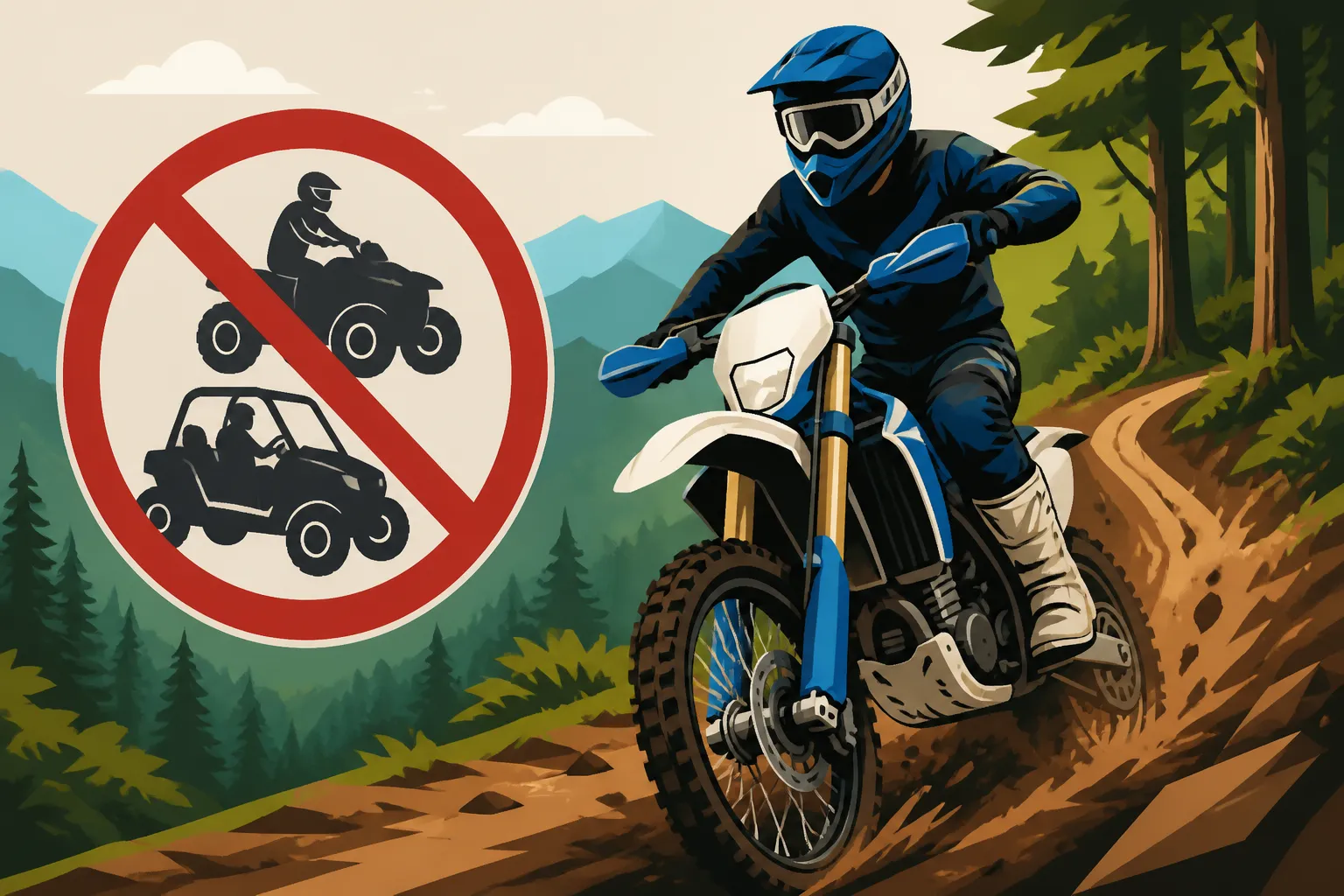
The reverse is worth remembering, too: a route that looks wide enough for a side-by-side is not necessarily open to every vehicle. Trail systems can include restrictions based on machine type, width, or other operating rules. Don’t decide based on a photo, a friend’s description, or the fact that another rider used the route.
If you’re comparing a trail listing with what you see at the trailhead, treat the posted restriction as the practical guide. [Hatfield-McCoy Single Track for Dirt Bikes] and [Buffalo Mountain and West Virginia's Single Track] are useful starting points for understanding the system’s motorcycle-focused riding. For broader context on trail designations, see [Hatfield-McCoy Trail Maps and Signage].
Why a dirt bike-only designation matters
A motorcycle-only restriction helps protect both riders and the trail. Dirt bikes are narrow and maneuverable, while ATVs and UTVs need more room to pass, turn, and avoid obstacles. On a tight, wooded route, differences in machine size can affect sightlines, passing options, and the amount of room available around rocks, roots, and bends.
The restriction also helps riders choose a route that matches their machine. A dirt bike rider looking for narrow, technical terrain may be disappointed by a broad route shared with larger vehicles. A UTV driver who enters a motorcycle-only route may find that the trail is physically too tight to navigate safely, even before considering whether the machine is permitted.
A route’s label is not a rating of how challenging it will feel. A motorcycle-only trail can still be demanding, and a trail open to multiple machine types can include rough or technical sections. Check both the vehicle restriction and the difficulty information before setting off. [West Virginia Trail Difficulty and How It Is Marked] explains why those are separate questions.
How to find and verify the right routes
Start with current trail information and posted signs
Begin with the official Hatfield-McCoy information for the trail system you plan to visit. Look for route descriptions, machine restrictions, trail ratings, and notices about closures or changes. Then confirm what is posted at the trailhead and along the route. A saved map or an older screenshot can be useful for planning, but it should not override a current closure notice or restriction sign.
This matters especially when your group is bringing different machines. A route suitable for a dirt bike may not be appropriate for an ATV, and it may be off-limits to a UTV. Before leaving the staging area, agree on which routes each machine can use. If the group splits up, decide where to meet and how everyone will stay within permitted areas.
For a practical overview of route markings, [Hatfield-McCoy Trail Maps and Signage] can help you prepare, while [Checking West Virginia Trail Status Before You Drive] is relevant when closures could affect your plans. Once on the route, follow signs and barriers rather than assuming a mapped line is still open.
Use navigation apps as a backup, not as permission
A navigation app can be handy for seeing your location, tracing a route, and noticing when your group has drifted away from its planned path. Some riders use onX Offroad alongside official trail maps for that added orientation. It can be especially reassuring in unfamiliar terrain, where a succession of turns can make it easy to lose track of your route.
Still, an app is a navigation aid, not proof that a trail is open to your machine. App data can differ in detail or timing from signs on the ground, and a route line does not necessarily communicate every restriction. Check the latest official trail information, observe the posted rules, and turn back if the route’s status or permitted machine type is unclear.
A sensible setup is to prepare before the ride: download or save the information you may need, charge your phone, and bring a backup way to navigate. For route-specific preparation, [Hatfield-McCoy Trailheads and Where to Start] can help you think through where to begin, while [Trail Rules Every West Virginia Rider Signs Up To] is a useful reminder that route selection is only one part of riding responsibly.
| What to check | Why it matters | Practical approach |
|---|---|---|
| Machine restriction | Confirms whether dirt bikes, ATVs, or UTVs are permitted | Read the route listing and follow posted signs |
| Trail width and shape | Helps you judge whether the route fits your machine and riding ability | Treat narrow single-track as a clue to investigate, not as permission |
| Difficulty marking | Gives a separate indication of how challenging the trail may be | Choose a rating that matches the least experienced rider |
| Closure notices | A familiar route may be temporarily unavailable | Check before leaving and again at the trailhead |
| Group machine mix | A route suitable for one machine may not suit the others | Agree on compatible routes before splitting up |
| Navigation coverage | Helps prevent wrong turns, especially in unfamiliar terrain | Use an app such as onX Offroad as a supplement to official information |
Choosing a suitable dirt bike ride
Match the trail to your experience and bike
A dirt bike’s light, narrow profile can make single-track appealing, but it does not make every narrow route an easy ride. Roots, loose rock, steep pitches, mud, tight turns, and changing trail conditions can all make a route more difficult than it appears on a map. Pick a route based on the rider’s ability as well as the machine’s suitability.
If you’re new to trail riding, keep the first outing conservative. Choose routes whose posted difficulty fits your experience, leave room in the day for breaks, and avoid treating a difficult section as a test you have to pass. A rider who is comfortable on open trails may still need time to adjust to a narrow route where turning around or passing can be harder.
Bike setup and condition matter, too. Check the tires, controls, brakes, chain, and fuel before leaving the staging area. Bring basic repair items appropriate for your bike and ride, and make sure everyone knows what to do if a machine develops a problem. A mechanical issue is more stressful when the group is deep into a route with little room to move.
Plan for a group, not just the lead rider
On narrow trails, the group should ride at a pace that allows each person to stay in control. Leave space between bikes so the rider behind has time to react to a sudden stop, obstacle, or change in direction. At trail junctions, don’t assume everyone saw the turn: wait where it is safe for the group to regroup and confirm the route.
Talk through the plan before starting. Decide who is leading, who is riding at the back, and what the group will do if someone gets separated. Set a reasonable turnaround point, especially if riders have different experience levels or the group is unfamiliar with the system. These small decisions can prevent a confident lead rider from unintentionally drawing less experienced riders into terrain they did not expect.
If your group includes a UTV or ATV, don’t assume it can follow a dirt bike onto every route. Check each machine’s permitted trails separately. [Wide Machine Restrictions on West Virginia Trails] is relevant when vehicle width affects route access. A mixed group may need to choose routes that accommodate everyone, or organize separate rides with clear meeting arrangements.
Riding responsibly and avoiding common mistakes
Stay on the marked route and respect closures
Stick to signed, permitted trails. Cutting around a barrier or making a new line around mud can damage the trail, create confusion for other riders, or lead into land that is not open to riding. A route that appears passable beyond a closure sign is still closed; don’t treat the sign as optional because the ground looks dry or another rider has gone through.
Conditions can change after rain, maintenance work, or other events. Check for status notices before traveling and pay attention to what you encounter on arrival. If a route is closed or a restriction is unclear, choose another confirmed option instead of guessing. That is usually less frustrating than getting far into a route and then discovering you have to turn back.
Trail etiquette matters on single-track because there may be limited room to pull aside. Be alert around blind turns, keep your speed appropriate for visibility, and give other riders room to maneuver. When you meet someone on the trail, slow down and communicate calmly so both riders can pass or find a safe place to wait.
Avoid these planning and riding errors
One common mistake is treating “single-track” as a complete answer to the question, “Can I ride here?” It describes a trail’s form, not necessarily its access rules. Another is assuming that because a route is open to dirt bikes, it must be easy for a beginner. Check the restriction and the difficulty separately, then make a choice that fits the riders in your group.
It’s also easy to rely too heavily on an app or an old map. Use digital navigation to stay oriented, but verify with current trail information and posted signs. If an app suggests a route that conflicts with a barrier or a machine restriction, follow the posted direction and find a legal alternative.
Finally, don’t make the day’s plan so ambitious that the group feels pressured to continue when someone is tired, uncomfortable, or unsure of the route. A shorter ride that everyone enjoys is better than pushing a rider into terrain beyond their comfort level. Before you head out, review [West Virginia Trail Systems Ranked by Difficulty] for help thinking through terrain choices, and make sure your route plan matches the abilities and machines in your group.
Disclaimer
This article is for general informational purposes only and does not constitute professional advice. Laws, prices and regulations vary by location and change over time. Consult a qualified professional for guidance on your specific situation.