Full-Size Jeep Access on West Virginia Trails
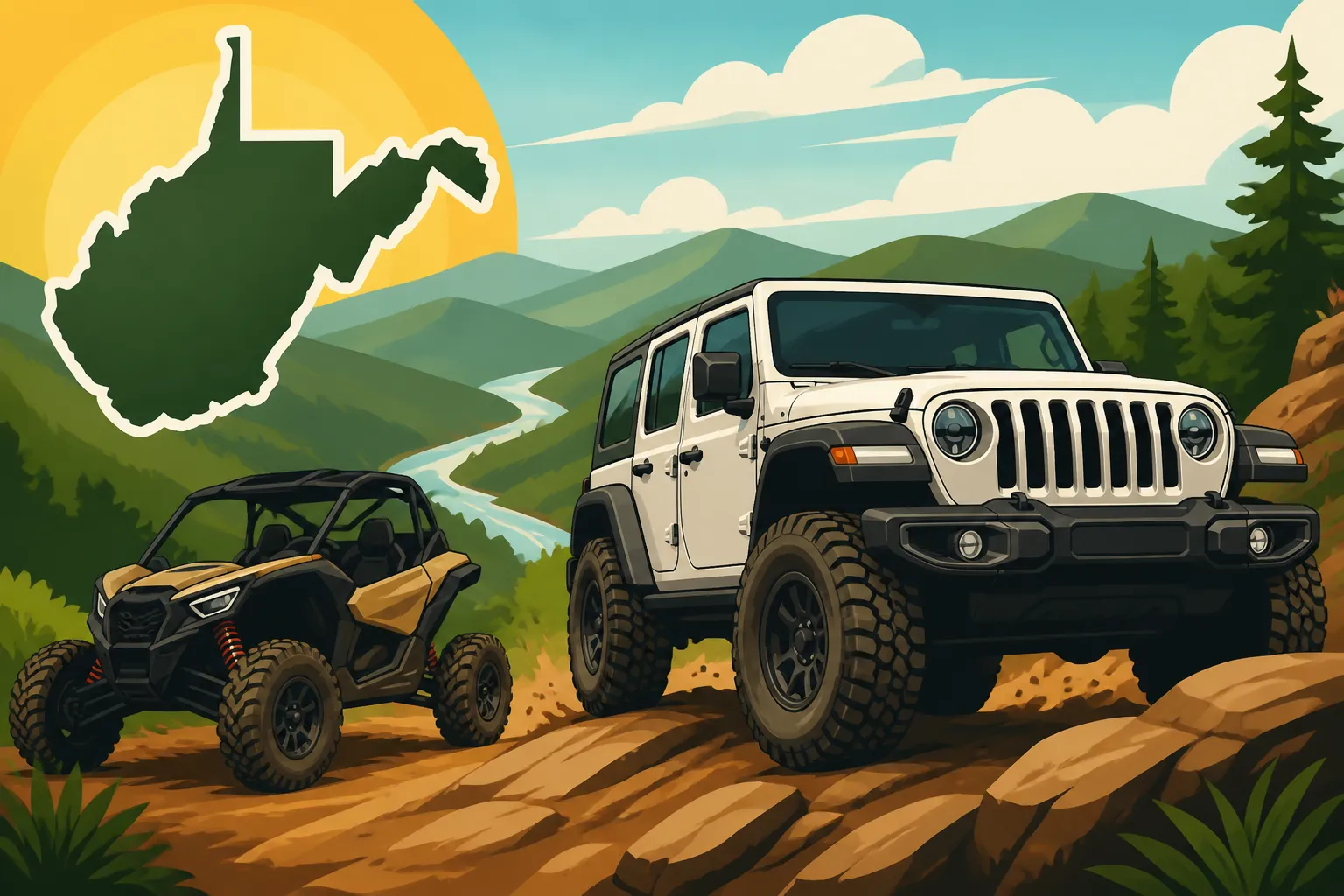
A full-size Jeep can look right at home on a West Virginia mountain trail, but that doesn’t mean it’s allowed on ATV routes. Many trails are built for machines much narrower than a Jeep, and a trail permit or road registration won’t override a land manager’s vehicle restrictions. This guide explains where Jeep access may be possible, where it isn’t, and what to check before unloading.
Can you drive a full-size Jeep on West Virginia ATV trails?
In most cases, you should not assume a full-size Jeep is allowed on a West Virginia ATV trail. ATV and UTV routes are designated for particular types and sizes of off-highway vehicles. A Jeep is a different class of vehicle, even if it has four-wheel drive, high clearance, and off-road tires.
The key is to distinguish an ATV trail from a place that specifically permits full-size 4×4 vehicles. A route’s rough appearance doesn’t determine who can use it; the posted rules and the land manager do.
Hatfield-McCoy trails are not general 4×4 routes
The Hatfield-McCoy network is a major draw for ATV and UTV riders, but its many miles of trails should not be treated as a Jeep network. Routes can be narrow, steep, winding, and designed around off-highway machines. A Jeep that fits physically may still be prohibited, and trying to squeeze one onto a trail can damage the route, block other riders, or put the driver in a dangerous position.
A Hatfield-McCoy permit is not general permission to take any off-road vehicle onto the system. It applies within the rules for the permitted vehicle types and trail areas. If you’re planning to bring a 4×4, start with [The Hatfield-McCoy Trails, West Virginia's 1,200-Mile Network] and confirm the vehicle rules with the trail authority before traveling.
Width restrictions can cause confusion. A trail rule about wide UTVs does not mean a Jeep is allowed as long as it meets a particular width. Jeep access needs to be explicitly permitted, not inferred from a measurement or from the fact that a side-by-side can ride there. For more on this distinction, see [Wide Machine Restrictions on West Virginia Trails] and [West Virginia Trails Too Tight for a 64-Inch Machine].
A road or forest route is not automatically an off-road trail
A gravel road through the woods may look like a trail, but it can be a public road, a forest road, a private access road, or a restricted route. Each has different rules. A Jeep that is legally registered for road use may be permitted on certain open roads, but that does not grant permission to drive off the road or onto nearby ATV trails.
This matters especially on public land. Motorized access is generally limited to roads or routes designated for motor vehicles. Stay on the marked route, follow gates and signs, and don’t assume an unmarked spur is open just because it appears on a map. [Monongahela National Forest Motorized Access] and [Forest Roads Open to ATVs in West Virginia] are useful starting points for understanding the difference between an open road and an off-highway trail.
Where full-size Jeep access may be possible
If you want to ride in a Jeep rather than an ATV or UTV, look for an off-road park or private property that specifically welcomes full-size vehicles. These destinations are different from ATV trail networks: they may have separate routes, vehicle rules, check-in procedures, and day-use requirements.
Look for parks that explicitly accept full-size vehicles
Burning Rock Offroad Park is one West Virginia destination to investigate for full-size 4×4 use. Before you make the drive, confirm directly with the park that your particular vehicle and planned activity are allowed. Ask about access for full-size Jeeps, any required passes or reservations, vehicle and equipment requirements, operating hours, and how trail difficulty is marked.
Don’t rely on a video, an old forum post, or a map label to establish permission. Park rules and available routes can change, and an area may have different rules for Jeeps, side-by-sides, dirt bikes, or other vehicles. You can start with [Burning Rock Offroad Park in West Virginia] and [Burning Rock: 10,000 Acres in Southern West Virginia], then check the park’s current information before leaving home.
A private off-road park may offer a better fit for a Jeep than a narrow ATV trail, but the terrain can still be demanding. A route that is open to full-size vehicles isn’t necessarily suitable for every Jeep, driver, or passenger. If you’re new to off-roading, ask which routes match your vehicle’s clearance, tire setup, recovery equipment, and experience.
Use this quick comparison before choosing a destination
| Destination type | Is a full-size Jeep generally a fit? | What to confirm |
|---|---|---|
| ATV or UTV trail network | Don’t assume it is allowed | Vehicle class, width rules, permits, and posted restrictions |
| Off-road park that welcomes 4x4s | Potentially, if the park confirms access | Jeep eligibility, route difficulty, passes, equipment, and operating rules |
| Designated public or forest road | Potentially, if the road is open to your vehicle | Road status, seasonal closures, registration requirements, and any restrictions |
| Private land | Only with the owner’s permission | Permission boundaries, access route, safety expectations, and recovery plan |
The table is a screening tool, not permission to enter. When a rule is unclear, ask the organization or land manager responsible for that specific property.
How to plan a Jeep trip without a wrong turn
A little checking ahead of time can prevent the frustrating scenario of arriving at a trailhead with a trailer, a Jeep, and no legal route to ride. Verify the destination, the vehicle class, and the access route as separate questions.
Confirm the vehicle rules with the land manager
When you call or message a park or trail authority, be specific. Say that you have a full-size Jeep, and provide the model or general dimensions if requested. Ask whether Jeeps are permitted on the routes you intend to use—not merely whether “off-road vehicles” are allowed. That broad phrase can include several vehicle types with different access rules.
Also ask whether access is limited to particular sections, whether a pass is required, and whether there are equipment or registration requirements. If the person you reach can’t confirm the answer, ask for the current written rules or an official map. A casual “it should be fine” is not a safe substitute for clear permission.
If you are considering an ATV destination for a different trip, use the appropriate vehicle and check the details for that system. For route planning across separate trail areas, [West Virginia Trail Systems You Can Link in One Day] may help you think about geography, but a suggested connection does not mean a Jeep is permitted on every route along the way.
Check maps, closures, and the route to the property
Use an official park or land-manager map as your primary reference. A consumer mapping app can help with navigation, but it may show roads or tracks without accurately communicating vehicle restrictions, private boundaries, or temporary closures. Treat an app’s route line as a clue—not as proof that a road is open to your Jeep.
Apps such as onX Offroad can help you review mapped roads, plan an approach, and keep a route visible while you travel. Still, compare the map with the destination’s current rules and closure notices. Don’t use a mapped line to justify entering a signed or gated route.
Before you leave, check the access road as well as the riding area. A legal off-road park may have a specific entrance or staging area, while nearby roads can have their own restrictions. Check [Trail Closures on West Virginia's Trail System] when planning a ride in a trail region, and confirm current conditions with the organization that manages the property.
Prepare your Jeep and make a responsible plan
Getting permission is only the first step. Mountain terrain can change quickly, and the right preparation makes the trip safer for your group and easier on the land.
Match the route to your Jeep and your experience
A vehicle being allowed at a park does not mean every trail is a good match. Consider your Jeep’s ground clearance, wheelbase, tires, protective equipment, and recovery points. A long-wheelbase vehicle can have trouble on tight turns or sharp breakovers; a shorter vehicle may still be poorly suited to steep, loose, or rocky sections if its tires and recovery setup aren’t ready.
Be honest about the experience level of the driver and passengers, too. If you’re uncertain about a route rating, ask park staff which routes are appropriate for a first visit. A conservative first loop is often more enjoyable than committing to a difficult climb and discovering halfway up that turning around is impossible.
Carry suitable recovery gear, a first-aid kit, water, and a way to communicate if cell service is limited. Tell someone where you’re going and when you expect to return. If your trip includes a trailer, plan where you’ll park and unload; don’t block a trailhead or use a roadside area unless it is clearly permitted.
Stay within marked boundaries and respect other users
Once you’re on a permitted route, stay on it. Driving around a gate, crossing a closed section, or cutting a new path can cause erosion and create safety problems for other visitors. Respect private property boundaries, posted signs, and instructions from park staff or trail personnel, even when a route looks passable.
Keep in mind that a region may have several kinds of recreation access side by side. An ATV trail, public road, private road, and off-road park route can look similar on the ground but have different rules. This is one reason to keep your destination’s current map handy and to check signs at the entrance rather than relying only on a GPS screen. onX Offroad can serve as a navigation aid, but it does not replace posted rules or permission from the land manager.
If your goal is specifically to explore West Virginia in a Jeep, choose the destination around confirmed full-size vehicle access—not around the assumption that all “off-road” routes are interchangeable. That small distinction can save a long detour and help protect the trails people rely on.
Disclaimer
This article is for general informational purposes only and does not constitute professional advice. Laws, prices and regulations vary by location and change over time. Consult a qualified professional for guidance on your specific situation.