Night Riding Rules on West Virginia Trails
West Virginia’s mountain trails can feel especially tempting after sunset, but a trail that is open during the day is not automatically open at night. This guide explains how daylight-only rules affect Hatfield-McCoy and other riding areas, what to check before setting out, and how trail riding differs from riding a properly equipped machine on a public road.
Can You Ride West Virginia Trails After Dark
Daylight-only rules on managed trails
On the Hatfield-McCoy trail system, riders should plan to be off the trails before dark. The network is managed for daytime riding, and a valid permit does not give you permission to ride after the permitted hours. It’s easy to underestimate the time needed to get back: a route that looks short on a map can take longer than expected when it includes steep grades, muddy sections, unfamiliar junctions, or a stop to help another rider.
This is why your riding plan should start with the return journey, not just the route out. If your group is leaving a trailhead late in the day, choose a short, familiar loop and leave enough daylight to reach your starting point. If you are already on the trail and realize you may not make it back before dark, don’t keep pushing deeper into the system to complete the planned ride. Turn around at a safe opportunity and head back using a known route.
For a fuller explanation of the managed-system policy, see [West Virginia's Daylight-Only Trail Riding Rule](West Virginia's Daylight-Only Trail Riding Rule). Also check [Hatfield-McCoy Trail Hours by Season](Hatfield-McCoy Trail Hours by Season) before planning around a particular season; don’t assume that longer summer daylight changes the posted riding hours.
Trail rules are different from road-riding rules
A machine’s headlights do not make an off-highway trail open after dark. Trail access rules and public-road requirements are separate questions. A properly equipped, authorized street-legal machine may be subject to rules for a road it is permitted to use, but that does not turn a closed trail into a nighttime route.
Likewise, a trail permit should not be treated as a general permission to ride anywhere in the area. It covers access under the applicable trail-system rules, not every road, property, or route nearby. Review [What a Trail Permit Does Not Cover](What a Trail Permit Does Not Cover) if you are unsure what your permit allows.
The distinction matters in trail towns such as Gilbert, Man, and Williamson, where riders may encounter roads, trail connectors, and managed trails during the same trip. Before switching from a trail to a public road—or assuming a connector is open after dark—check the rules for that specific place. [West Virginia Rules for Riding After Dark](West Virginia Rules for Riding After Dark) can help you understand why road riding and trail access should be treated as separate issues.
| Where you plan to ride | What to establish before the trip | What not to assume |
|---|---|---|
| Hatfield-McCoy managed trail | Posted riding hours, current access, and a route that gets you back in daylight | A permit or headlights allow riding after dark |
| Another managed trail area | The land manager’s hours and any local restrictions | Every West Virginia trail has the same schedule |
| Private riding property | The owner’s permission and property-specific rules | Private land is automatically open at night |
| Public road | Whether your machine and route are authorized for road use, plus applicable equipment rules | Road legality makes nearby trails open after dark |
How to Plan a Ride That Ends Before Dark
Check the hours, closures, and route before leaving
Start with the specific trail system, not a general search for “West Virginia ATV hours.” Different areas can have different operating rules, and access may change because of closures, maintenance, weather, or landowner restrictions. Check the trail authority’s current information before you travel, then read the signs and notices at the trailhead when you arrive. The guide [Checking West Virginia Trail Status Before You Drive](Checking West Virginia Trail Status Before You Drive) covers this pre-trip check in more detail.
A map is useful for planning, but it is not a substitute for the official trail status or posted rules. Use a current trail map to identify your start point, likely turnaround points, and the route back. If you use onX Offroad to review terrain and keep your group oriented, treat it as a navigation aid rather than proof that a route is open or that riding after dark is allowed. Check [West Virginia Trail Maps and Signage](West Virginia Trail Maps and Signage) for more on reading route information and trail markers.
Build a time buffer into the plan. A route may take longer than its distance suggests, especially when the group includes first-time riders, larger machines, children, or anyone who prefers a slower pace. Stop to regroup at known junctions rather than letting riders spread out. If weather, a mechanical problem, or a wrong turn costs time, shorten the route instead of relying on headlights to finish it.
Set a firm turnaround time for the group
Agree on a turnaround time before anyone starts the engine. Make it early enough that the slowest rider can return without rushing. A family group, for example, may need more time for breaks and careful riding than a group of experienced adults on a familiar route. If one rider is uncomfortable with a hill, a rocky section, or a confusing junction, the whole group should account for that—not leave that rider to catch up alone.
Pick landmarks that everyone can recognize, such as the trailhead, a marked intersection, or a signed route junction. Tell the group what to do if riders get separated: stop at a safe place, stay together if possible, and use the agreed route back rather than trying to improvise a shortcut. A navigation app such as onX Offroad may help riders confirm their position, but it cannot make a closed route legal or replace a group plan.
A simple ride plan can include:
- The trailhead and intended loop.
- The latest time the group will turn back.
- A meeting point if riders become separated.
- A way to contact the group if someone has a problem.
- The route everyone should use to return.
Share the plan with someone who is not riding, especially if you are visiting from out of town or heading into an area where mobile service may be limited. For additional practical preparation, see [What to Carry on a Remote West Virginia Ride](What to Carry on a Remote West Virginia Ride).
Lights, Equipment, and Navigation After Sunset
Why headlights do not override a trail closure
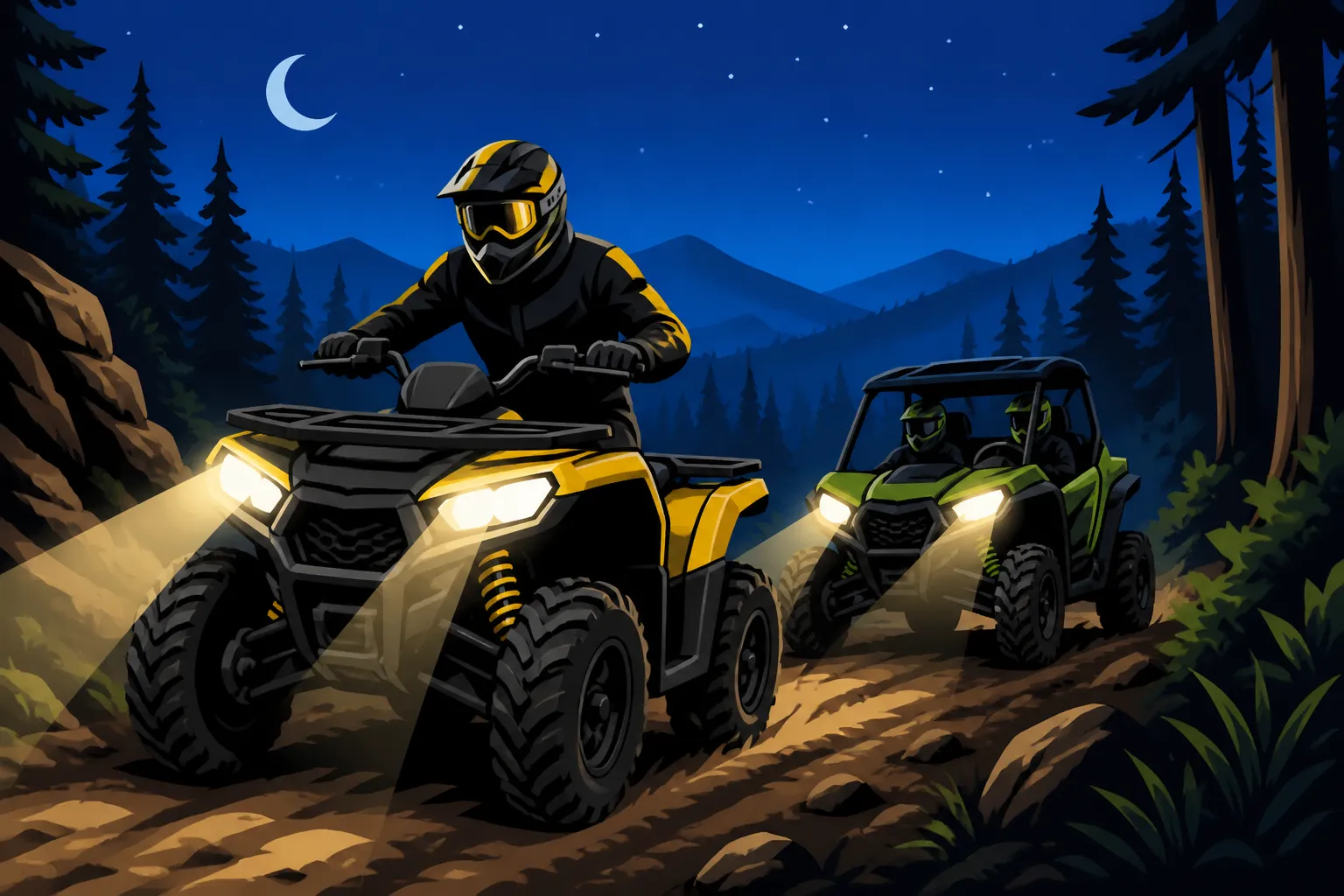
Good headlights are important for visibility when a machine is being used in a place and at a time where riding is allowed. They do not change the operating hours of a managed trail. Riding after dark on a route that is closed for nighttime use can create safety risks for your group and for other people, and it may lead to enforcement or loss of riding privileges.
Night conditions make familiar terrain harder to read. A headlight beam can hide the depth of a rut or the edge of a drop, while shadows can make a rock or branch seem farther away than it is. Dust, fog, rain, and wet leaves can further reduce visibility. On narrow mountain routes, a rider may also have less time to react to another machine around a blind bend.
If you need to ride a machine on a public road after dark, the relevant road rules and equipment requirements are a separate matter. Don’t use that fact to infer that a nearby off-road route is available at night. Review [Lights Required After Dark in West Virginia](Lights Required After Dark in West Virginia) alongside the rules that apply to the particular road and machine.
Use navigation tools as backups, not permission
A downloaded map can be useful when cell service drops, but it should support a conservative route plan rather than encourage a late ride. onX Offroad can help riders prepare by reviewing mapped routes and keeping a location reference available. Confirm that the map reflects the area you intend to ride, and compare it with official system information and signs at the trailhead.
Do not rely on a phone battery or a single navigation device. Save the information you need before leaving service, bring a charging option, and make sure every rider knows the basic route. If your group has multiple machines, agree on what to do if one device fails or a rider loses their map. The goal is to avoid a situation where someone tries to find a way back by taking an unfamiliar route after daylight ends.
For more navigation preparation, see [onX Offroad for West Virginia Trails](onX Offroad for West Virginia Trails). The key limitation is simple: a mapped route is not automatically an authorized route, and a working GPS does not extend the hours set by the trail manager.
What to Do if You Are Still Out Near Dark
Stop extending the ride and reassess safely
If you notice that daylight is fading, stop adding detours or trying to finish an optional loop. Check your location, confirm the return route, and regroup in a safe place. If you can reach the trailhead before dark by turning around, do so promptly. Don’t split the group to save time; a rider who gets separated may have a harder time navigating and may be more likely to make a risky decision.
If a machine breaks down, a rider is injured, or the route back is blocked, prioritize the immediate safety of the people in your group. Contact emergency services when the situation warrants it, and provide your location as clearly as possible. Use trail names, signs, junction markers, or saved map information to describe where you are. Avoid leaving an injured person alone simply to search for a faster route.
A map app such as onX Offroad can help you communicate a location, but do not assume that a pin or recorded track will be enough on its own. Note visible signs and landmarks, conserve phone battery, and follow instructions from emergency responders or trail personnel. If the issue is a minor delay rather than an emergency, contact the appropriate trail authority or local assistance for guidance instead of treating the trail as open after hours.
Avoid the same problem on the next ride
After the ride, note what caused the delay. Perhaps the route was longer than expected, a stop took longer, or the group underestimated muddy conditions. Use that information to plan a shorter loop next time, leave earlier, or choose a system and route better suited to your group’s experience. If conditions have changed, check [Trail Closures on West Virginia's Trail System](Trail Closures on West Virginia's Trail System) before setting out again.
If your plans include riding after sunset, first establish whether the specific property or road allows it. Ask the land manager or trail authority directly, and follow the posted rules. Don’t rely on an old online post, a friend’s recollection, or the fact that another rider has lights installed. For a managed trail, the safest planning assumption is to finish the ride within its posted hours and return to the trailhead before dark.
Disclaimer
This article is for general informational purposes only and does not constitute professional advice. Laws, prices and regulations vary by location and change over time. Consult a qualified professional for guidance on your specific situation.