Who Maintains the Hatfield-McCoy Trails
A washed-out culvert, a fallen tree, or a closed gate can change a ride in southern West Virginia fast. The Hatfield-McCoy Trails are maintained through coordinated work involving the trail authority, field crews, contractors, landowners, and riders who report problems. This guide explains who does what, what maintenance looks like, and how to respond when you spot trail damage.
Who is responsible for maintaining the Hatfield-McCoy Trails
The Hatfield-McCoy trail authority coordinates the system
The Hatfield-McCoy Regional Recreation Authority is the central organization responsible for managing the trail system. Its work is broader than fixing a muddy section or replacing a sign: it coordinates trail operations, access, information, and maintenance across a network that spans multiple communities and land parcels.
That coordination matters because the trails are not one continuous public road maintained by a single county road department. They run across a patchwork of terrain and property, so maintenance has to account for the condition of individual routes, access agreements, rider safety, and the needs of nearby communities. The authority’s role is to help keep that larger system usable and organized.
The authority also provides a point of contact for trail information and problems. If riders notice a damaged sign, a blocked route, or a concern that could affect safety, reporting it through the appropriate trail channels gives the people managing the system a chance to assess it. A rider’s report is useful, but it does not necessarily mean a crew can reach the location immediately or that the route will reopen on a particular schedule.
Field crews and contractors handle work on the ground
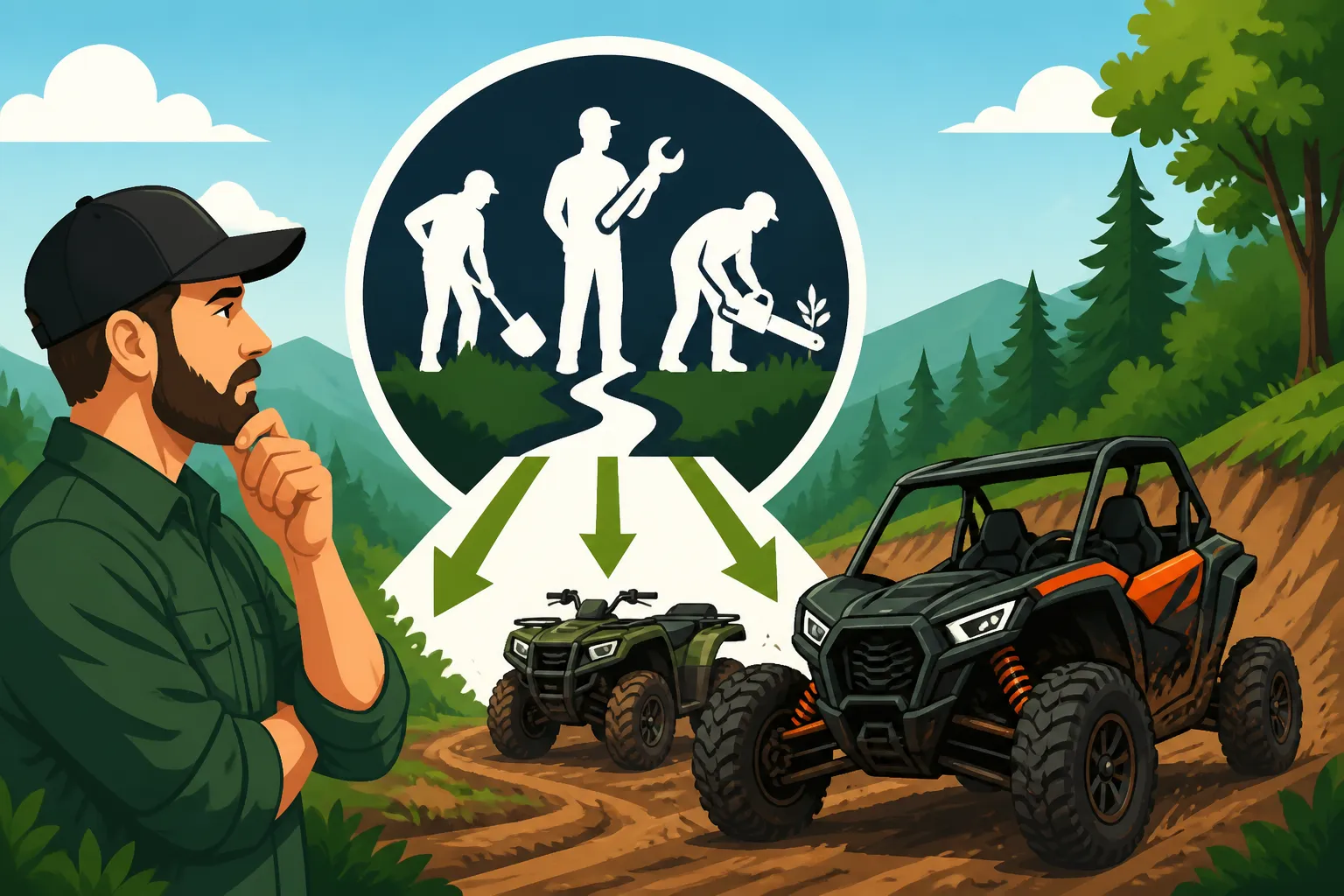
Trail maintenance is practical, physical work. Crews may need to inspect a route, clear an obstruction, improve drainage, repair a section of trail, or replace damaged markers. Some jobs can be relatively straightforward; others require equipment, materials, access coordination, and suitable weather.
A downed branch on a well-traveled route might be noticed and addressed sooner than a damaged culvert in a remote hollow. The latter can take more planning and equipment, especially if the ground is saturated or a machine cannot safely reach the site. That is one reason riders may see a reported issue remain in place for a while even when it has been acknowledged.
Contractors or other specialized support may be needed for work that goes beyond routine trail clearing. The exact crew involved can vary by project and location. The important point for riders is that maintenance is coordinated rather than automatically handled by the nearest town or county road crew. For a broader look at how the network is organized, see West Virginia’s Thirteen Hatfield-McCoy Trail Systems.
How trail maintenance works in practice
Inspections help identify problems before they become bigger hazards
A trail can change after a storm, heavy use, or a long stretch of wet weather. Water may cut a rut deeper, loosen gravel, undermine a crossing, or make a slope more vulnerable to erosion. Regular observation helps identify problems, but conditions can change between inspections, which is why reports from riders can be valuable too.
Maintenance is not simply a matter of making every route smooth. These are off-road trails through varied terrain, and their surfaces are part of the riding experience. The goal is to keep routes appropriately usable and marked while managing hazards, drainage, and erosion—not to turn every hill, rock section, or muddy stretch into a graded roadway.
When a problem is found, the response depends on what it is and where it is. A crew may be able to remove debris or improve a marker relatively quickly. A washed-out crossing might require assessment, equipment, materials, or a temporary closure while a safe repair is planned. Riders should not assume a route is safe simply because it appears on a map or was open on their last visit.
Drainage, signs, and closures are all part of maintenance
Water management is one of the less visible but important parts of trail upkeep. If water is not directed away from a route, repeated traffic can deepen ruts and carry soil downhill. Crews may need to address drainage features, crossings, or eroded areas to limit further damage. Riding around a muddy section can make the problem worse by widening the trail or creating new tracks.
Signs and markers also need attention. A missing or damaged marker can leave riders unsure which route to follow, particularly at a junction or in an area with several connecting trails. If you encounter confusing or damaged signage, note the nearest trail identifier or recognizable junction and report what you saw. For help understanding signs and route information, read West Virginia Trail Maps and Signage and Reading a Hatfield-McCoy Trailhead Kiosk.
Closures are a maintenance and safety tool, not just an inconvenience. A route may be closed because of damage, a hazard, land-access concerns, or work underway. Do not move a barrier or ride around a closure sign. Check current trail information before heading out, and treat signs at the site as important even if an older map shows the route as open. The practical details are covered in Trail Closures on West Virginia’s Trail System.
| Maintenance issue | Why it matters | What riders should do |
|---|---|---|
| Downed tree or debris | Can block passage or create a visibility hazard | Avoid risky attempts to move large debris and report its location |
| Erosion or deep rutting | Can worsen with repeated traffic and threaten trail stability | Stay on the marked route and do not create a bypass |
| Damaged crossing or culvert | May create a fall or machine-damage risk | Stop before the hazard and use an official detour if one is posted |
| Missing or unclear marker | Can lead riders off-route or toward a closed area | Note the junction and report the missing or confusing sign |
| Closure barrier or notice | Signals that access is restricted or a route may be unsafe | Do not cross, move, or ride around the barrier |
Why landowners and riders matter
Land access agreements shape what can be maintained
Many Hatfield-McCoy routes cross land that is not simply open for unrestricted public use. Access depends on arrangements with landowners and other parties. Those arrangements help make a trail network possible, but they also mean that the authority’s ability to maintain or alter a route can depend on property access and the terms of the agreement.
This is one reason riders should stay on marked routes. A shortcut through the woods may seem harmless, especially when a muddy area is frustrating, but it can lead onto land that is not part of the authorized trail. It can also damage vegetation, worsen erosion, or create a route that maintenance crews did not assess. Respecting gates and boundaries helps protect the access that allows the network to operate. See Landowner Agreements Behind West Virginia’s Trails for more on how those relationships affect the trail system.
Maintenance access itself can be complicated. A crew may need to reach a remote area with equipment, coordinate entry, or wait until conditions are safe for work. If a landowner’s access or a site condition affects a project, a repair may take longer than riders expect. That does not necessarily mean a report has been ignored; it may mean the work needs additional coordination.
Rider reports help crews understand changing conditions
Riders often notice a problem before it appears in a general update. A fresh washout, a newly fallen tree, a damaged sign, or a blocked route can develop between scheduled checks. A clear report gives trail staff more useful information than a general message that says “the trail is bad.”
When possible, include the trail system, route or marker number, nearest junction, direction of travel, and a concise description of the issue. If you can provide a location safely, do so without putting yourself or another rider at risk. A photo may help explain the problem, but do not stop in a dangerous place or approach unstable ground just to document it.
A report is not permission to keep riding through a hazard. If a crossing looks compromised or a slope is actively failing, turn back or follow the official detour. For advice on reporting a problem and what information can help, see Reporting Trail Damage at Hatfield-McCoy. Riders who follow posted routes and avoid creating new tracks also make maintenance easier; West Virginia Trail Etiquette on Shared Routes covers the habits that help keep shared trails in better shape.
How riders can check conditions and reduce trail damage
Check official updates before and during your ride
Before driving to a trailhead, check the official Hatfield-McCoy information channels for current route access and closures. A map is useful for planning, but it may not reflect a closure or damage that developed after the map was prepared. At the trailhead, read posted notices and follow the signs you encounter along the route.
Digital tools can help with orientation, especially when riders want to understand where they are in relation to a planned route. Some riders use onX Offroad to review maps and track their position. Use a mapping app as a navigation aid, not as proof that a route is open. If an official notice or trail sign conflicts with what appears in an app, follow the posted restriction and confirm status through the trail system’s official channels.
It can also help to save information before leaving an area with reliable service. Cell reception may be inconsistent in mountain hollows and remote sections, so do not plan on being able to look up every junction or closure while riding. onX Offroad can support route awareness, but it should not replace a paper backup, trailhead information, or good group-riding communication.
Ride in ways that support the maintenance effort
The simplest way riders can help is to stay on the marked route. If a section is wet, resist the urge to create a parallel track around it. If a barrier is in place, do not move it. These choices can prevent a small maintenance issue from becoming a wider damaged area or an access problem.
Adjust your riding to conditions. After heavy rain, a route may be more vulnerable to rutting and erosion. Slowing down, avoiding aggressive wheelspin, and giving other riders room can reduce unnecessary damage. If a section seems unsafe, turn around rather than trying to force a passage through it. More guidance is available in West Virginia Trail Conditions After Rain.
Finally, report what you see without assuming that every rough patch needs immediate repair. Some uneven surfaces are part of an off-road trail, while a collapsed crossing, a new hazard, or a missing marker may need attention. A useful report distinguishes between ordinary trail character and a specific condition that could endanger riders, confuse navigation, or cause further damage. That distinction helps the people responsible for the system prioritize their work.
Disclaimer
This article is for general informational purposes only and does not constitute professional advice. Laws, prices and regulations vary by location and change over time. Consult a qualified professional for guidance on your specific situation.