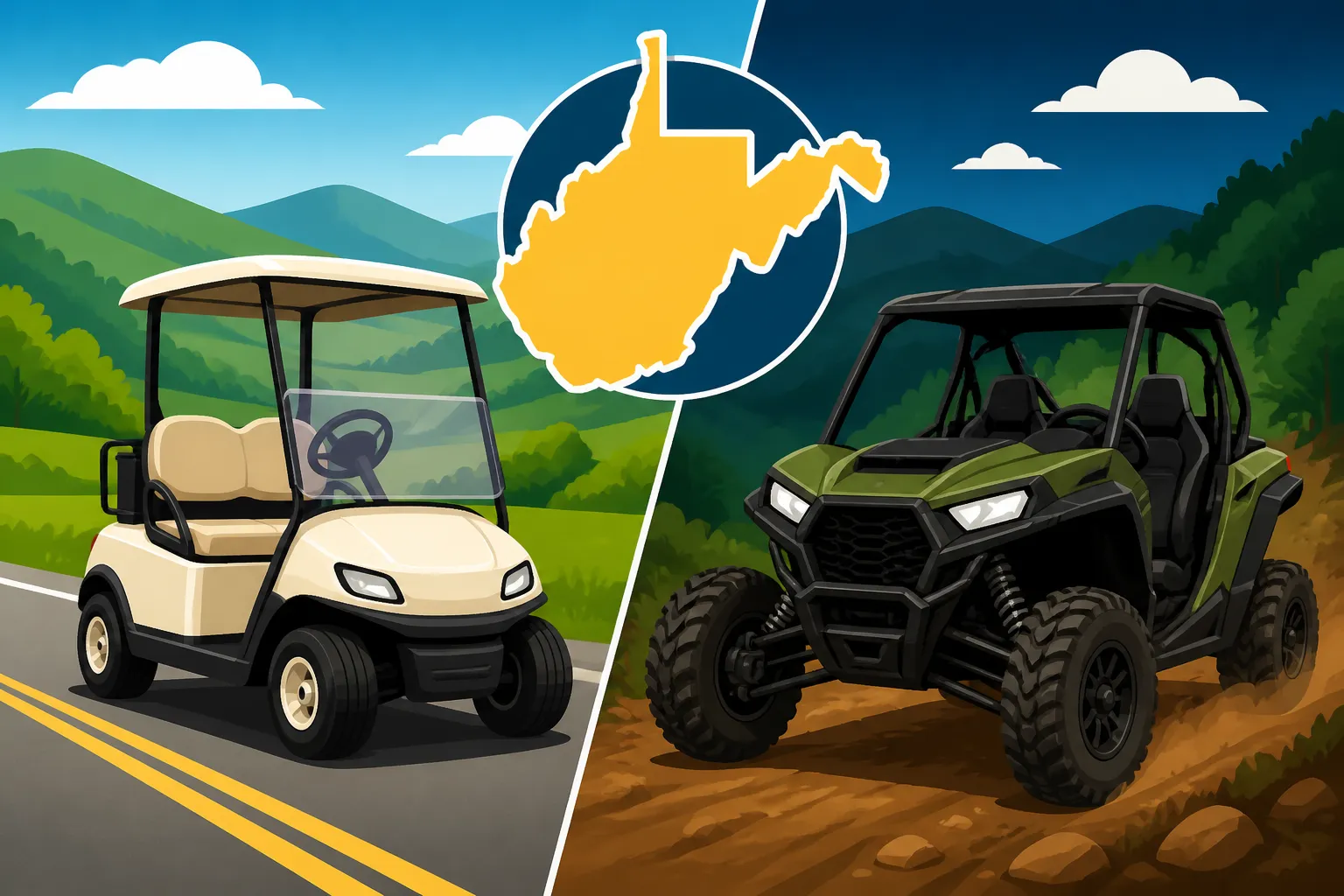
Golf Carts on a West Virginia Community Road
There's nothing quite like the convenience and charm of zipping around your neighborhood in a golf cart, especially when you live in a close-knit community or near amenities you frequent. For many West Virginia residents, the dream of using their golf cart for more than just the back nine — perhaps for a quick trip to a friend's house, the community pool, or even a local store — is very real. However, the reality of navigating West Virginia's laws regarding golf carts on public roads can feel like trying to hit a moving target. This guide will help you understand the nuances of state and local regulations, outlining what it takes to legally drive your golf cart on West Virginia community roads, what equipment you'll need, and the important distinctions to keep in mind.
The General Rule: Are Golf Carts Even Allowed on West Virginia Community Roads?
It's a question many golf cart owners ask, often with a mix of hope and trepidation. The short answer in West Virginia is: it's complicated, but often yes, under specific circumstances and usually at the discretion of local authorities. Unlike dedicated off-road vehicles which have their own set of rules, golf carts occupy a unique space in the eyes of the law, primarily due to their original design purpose and lower speed capabilities.
The State's Stance on General Road Use
At the state level, West Virginia law doesn't explicitly make all golf carts street-legal right out of the box for general public road use. Instead, the state largely categorizes standard golf carts as recreational vehicles intended for golf courses or private property. However, it does provide a pathway for golf carts to become street-legal by reclassifying them as "Low-Speed Vehicles" (LSVs). This distinction is critical. A golf cart, in its basic form, is typically limited to golf courses or private property. To venture onto public roads, it usually needs to undergo a transformation, meeting specific safety and equipment standards set by the state to qualify as an LSV. Without this classification, you're generally restricted to private land.
This might feel frustrating if you just want to drive your cart a few blocks, but it's rooted in safety. Golf carts aren't built with the same crash protections or visibility features as standard automobiles. The state's approach aims to ensure that if these vehicles are sharing space with cars, they have at least a baseline of safety features to protect their occupants and other drivers. It's a pragmatic approach to integrate slower, lighter vehicles into the existing road network.
Local Ordinances: Where the Rules Really Live
While the state sets the framework for what makes a vehicle a Low-Speed Vehicle, the actual authority to permit golf cart use (even non-LSV golf carts) on local community roads often falls to individual municipalities, counties, or even planned communities. This is where the landscape gets incredibly varied. What's perfectly legal in one town might lead to a citation just a few miles down the road. You absolutely must check with your specific city hall, county commission, or homeowner's association. [Golf Cart Ordinances in West Virginia Towns] can differ widely, so don't assume your neighbor's rules apply to you.
Many West Virginia towns, especially those with tight-knit communities, retirement villages, or areas adjacent to trail systems, have recognized the utility and desire for golf cart use. They may pass specific ordinances allowing golf carts on certain community roads, often with speed limits of 25 mph or less, and sometimes with additional local equipment requirements beyond state LSV standards. These local rules are typically created to enhance local mobility and quality of life, acknowledging that in some areas, golf carts are less a novelty and more a practical mode of local transport. It's not uncommon for these ordinances to specify particular roads, hours of operation, or even permit systems for residents.
Understanding the "Low-Speed Vehicle" Distinction for Road Legality
If your goal is to consistently and legally drive your golf cart on public roads in West Virginia, understanding the Low-Speed Vehicle (LSV) classification is paramount. This isn't just a fancy name; it's a legal category that outlines precisely what safety equipment and operational standards a golf cart (or similar vehicle) must meet to be considered road-ready.
What Makes a Golf Cart a "Low-Speed Vehicle" in WV?
In West Virginia, a Low-Speed Vehicle is formally defined as a four-wheeled vehicle whose top speed is greater than 20 miles per hour but not greater than 25 miles per hour. This speed range is key. If your golf cart can't hit 20 mph, or if it can exceed 25 mph, it doesn't fit the LSV definition. If it goes faster than 25 mph, it usually needs to be titled and registered as a full-fledged car, which is an entirely different (and much more complex) process. The LSV designation is designed for those vehicles that are slower than typical traffic but still capable of keeping up with minimal flow on certain low-speed roads.
To be an LSV, your golf cart needs to be manufactured to meet federal safety standards for low-speed vehicles, or you'll need to upgrade it significantly to meet specific requirements. This isn't a casual endeavor; it's about making sure your cart is visible, audible, and capable of basic signaling, similar to a car. These modifications are often what gives owners pause, as they can represent a significant investment beyond the initial cost of the golf cart. Without meeting these strict criteria, your cart, no matter how shiny, remains just a golf cart in the eyes of state law, confined mostly to private property. [Golf Carts and West Virginia Title Rules] can give you an idea of the process.
The Essential Equipment for Road-Legal Status
Converting your standard golf cart into a legal Low-Speed Vehicle requires specific equipment, ensuring it can safely share the road. This isn't an optional checklist; it's a mandatory one if you want to drive legally beyond private land. Here's what's typically required:
- Headlamps: You need working headlamps that are visible from at least 500 feet, designed for nighttime visibility, not just decorative use.
- Taillamps: Red taillamps are necessary, visible from at least 500 feet to the rear.
- Stop Lamps (Brake Lights): When you hit the brakes, lights must illuminate to warn drivers behind you.
- Turn Signal Lamps: Front and rear turn signals are essential for indicating your intentions to other drivers.
- Reflex Reflectors: These augment your visibility, especially from the sides and rear, further reducing blind spots for other vehicles.
- Exterior Mirrors: At least one exterior mirror mounted on the driver's side, or an interior mirror providing a clear view to the rear if your cart has a windshield that allows it. Many prefer two exterior mirrors for better situational awareness.
- Parking Brake: A fully functional parking brake is a must for securing the vehicle when stopped.
- Horn: A working horn is needed to alert pedestrians or other drivers to your presence.
- Safety Glazing Windshield: The windshield must be made of safety glazing material, meaning it won't shatter into dangerous shards in the event of an impact. A flimsy plastic shield won't cut it.
- Vehicle Identification Number (VIN): Like any road-going vehicle, an LSV must have a VIN. If your golf cart doesn't have one that meets DMV standards, you might need to apply for a state-issued VIN.
- Seat Belts: All seating positions must be equipped with seat belts. This is a critical safety feature, often overlooked on recreational golf carts.
You might find yourself needing to purchase aftermarket kits to bring your golf cart up to these standards. Companies like SuperATV offer a variety of universal lighting kits, turn signal kits, and mirrors that can help you meet these requirements. Always ensure any aftermarket parts meet DOT (Department of Transportation) standards if applicable, and that they are installed correctly. Keep in mind that beyond the equipment, your vehicle will need to pass an inspection if it's not originally manufactured as an LSV. [Equipment a West Virginia SPV Must Carry] is a good read for comparison, as SPVs also have specific gear needs.
Navigating the Specifics: Where and How You Can Ride
Once your golf cart is properly equipped as a Low-Speed Vehicle (LSV) and registered, or if your local community has specific ordinances for golf cart use, you still need to know the limitations on where and how you can actually ride it on West Virginia community roads. It's not a free-for-all; there are rules designed to integrate these slower vehicles safely into the existing road infrastructure.
Permitted Road Types and Speed Limits
A registered LSV in West Virginia is generally permitted to operate only on roads with a posted speed limit of 35 miles per hour or less. This is a critical restriction. You cannot take your LSV onto highways, interstates, or any road where the traffic typically flows faster than 35 mph. The rationale is clear: LSVs, with their maximum speed of 25 mph, would impede traffic and create dangerous situations on higher-speed roads. The intention is for LSVs to be used in residential areas, within town limits, or on designated community roads where traffic is naturally slower.
Furthermore, even on roads under 35 mph, local municipalities can impose stricter limitations. Some towns might designate specific "golf cart friendly" routes, prohibiting them on main thoroughfares even if the speed limit technically falls within the state's 35 mph threshold. Always double-check [West Virginia Golf Cart Ordinances in West Virginia Towns] before you venture out, as ignorance of local law is not an excuse for a citation. These local rules often consider traffic volume, road design, and safety concerns unique to that community. For example, a town might allow golf carts on residential streets but prohibit them on a busy street with blind curves, even if both are posted at 25 mph.
Driver Requirements and Operational Rules
Operating an LSV, even a golf cart modified to be one, isn't something just anyone can do. In West Virginia, the driver of an LSV on public roads must possess a valid driver's license. This means a learner's permit or a junior operator's license might not be sufficient; you need a full, unrestricted license. This requirement underscores the state's view that operating any vehicle on public roads requires a certain level of skill, knowledge of traffic laws, and accountability. [Driver's License Rules for West Virginia Road Riding] clarifies this for ATVs and often applies similarly to LSVs on public roads.
Beyond having a license, standard rules of the road apply:
- Obey all traffic laws: This includes stop signs, traffic lights, and yield signs. You are a vehicle in traffic.
- Maintain a safe speed: While your cart can go up to 25 mph, you should always adjust your speed to conditions, especially in residential areas or when children are present.
- Stay to the right: Allow faster traffic to pass safely.
- Use turn signals: Indicate your intentions clearly and well in advance.
- No distracted driving: Just like in a car, avoid using your phone or other distractions while operating an LSV.
- Seat belts are mandatory: All occupants must wear their seat belts if the LSV is so equipped (which it must be to be street legal).
- Nighttime driving: If allowed by local ordinance and your LSV meets all lighting requirements, exercise extreme caution. LSVs are smaller and harder to spot than cars, even with proper lights.
It's also worth noting that some communities might have specific rules for young riders, even if they're passengers. While [West Virginia ATV Road Rules for Young Riders] are primarily for ATVs, they highlight the general concern for youth safety on public thoroughfares.
| Feature | Standard Golf Cart (Typical) | Low-Speed Vehicle (LSV) in West Virginia |
|---|---|---|
| Purpose | Golf courses, private property | Public roads (under 35 mph posted) |
| Top Speed | Varies, usually under 20 mph | 20-25 mph |
| Required Title/Registration | No, for private use | Yes, as a Low-Speed Vehicle |
| Headlights | Often optional, basic | Yes (DOT-compliant) |
| Taillights/Brake Lights | Often optional | Yes (DOT-compliant) |
| Turn Signals | No | Yes |
| Windshield | Usually plastic, non-safety | Yes (Safety glazing material) |
| Seat Belts | No | Yes, for all seating positions |
| Mirrors | Often one rearview | At least one exterior (driver's side) |
| Horn | No | Yes |
| Driver's License | Not required (on private land) | Yes (valid, unrestricted) |
| Insurance | Homeowners or specific policy | Required (liability, at minimum) |
Common Pitfalls and Important Considerations for Golf Cart Owners
Navigating the rules for golf carts on West Virginia community roads can feel like a maze, and there are several areas where owners often get tripped up. Being aware of these common pitfalls and understanding the practical considerations can save you from fines, accidents, or the disappointment of realizing your golf cart isn't truly road-ready.
Insurance and Safety: Beyond the Letter of the Law
Even if your golf cart is a fully-fledged, registered Low-Speed Vehicle, don't overlook the crucial aspects of insurance and overall safety. While West Virginia requires liability insurance for any motor vehicle operating on public roads, golf carts, even as LSVs, sometimes fall into a gray area with standard auto policies. You must ensure your LSV is properly insured. Do not assume your homeowner's policy covers incidents when your golf cart is off your property and on a public road. A specific LSV or recreational vehicle policy might be necessary. Getting caught without insurance could lead to severe penalties. [Insurance Required for a West Virginia SPV Plate] is a good reference point for the type of coverage needed for other specific vehicles on the road.
Beyond legal requirements, personal safety is paramount. LSVs lack the crumple zones, airbags, and robust chassis of a typical car. Defensive driving is critical. Always assume other drivers don't see you. Wear bright clothing, especially if riding near dusk or dawn. Even with proper headlights and taillights, your small profile can make you less noticeable than a full-sized vehicle. Consider adding extra reflective tape or an orange flag for enhanced visibility, particularly if you're riding in areas with varied terrain or limited sight lines.
When a Golf Cart Isn't a Low-Speed Vehicle
One of the biggest misunderstandings is treating a golf cart that looks like an LSV as if it is an LSV. Many people add lights, a horn, and even a windshield to their golf carts for convenience or aesthetic reasons, but without going through the formal process of meeting state LSV definitions, getting it inspected (if required), and properly [Registering a Low-Speed Vehicle in West Virginia], it's still just a golf cart. This means it's generally not legal for public road use, even on community roads. The mere presence of equipment does not equate to legal street-worthiness.
Another common scenario involves golf carts that have been modified to go significantly faster than 25 mph. If your cart is souped-up and can hit 30, 40, or even 50 mph, it immediately falls outside the LSV definition. At that point, it may be classified as a motor vehicle, requiring full automotive safety standards, titling, and registration, which golf carts are rarely designed to meet. Attempting to pass off a high-speed golf cart as an LSV can lead to serious legal trouble. Always be honest about your cart's capabilities and ensure it truly fits the legal parameters for an LSV if you plan to use it on West Virginia's community roads.
Finally, remember that specific communities might have their own distinct local rules. Some towns might explicitly prohibit golf carts altogether, even if they meet LSV standards, or only allow them during certain hours or on specific routes. Other communities, particularly planned developments or retirement communities, might have internal rules that don't follow state LSV guidelines but are specific to their private roads. Always check local ordinances first, as they can sometimes be more restrictive (or occasionally more permissive, on private roads) than state law, particularly regarding neighborhood golf cart usage.
Disclaimer
This article is for general informational purposes only and does not constitute professional advice. Laws, prices and regulations vary by location and change over time. Consult a qualified professional for guidance on your specific situation.