Recovery and Towing on West Virginia Trails
A machine buried to its floorboards in a muddy hollow can turn a fun West Virginia ride into a stressful, risky situation fast. Recovery is harder when the trail is narrow, cell service is patchy, or other riders are approaching. This guide explains how to prepare, assess a stuck or disabled ATV or UTV, recover it as safely as possible, and arrange help when it cannot move under its own power.
Prepare for Recovery Before You Ride
Carry gear that matches your machine and trip
A basic recovery kit can save time, but only if its components are suitable for your ATV or UTV and used as intended. Start with a recovery strap or winch line rated for the work, soft shackles or other compatible connectors, gloves, and a way to protect a tree if you may need to use one as an anchor. Follow the equipment and vehicle manufacturers’ instructions; a strap that is damaged, poorly matched, or attached to an unsuitable point can fail under load.
A winch can help with a controlled pull, but it is not a guarantee that every recovery will be safe. Check the winch line, hook or connector, mounting point, and remote before leaving. If you ride with a partner, agree on simple signals and make sure both of you know how to stop the winch. A passenger should not be asked to stand near a loaded line or guide a pull from a position where a snapped line or moving vehicle could reach them.
Pack practical support items too: a tire repair kit appropriate for your tires, a compact air source, basic hand tools, a flashlight, water, first-aid supplies, and a charged phone or other communication device. The right kit depends on the length and remoteness of the ride. [What to Carry on a Remote West Virginia Ride] offers a useful starting point for thinking through what belongs in your machine.
Plan around terrain, weather, and communication gaps
West Virginia trails can combine steep grades, slick rock, mud, tight turns, and creek crossings. Conditions that seem manageable on a dry morning may change after rain, when runoff softens the trail or raises water over a crossing. Check posted trail information before setting out and avoid assuming that a familiar route will have the same grip or water level each time. For a closer look at common obstacles, read [Mud, Rock and Creek Crossings in West Virginia] and [West Virginia Trail Conditions After Rain].
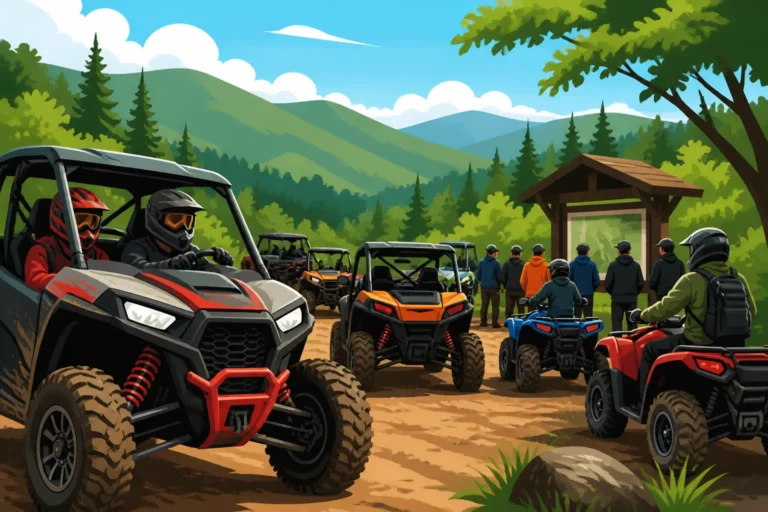
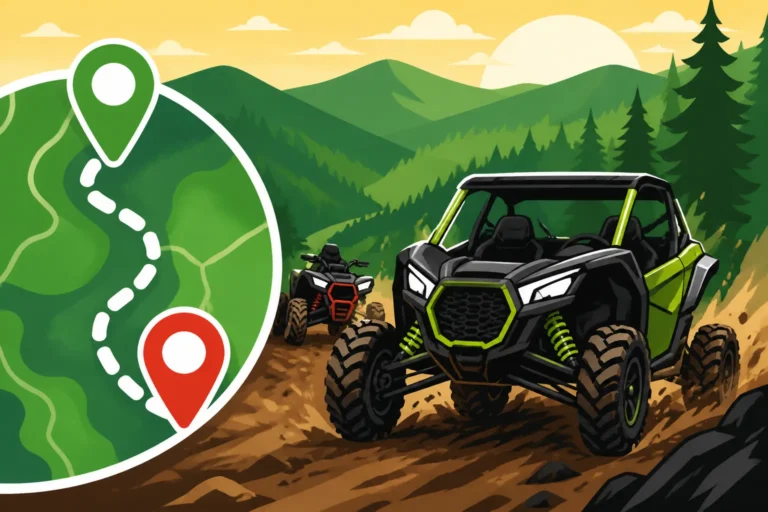
Discuss a recovery plan before the group splits up or enters a difficult section. Decide who carries the recovery gear, how the group will communicate, and where to regroup if someone has to stop. On a route around Gilbert, Logan, Matewan, or Pineville, a nearby town does not necessarily mean a phone will work from every hollow or ridge. Save key information for offline use where possible. A tool such as onX Offroad can help riders plan routes and keep map information available when they have prepared it for offline use, but it should not replace posted trail signs, local guidance, or a paper backup.
Before you ride, tell someone who is not on the trip where you expect to go and when you plan to check in. If the plan changes, update them when you have service. Cell coverage can be inconsistent in remote riding areas, so consider how your group will get help if a phone call is not possible. [Cell Service on the Hatfield-McCoy Trails] and [Trail Rescue in West Virginia and Who Responds] can help you think through that part of trip planning.
| Situation | First priority | Avoid |
|---|---|---|
| Machine is stuck but appears undamaged | Check people, footing, and the recovery point before a controlled pull | Spinning tires or pulling from an unapproved point |
| Machine has a flat or mechanical problem | Move people out of traffic and assess whether a safe trail-side repair is possible | Continuing to ride on a damaged tire or ignoring a fluid leak |
| Machine is tipped, unstable, or near water | Keep people clear and call for experienced help if the scene is unsafe | Standing downhill, reaching under the machine, or rushing to right it |
| Group cannot safely move the machine | Share your location and arrange help through appropriate local channels | Leaving an injured person or abandoning the machine without a plan |
Recover a Stuck ATV or UTV Carefully
Stop, secure the scene, and assess what is happening
When a machine bogs down, the instinct is often to hit the throttle or pull immediately. Pause first. Check that everyone is accounted for, look for injuries, and make sure no one is standing in the path of the machine or recovery line. If you are on a narrow trail, keep the group visible and out of the way of approaching riders. Use a spotter only if that person can stand well clear of the pull and communicate without stepping into a hazard.
Work out why the machine is stuck. Is a tire buried in mud, is the chassis resting on a rock, or is the machine angled on a slope? Is water moving nearby? Is a tire damaged, or is there a warning light, unusual smell, or fluid leak? A simple loss of traction is different from a machine that is hung up, unstable, or mechanically damaged. If the ATV or UTV is leaning sharply, partly submerged, or close to a drop-off, do not treat it like an ordinary mud recovery.
Take a moment to choose a route out that does not create a new problem. A short pull toward firmer ground may be safer than trying to reverse along the exact line that caused the machine to get stuck. Avoid damaging trail edges, cutting around a marked route, or crossing land that is not open to riders. Stay alert to trail markers and barriers; [Staying on Marked Trails in West Virginia] is a useful reminder that a recovery does not make an unauthorized shortcut acceptable.
Use a controlled pull and keep everyone clear
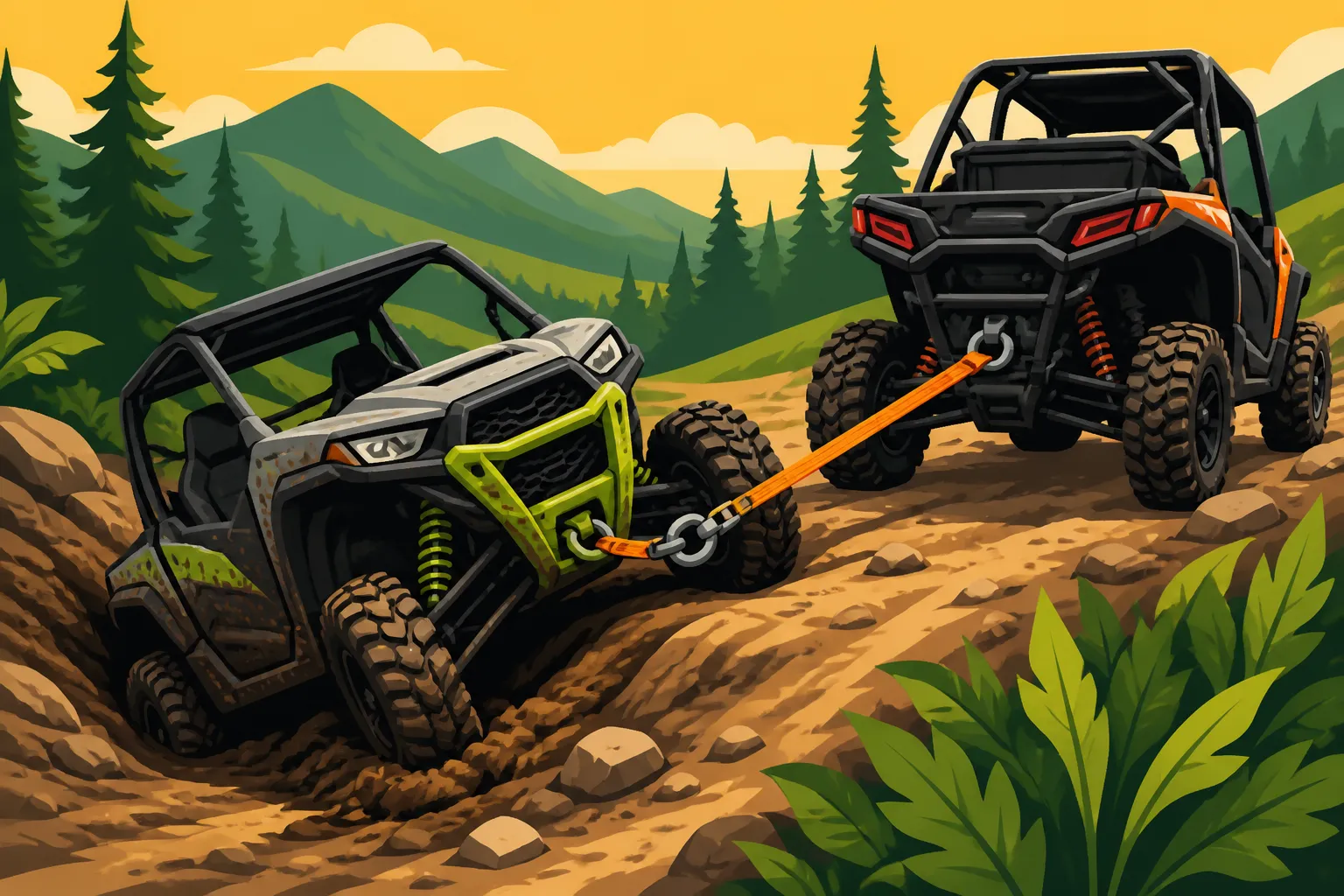
Attach recovery equipment only to manufacturer-approved recovery points. Do not use a hitch ball, an improvised frame point, or a part that is not designed to take a pulling load. A ball or unsuitable attachment can break free under tension. If you do not know where the approved points are, stop and consult the owner’s manual or get help from someone qualified rather than guessing.
Before applying tension, remove slack gradually and check that the line is clear of sharp edges and pinch points. Keep people well away from the line, its connectors, and the likely path of either machine. No one should straddle a loaded strap, hold it by hand, or stand between the stuck vehicle and the pulling vehicle. Use a spotter at a safe distance, and agree that anyone can call “stop” if the line shifts, a vehicle moves unpredictably, or the anchor begins to fail.
Use small, controlled movements rather than a hard acceleration. If the machine does not move, stop and reassess. More force is not always the answer; it can damage the stuck machine, the pulling vehicle, the trail, or the recovery equipment. For a winch pull, follow the winch manufacturer’s directions and keep hands away from the line while it is under tension. If the load is angled or the anchor point is questionable, do not continue simply because the equipment is already attached.
A tree may be a useful anchor only when it is appropriate and protected. Use a tree-saver strap rather than wrapping a winch line or chain around the trunk, and consider whether the tree, soil, and pull direction can safely handle the load. Never assume that a small tree, loose rock, or another machine is a reliable anchor. If the pull requires equipment or experience your group does not have, step back and arrange assistance.
Handle Breakdowns, Tipped Machines, and Difficult Terrain
Know when a trail-side fix is reasonable
A minor issue may be repairable beside the trail if the area is stable, the group can work without blocking other riders, and the repair is within someone’s skills. A small puncture, loose accessible component, or drained battery may have a straightforward solution if the right tools and supplies are available. Keep people out of the travel path while work is underway, and do not leave tools or parts where another rider could hit them.
Some signs mean it is time to stop trying to ride: a damaged steering or suspension part, a brake problem, a tire that will not hold air, a hot engine, an active fluid leak, or a machine that makes a new grinding or knocking noise. A machine that can move does not necessarily remain safe to ride. Trying to limp it farther may worsen the damage or make control unpredictable, especially on a steep or rocky section.
For a mechanical problem, record the machine’s location and describe what happened before you call for help or contact your riding group. A clear description is more useful than “we’re stuck somewhere on the trail.” Note the trail system, trail name or number if visible, nearest junction or landmark, and whether anyone is injured. If the machine is off the trail, say whether it can be approached without special equipment. When communication is available, an offline map app such as onX Offroad may help you identify and share a location, but compare what you see with trail signs and landmarks on the ground.
Treat a tip-over or water hazard as a safety incident
A tipped machine creates hazards beyond the inconvenience of getting it upright. First check the occupants for injuries and do not move someone who may have a serious injury unless staying put presents an immediate danger. Keep bystanders away from the machine, especially if it is on a slope or unstable ground. A UTV can shift unexpectedly as its weight moves, and an ATV may roll farther if it is not secured.
Do not stand downhill from an unstable machine or reach under it to pull someone free. If a person is trapped, injured, or in immediate danger, contact emergency services when possible and give the most precise location you can. If the machine is in water, keep people away from current, submerged obstacles, and unstable banks. Do not wade into a crossing to attach a strap if you cannot judge the depth or footing safely. A machine recovery is not worth creating a second emergency.
After the people are safe, decide whether a recovery is within your group’s ability. Righting a machine can involve significant weight, awkward leverage, fuel or fluid concerns, and a risk of it rolling again. Follow the manufacturer’s guidance for your machine. If the ground is steep, the vehicle is badly damaged, or the group cannot control its movement, wait for experienced assistance rather than improvising a pull.
For difficult conditions, local trail staff or qualified recovery help may be more appropriate than a fellow rider with limited gear. The availability and response method can vary by location and circumstances, so do not assume that help will arrive quickly or that a trail authority provides towing. [Trail Rescue in West Virginia and Who Responds] is relevant reading for understanding why it is important to plan before trouble starts.
Arrange Towing and Get Home Safely
Share a useful location and request the right kind of help
Before calling, gather the details someone will need to make a sensible plan. Give the trail system, the closest trail marker or junction, your direction of travel, the number of people in the group, and whether there are injuries. Explain whether the vehicle is stuck, broken down, tipped, or blocking the route. Mention if it is a full-size side-by-side, a smaller ATV, or a trailer-mounted machine, because access and loading needs can differ.
If you can safely do so, send a location pin and also describe visible landmarks. A pin can be inaccurate when service is weak or a device has not downloaded map information; a trail sign, junction, bridge, or nearby access point helps someone confirm they are in the right place. Keep your phone available for follow-up and conserve its battery if you are far from a reliable signal. If no call will go through, move only if the group can do so safely and without losing contact with an injured or stranded person.
When you request towing, be clear about where the machine is and what equipment may be required to reach it. A road-going tow truck may not be able to enter a narrow trail, and a recovery vehicle may need an authorized access route. Do not direct someone onto a closed trail, private property, or a route they are not permitted to use. If the machine is near a trail junction, move it only if it can be done safely and without creating another hazard.
Tow only from suitable points and follow trail access rules
Towing a machine behind another ATV or UTV is different from recovering one that is briefly stuck. Before towing, check the owner’s manual for approved towing points and limits. Use equipment designed for the task, keep the tow line as short and controlled as practical, and agree on signals between drivers. The operator in the disabled machine must be able to steer and brake as needed. If it cannot be controlled, towing it with a strap may put both riders and other trail users at risk.
Do not tow a machine if its steering, brakes, wheels, or frame are compromised in a way that prevents safe control. Do not attach a line to a bumper, rack, or other part unless the manufacturer identifies it as suitable. If the machine cannot be pulled without dragging it over rocks, forcing it around a tight turn, or risking a rollover, stop and arrange an appropriate recovery vehicle. A rough, improvised tow can turn a repairable breakdown into extensive damage.
Keep the group together and communicate with riders approaching from both directions if the trail is obstructed. Do not leave a person alone with an unsafe vehicle while others go for help unless you have made a safe, clear plan. When you reach an approved access point, arrange transport suitable for the machine and confirm that the trailer, ramps, and tie-down points are appropriate. Secure the ATV or UTV according to the equipment manufacturers’ instructions before traveling on public roads.
Recovery also comes with a responsibility to protect the trail. Avoid widening the route, pulling trees or rocks into it, or leaving broken equipment and trash behind. If a trail is blocked or damaged, report the issue through the appropriate trail system contact and follow any posted closure directions. For a broader look at planning a trip where help may be far away, see [Riding Alone on a Hatfield-McCoy Trail] and [West Virginia Trail Maps and Signage].
Disclaimer
This article is for general informational purposes only and does not constitute professional advice. Laws, prices and regulations vary by location and change over time. Consult a qualified professional for guidance on your specific situation.