Holiday Weekend Crowds at West Virginia Trailheads
Holiday weekends can turn a West Virginia trailhead into the slowest part of your ride: trailers are maneuvering for space, groups are trying to meet up, and a delayed start can squeeze your time on the trails. A little planning helps you avoid the worst bottlenecks, choose a practical starting point, and keep your group together once you leave the parking area.
Why West Virginia Trailheads Get Busy on Holiday Weekends
The crowding starts before you reach the trails
On a holiday weekend, the pressure builds at several points at once. Riders arrive with trucks, trailers, and sometimes more than one machine. A single parking space may take longer to claim when someone has to back a long trailer into it, unload a side-by-side, and secure the tow vehicle. Add friends arriving separately or a group waiting for one late rider, and the lot can feel crowded even before anyone turns toward a trail.
The approach to the trailhead can become part of the delay, too. Roads into southern West Virginia riding areas may be narrow, hilly, or unfamiliar to visitors. A line of vehicles moving slowly behind a trailer is not unusual on a busy arrival day, and it can be stressful if you are trying to follow directions, watch for oncoming traffic, and keep a riding group together. Build extra time into the drive rather than assuming the last few miles will take as long as your navigation estimate suggests.
Places such as Gilbert, Williamson, and Pineville draw riders planning trips around nearby trail systems. That does not mean every lot in those areas will be full, or that one town is always busier than another. It does mean you should check where you intend to start, confirm that your machine is permitted there, and avoid treating a familiar town name as a guarantee of open parking. The practical details are covered in Hatfield-McCoy Trailheads and Where to Start and West Virginia Trailhead Parking That Fits a Toy Hauler.
Holiday traffic affects the whole ride plan
A crowded trailhead can shift your schedule in ways that are easy to underestimate. If unloading takes longer, your group may set off later than planned. If you are meeting another party, waiting for them may push the start back further. Later in the day, riders may return to the same busy lot at once, creating another round of congestion around loading, trailer positioning, and departures.
Crowds can also affect the trails themselves. More machines on shared routes mean you may encounter other groups at narrow sections, intersections, or places where riders stop to regroup. That is a reason to ride at a pace your group can manage, leave room between machines, and resist the urge to rush because the day started late. On an unfamiliar route, a slow start is usually safer than trying to make up time.
Think about the day as a full sequence rather than just “drive there and ride.” Include time for parking, unloading, checking permits and gear, eating, refueling if needed, and loading back up. If you are staying nearby, Overnight Trailer Parking Near West Virginia Trails can help you think through where the trailer will be kept outside the trailhead lot. For choosing a less hectic day when your schedule allows, see Weekday Riding at Hatfield-McCoy.
Plan Your Arrival Before You Leave Home
Choose a trailhead that fits your group and equipment
The best starting point is not necessarily the closest one. Consider the size of your tow vehicle and trailer, how many machines you are bringing, whether everyone in the group knows how to unload efficiently, and how much trail time you actually want. A compact vehicle and one ATV may be able to use a space that would be awkward for a long trailer and a wide side-by-side. If you are hauling a toy hauler, confirm that the parking arrangement can accommodate it instead of assuming every trailhead has room to turn around.
Match the starting point to your group’s riding ability, too. A group with first-time riders may need a different route plan from experienced riders hoping for a longer, more technical day. On a busy weekend, splitting up without agreeing on a meeting place can make an already crowded day harder. Decide in advance whether everyone will ride together, what to do if someone needs to stop, and which trailhead or landmark will be your regrouping point.
Trail access and parking arrangements can vary, so check current information through the relevant trail authority or local provider before committing to a location. A map app can help you understand the general approach, but it is not a substitute for confirming the correct trailhead, permitted access, and any closure notices. West Virginia Trail Maps and Signage offers a useful starting point for thinking about route information, while [Checking West Virginia Trail Status Before You Drive] is especially relevant when a long drive depends on access being available.
Use maps as a planning aid, not a promise
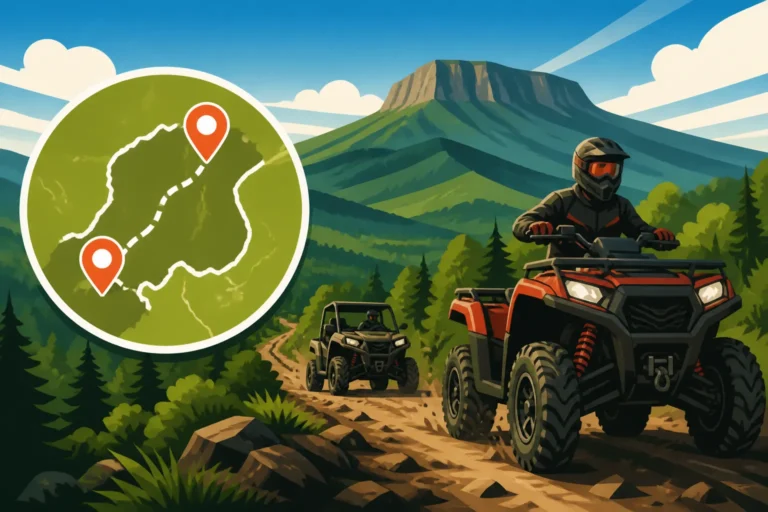
Digital mapping can help you compare routes, mark a planned meeting spot, and keep a general sense of where your group is headed. onX Offroad can be useful for reviewing route options and saving map information before you lose reliable cell service. Before departure, open the map, identify your intended trailhead, and make sure each rider understands the basic route plan rather than relying on one person’s phone.
Download or save what you need while you still have a dependable connection. Cell coverage can be inconsistent in mountain hollows and remote riding areas, and a map that depends on a live connection may not be much help when you need it. Carrying a paper map is a sensible backup, particularly for a group where not everyone has the same app or phone battery life. Carrying a Paper Trail Map in West Virginia explains why a non-digital backup can matter.
No map app can guarantee that a route is open, that a parking space will be available, or that a marked trail will be suitable for every machine. Use onX Offroad for orientation and preparation, then verify access and closures through official trail information. If someone in your group gets separated, agree on a simple response ahead of time: stop somewhere safe, avoid riding off-route to search, and use the plan you settled on before leaving the trailhead.
Make Parking and Unloading Less Stressful
Arrive with a realistic timing buffer
If you can choose your arrival time, aim to get to the trailhead early enough that a delay will not wipe out the ride. “Early” does not mean speeding or driving while tired; it means leaving home with enough margin for holiday traffic, a slower approach road, and a crowded parking area. If your group is traveling from different places, give everyone the same clear meeting time and location, and ask each driver to arrive with fuel, food, and gear sorted before reaching the lot.
Avoid making the trailhead the place where your group has its first full planning conversation. Assign simple jobs in advance: one person confirms permits, another checks helmets and eye protection, and each driver knows where to park and unload. A prepared group takes up less space and spends less time with vehicles blocking access while people search for gloves, straps, or paperwork.
Be patient when another driver is backing a trailer or loading a machine. A busy lot is a poor place to squeeze past a moving rig or leave a truck stopped across the only convenient lane. Follow posted instructions, keep access areas clear, and park only where allowed. If the lot is full, do not improvise by blocking a road, trail entrance, or neighboring property. Find an authorized alternative or adjust the plan.
Keep the loadout simple and the group organized
A holiday ride is easier when every machine has the essentials and no one has to make repeated trips between the truck and the trail. Pack helmets, eye protection, water, basic repair items, and the paperwork or permits your ride requires in a consistent place. Do a quick check of straps, tires, lights, and fuel before departure from home, then make a shorter final check at the trailhead.
| Before you leave | At the trailhead | Before the group rides out |
|---|---|---|
| Confirm the trailhead and access details | Park only in an authorized space | Check helmets and eye protection |
| Check trail status and weather | Keep roads and access lanes clear | Confirm the route and regrouping plan |
| Save maps for offline use | Unload without blocking other vehicles | Make sure everyone has water and essentials |
| Prepare permits and required documents | Secure the tow vehicle and trailer | Agree on what to do if someone gets separated |
Use onX Offroad or another navigation method to mark a meeting point that everyone can identify, but also describe it aloud. “We’ll meet at the marked junction after the first loop” is less helpful if riders are unsure which junction you mean. Pick a clear location shown on your map and make sure the group knows how to stop safely without obstructing other riders.
If parking conditions are too tight for your trailer or the group is arriving in many vehicles, consider reducing the number of vehicles where practical. Carpooling can make coordination easier and reduce the space your party needs, but only if the drivers agree on departure times and have enough room for people and gear. Never assume you can leave an extra vehicle in an overflow area unless that location is explicitly permitted.
Ride Safely When the Trails Are Busy
Expect other riders at junctions and narrow sections
On crowded days, slow down as you approach intersections, blind corners, and places where riders may stop to check a map or regroup. Do not assume that a trail is clear just because you cannot see around the next bend. Keep a manageable gap between machines, especially when dust, mud, or vegetation limits visibility. If your group is spread out, let the lead rider know before the last machine falls behind.
When you meet another group, give them space to pass and avoid crowding a stopped machine. Be considerate at narrow sections and on hills where it may be difficult for riders to safely move aside. A short pause to sort out who goes first is better than a rushed maneuver that leaves someone balancing on a steep or uneven spot. Keep conversations and regrouping stops out of the main travel line whenever possible.
Staying on marked routes matters even more when the trail is busy. Taking an unofficial shortcut to pass a slower group can create a safety problem and may put you outside authorized access. Follow posted signs and barriers, and check official notices if a route is closed. West Virginia Trail Etiquette on Shared Routes and Trail Closures on West Virginia's Trail System are useful reads before a high-traffic ride.
Have a backup plan for delays, separation, or changing conditions
A crowded weekend can bring small problems that disrupt the day: a rider may need a break, someone may take a wrong turn, or a delay at the trailhead may leave less time for the planned route. Set a turnaround time before starting, not after the group is already tired. If the day is running late, shorten the ride rather than trying to squeeze in a longer route near the end of your available daylight.
Do not count on every rider having enough battery, signal, or familiarity to navigate independently. Keep the group at a pace that works for its least experienced rider, and establish a safe stop-and-wait rule if people lose sight of one another. If someone is separated, the rest of the group should avoid scattering in different directions. Use the agreed meeting point and contact or emergency plan where available.
Before you leave home, check trail conditions and closure information again, especially if heavy rain or other changing conditions could affect access. A trailhead that was part of your plan earlier may not remain the right choice. A second approved starting point or a shorter route can save the day without pushing your group into unsafe or unauthorized areas. For more preparation advice, see What to Carry on a Remote West Virginia Ride and Getting Lost on a West Virginia Trail.
Disclaimer
This article is for general informational purposes only and does not constitute professional advice. Laws, prices and regulations vary by location and change over time. Consult a qualified professional for guidance on your specific situation.