West Virginia Trailhead Parking That Fits a Toy Hauler
A toy hauler can turn a West Virginia riding weekend into a lot more than a quick trail stop—but only if you can park, unload, and turn around without blocking the trailhead or getting stuck on a narrow mountain approach. This guide explains how to check whether a trailhead suits your rig, what to ask before you drive, and how to plan a practical backup.
Start with your complete rig, not just the trailer
Measure the whole combination
A toy hauler’s advertised length is only part of the parking calculation. You also need to account for the tow vehicle, hitch, and the extra room needed to pull forward or back into a space. A rig that fits in a straight parking spot may still be difficult to maneuver if the lot is tight or the approach is sharply angled.
Write down the length and width of your truck-and-trailer combination, including mirrors where relevant. Note the trailer’s height, turning needs, and whether you’ll need room to lower a ramp. If you’re traveling with a second vehicle or another trailer, include that in the plan rather than assuming you’ll find an open place to leave it.
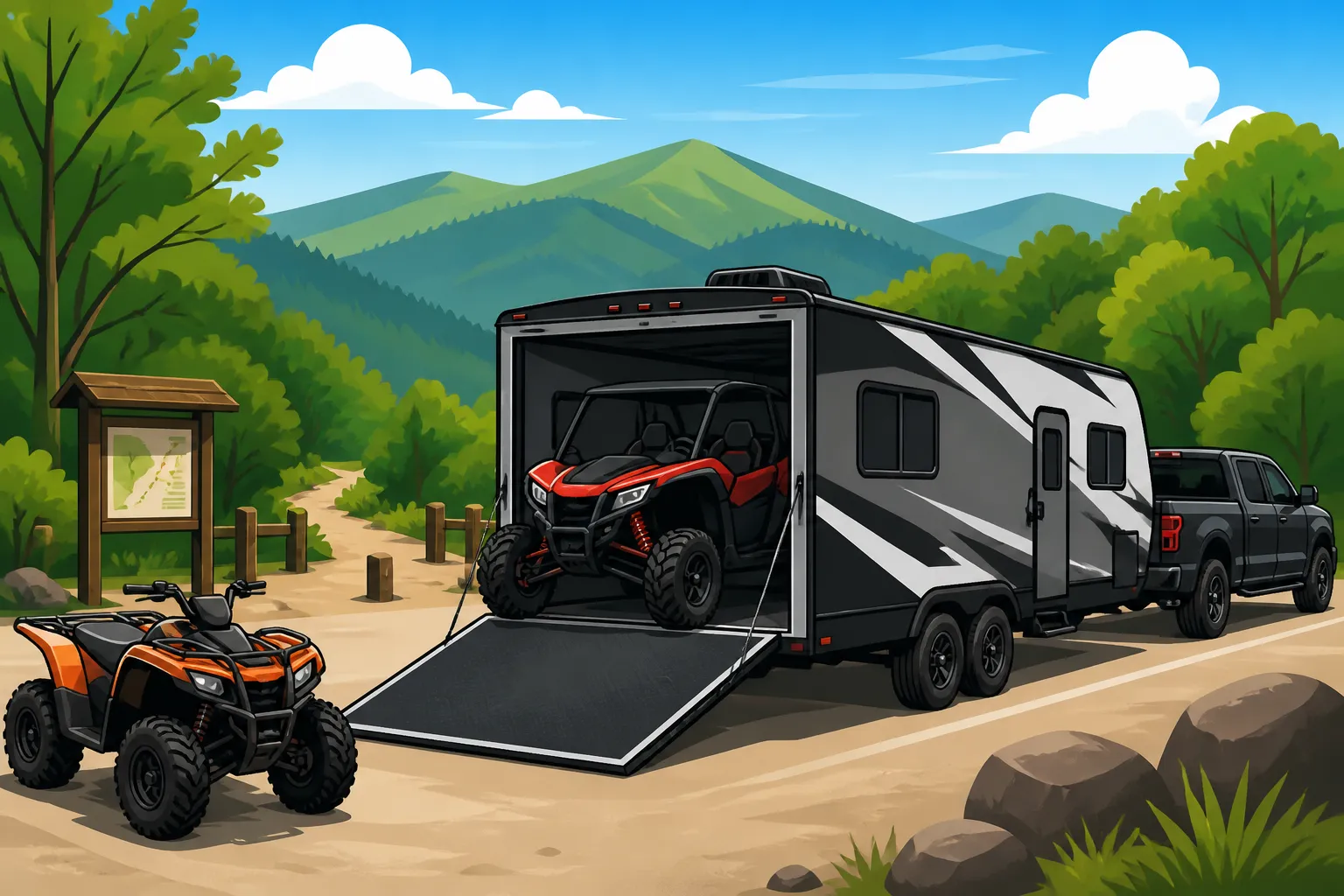
Think through the unloading routine, too. Will the ramp need to extend into a travel lane? Can you unload without blocking another vehicle? Do you need space to walk around the trailer safely? These details matter at busy trailheads, where another rider may arrive while you’re securing machines or moving gear.
Check access as carefully as the parking space
A roomy lot is no help if the road leading to it is difficult for your combination. In southern West Virginia, approaches can include steep grades, tight turns, narrow sections, and limited places to pull over. A route that looks short on a map may still be awkward for a long trailer, especially if you meet oncoming traffic.
Before setting out, check the route from the main road to the actual parking area. Look for low-clearance structures, sharp turns, construction, and any restrictions on trailers or large vehicles. Don’t rely on a phone’s default route without considering whether it is suitable for a truck towing a toy hauler.
Use [Hatfield-McCoy Trailheads and Where to Start] to narrow down which system or access area fits your itinerary, then confirm parking and approach details directly with the relevant trail operator, lodging provider, or local authority. A trailhead’s presence on a map does not guarantee that its lot accommodates a large rig.
Verify parking before you commit to a trailhead
Ask specific questions instead of asking whether parking is available
“Is there parking?” can get you an answer that’s technically true but not useful for a large trailer. Ask whether the lot can accommodate your full truck-and-trailer length, whether there is room to turn around, and whether parking is allowed for the duration you need. If you plan to unload at the trailhead, ask whether the layout leaves space to lower the ramp safely.
It helps to describe your rig in plain terms: truck plus toy hauler, approximate overall length and width, and whether you’ll be arriving with another vehicle. Ask about the surface and slope, too. A gravel or uneven area may be manageable for one rig but uncomfortable if you need to back in precisely or maneuver on a grade.
Make a note of who confirmed the information and when. If parking depends on a business, campground, or private lot, ask whether you need permission, a reservation, or a separate arrangement. Do not assume that a public trail access point permits overnight trailer storage just because riders use it during the day.
Compare the likely options
Parking needs differ by trip style. A same-day ride, a multi-day stay, and a group weekend each call for different arrangements. Use the table as a planning checklist, then confirm the actual rules and space with the property or authority responsible for the location.
| Parking option | Why it may work | What to confirm |
|---|---|---|
| Trailhead lot | Convenient for unloading and starting a ride | Full rig fit, turning room, surface, hours, and overnight rules |
| Campground or RV site | May offer a designated space for a large vehicle | Site dimensions, trailer access, machine storage, and trail connection |
| Cabin or lodging property | Can simplify parking during a multi-day stay | Whether the driveway fits your rig and whether trailers can remain there |
| Separate trailer parking | May help if the trailhead lot is too small | Permission, security, distance from the ride, and transport plan |
| Town parking | Could be useful for errands or a stop between rides | Local restrictions, trailer rules, and whether parking is allowed at all |
If you’re planning to stay close to the trails, [Cabins With Direct West Virginia Trail Access] and [Overnight Trailer Parking Near West Virginia Trails] can help you think through alternatives to leaving a toy hauler at a day-use lot. Treat any listing or general description as a starting point: ask for a specific site or parking area that can fit your rig.
Choose a parking plan around your riding area
Use the trail system and the town as a pair
It’s easy to focus on the trail system and forget that you also need a workable place to park, unload, and spend the night. Start with the riding area you want, then compare nearby towns and lodging options based on trailer access. Gilbert, Man, Logan, Pineville, and Williamson are names riders may encounter while planning southern West Virginia trips, but proximity alone does not tell you whether a particular lot suits a toy hauler.
For a ride based around Rockhouse, look into [Parking at the Rockhouse Trailhead] alongside any nearby lodging or parking arrangements. If you’re considering another area, [Pinnacle Creek Access From Pineville] and [Ivy Branch Trailhead Access] can help you identify access points to investigate. In each case, confirm the exact location and parking conditions rather than assuming that a trailhead name refers to a large, open lot.
A useful plan usually has a primary parking option and a backup. For example, you might arrange to park at a campground or lodging property, then ride from an approved access point. Or you may use a trailhead lot for the day and keep the trailer at a separate permitted location. The right choice depends on the rules, your lodging, and whether the route between parking and the trail is practical for your machines.
Use maps for orientation, not as proof of parking capacity
A mapping app can help you understand the general area, locate roads, and compare possible approaches. onX Offroad may be useful for reviewing your route and getting oriented around a riding area, but a map cannot confirm that a lot has enough turning space, that a gate is open, or that overnight parking is allowed. Verify those details with someone responsible for the property.
Look beyond the last turn on the map. Check whether the approach includes a steep or narrow stretch, whether there is a safe place to stop if you need to let traffic pass, and whether you can exit without a difficult backing maneuver. If you have concerns, ask for the name of the lot or access point and request directions suited to a truck and trailer.
Download or save your route information before leaving areas where cell service may be unreliable. A second map source or a written address can be helpful if an app reroutes you unexpectedly. [West Virginia Trail Maps and Signage] is also useful context for understanding how to prepare for navigation once you’re near the riding area. Keep in mind that trail maps are not parking permits or confirmation of vehicle access.
Make arrival, unloading, and departure safer
Arrive with a clear unloading routine
Before you pull into a busy lot, know where you intend to park and how you’ll unload. If the area is crowded, avoid stopping in a travel lane while you figure out the ramp or move equipment. Park only where permitted, check that the trailer is stable, and keep your machines and gear within the space you’re allowed to use.
Once the ramp is down, protect the area around it. Keep people clear of the loading path, and don’t let equipment spread into a neighboring space or access route. If a site is too tight to unload safely, use your backup location rather than trying to make an awkward setup work.
For a group, agree on roles before arriving. One person can guide the driver while another checks the space and watches for other vehicles. It’s much easier to coordinate in advance than to try to direct a long trailer while riders, pedestrians, and parked vehicles are moving around.
Plan your return and overnight storage before the ride
A trail day can run longer than expected, and a late return can make parking problems more stressful. Before you leave, know the lot’s closing rules, whether the property allows trailers to remain, and where you’ll go if the planned space is unavailable. Keep the contact details for your campground, lodging, or parking provider handy.
If you’re staying overnight, ask whether the trailer can remain connected to the tow vehicle, whether the machines can stay inside, and whether there are restrictions on using ramps or unloading after a certain time. These are property-specific questions, so get clear permission rather than relying on assumptions or another guest’s experience.
Use [Planning a West Virginia Riding Weekend] to build the parking decision into the rest of your trip. Include arrival time, unloading, fuel and food stops, and the route back to your overnight parking spot. A little planning can prevent the frustrating scenario of finishing a ride tired and discovering that the place you expected to leave your trailer is closed or unsuitable.
A practical pre-trip checklist
Before leaving home, work through these steps:
- Measure the full truck-and-toy-hauler combination and note its height and width.
- Choose the trail system and identify the exact access point you plan to use.
- Check the complete approach route for turns, grades, restrictions, and difficult road sections.
- Contact the trail operator, campground, lodging provider, or property manager to confirm parking details.
- Ask specifically about turning space, ramp use, overnight parking, and any required permission.
- Identify a backup place to park if the primary lot is full or unsuitable.
- Save directions and contact details where you can access them without cell service.
- Plan how your group will unload, secure the trailer, and return before any parking restrictions apply.
A toy hauler doesn’t need a perfect parking spot, but it does need a suitable one. Measure first, verify the approach and lot with the people responsible for it, and keep an approved backup in your plans. That way, the first challenge of your West Virginia riding weekend is less likely to be maneuvering a trailer in a crowded lot.
Disclaimer
This article is for general informational purposes only and does not constitute professional advice. Laws, prices and regulations vary by location and change over time. Consult a qualified professional for guidance on your specific situation.