West Virginia Trail Towns With Direct Trail Access
Choosing a West Virginia trail town is about more than finding a cabin near the mountains. Riders need to know whether trails actually connect to town, where machines can be unloaded, and which streets or routes are legal to ride. This guide compares several Hatfield-McCoy-area towns with nearby trail access and explains how to plan a trip without assuming every road is open to ATVs.
What direct trail access means in West Virginia
A trail town is not automatically open to every rider
“Direct trail access” can mean a few different things. A town may sit beside a designated trailhead, have marked connections that let riders reach local businesses, or simply be close to a trail system by truck. Those are not interchangeable. Before booking, ask exactly where you can unload and whether you can ride from your lodging to a permitted trail entrance.
Even in a well-known trail town, riders should not assume every public road is an ATV route. Street riding depends on local permissions and applicable state rules, and a trail permit does not make an unauthorized road legal. Check the town’s rules, the trail authority’s current notices, and any signs or barriers along the route. For the broader distinction between trail access and town riding, see [West Virginia Trail Towns You Can Ride Into] and [Riding an ATV on the Road in West Virginia].
Match the town to the trail system you want to ride
The Hatfield-McCoy network includes multiple trail systems spread across southern West Virginia. A town that is convenient for Rockhouse may not be the easiest base for Pocahontas or Pinnacle Creek. Think about your group’s riding ability, the machine’s width, and whether you want to spend most of the day on one system or make a longer trip between areas.
Start by locating the official trailhead that serves your planned system, then confirm how far it is from your lodging and trailer parking. A map app such as onX Offroad can help you compare the general layout and plan a route, but it should not replace official trail maps, posted signs, or closure information. For a network overview and a practical starting point, read [The Hatfield-McCoy Trails, West Virginia's 1,200-Mile Network] and [Hatfield-McCoy Trailheads and Where to Start].
Plan around access, permits, and closures
A trail permit is generally part of riding on the managed Hatfield-McCoy system, but it does not grant permission to ride off the marked route or onto adjoining private property. Trail conditions and access can also change. Before leaving home, check trail status and confirm which entrance is open for your chosen system. If you are traveling with an out-of-state machine, review the relevant trail and paperwork requirements rather than assuming your home-state registration answers every question.
A simple pre-trip check can prevent a frustrating first morning: verify the trail system, identify the exact trailhead, confirm lodging and trailer arrangements, and check the permitted route between them. [West Virginia Trail Maps and Signage] is useful for understanding how to follow the marked network once you arrive.
West Virginia trail towns to consider
| Town | Nearby riding area | Best fit | What to confirm before booking |
|---|---|---|---|
| Gilbert | Rockhouse and Braveheart areas | Riders seeking a busy trail-town base | Which trailhead and permitted town connections serve your lodging |
| Man | Bearwallow area | Riders who want a base near the Bearwallow system | Distance to the trail entrance and trailer parking |
| Williamson and Matewan | Buffalo Mountain area | Riders interested in the western part of the network | Current access points and any permitted town routes |
| Bramwell | Pocahontas area | Riders planning to explore the southern gateway | Which trailhead is most convenient for your stay |
| Pineville and Mullens | Pinnacle Creek area | Riders looking for access in Wyoming County | Exact unloading, lodging, and trailhead arrangements |
Gilbert for a lively base near Rockhouse
Gilbert is one of the best-known places to stay when Rockhouse is the main attraction. Its identity as a trail town makes it a natural choice for riders who want to be near trail access, lodging, food, and other trip essentials. The area also provides access to Braveheart riding, so it can work well for a group interested in more than one nearby option.
Do not book solely because a listing says “trail access.” Ask whether you can ride directly from the property, whether you must trailer to a trailhead, and where a truck and trailer can be parked overnight. Those details matter when you arrive late, have a wide side-by-side, or are traveling with several machines.
Gilbert can suit a mixed group because riders can plan shorter days as well as longer outings, depending on route choice and conditions. Before promising everyone a ride into town for lunch, confirm which connections are open and legal for your machine. For a route-specific look at a popular outing, see [Riding Rockhouse to Gilbert for Lunch]. If you are considering a longer day toward another area, [Riding From Gilbert to Man in a Day] can help frame the planning questions.
Man for a Bearwallow-area trip
Man is a useful base for riders whose plans center on the Bearwallow area. It gives visitors another option beyond Gilbert and can be appealing when the group wants to explore a different part of the trail network. As with any trail-town stay, “near the trails” does not necessarily mean a machine can travel from the cabin or campground to the system without using a trailer.
Ask the host or local operator to name the access point, not just the trail system. Get directions that account for your trailer, check whether the parking area can handle its length, and ask about any restrictions on moving machines through town. If your group plans to ride between systems, confirm that the route is an authorized trail connection and not simply a road that appears to link two places on a map.
Man may also work for a group that wants a quieter base and is comfortable arranging its own food and supplies. Plan those stops before you unload, especially if your lodging is outside the town center. [Riding From Gilbert to Man in a Day] provides a useful reminder that a ride between towns needs route, distance, and access planning—not just a destination pin.
Williamson and Matewan for Buffalo Mountain access
Williamson and Matewan are useful names to consider when Buffalo Mountain is high on the itinerary. The two towns are part of the western side of the Hatfield-McCoy riding area, and riders often look at them together when planning a visit. Your best choice depends on the exact trail entrance, where you find suitable lodging, and whether you want to ride into town or simply use it as a nearby service stop.
Before reserving, check the distance from the property to the official access point. A short drive on a road may be an easy trailer trip but not a legal ATV connection. Ask whether the lodging has secure parking for machines and trailers, and whether fuel and supplies are conveniently available without taking an unapproved route.
Matewan’s historic character may be part of the appeal, while Williamson can be a practical stop for travel and errands. Let the trailhead location—not the town’s reputation alone—decide which one makes sense for your group. For access-planning context, see [Riding Buffalo Mountain to Matewan] and [Buffalo Mountain Access From Williamson].
Bramwell for Pocahontas-area riding
Bramwell is worth considering for riders planning to explore the Pocahontas area. It offers a different base from the more frequently discussed Gilbert and Man options, and may suit visitors who want to build a trip around that part of southern West Virginia. As always, confirm the actual route from your lodging to the trail system rather than relying on a broad “near trail access” description.
The practical questions are familiar but important: Is there room to park a truck and trailer? Can machines be unloaded at the property? Is the trail entrance close enough to reach by an approved connection, or will you need to tow to it? A clear answer to those questions can save the group from losing the first morning to last-minute logistics.
If your group is making a multi-day trip, consider whether you want to stay in one town or move lodging between trail areas. Moving mid-trip can add packing and towing hassle, but it may reduce long drives to trailheads. See [Pocahontas Access From Bramwell] when comparing the area with other riding bases.
Pineville and Mullens for Pinnacle Creek
Pineville and Mullens are two towns to investigate if Pinnacle Creek is the main destination. The right choice may come down to the specific entrance, lodging availability, and how you plan to handle the trailer. A town name alone does not tell you whether a particular cabin or campground has direct access, so confirm the details with the property before paying a deposit.
Pineville can be a convenient starting point for understanding the system’s access, while Mullens may be a better fit depending on your route and overnight plans. Ask whether the property provides machine parking, whether the trailhead is reachable without using an unauthorized public road, and what services are nearby. If you are towing a long trailer, check access and turning space before arrival.
For a closer look at the area’s approach, read [Pinnacle Creek Access From Pineville]. You can also compare travel plans with [Riding Pinnacle Creek to Mullens] before deciding whether to stay put or make a town-to-town outing.
How to choose the right base for your group
Compare lodging by access, not by the headline
A listing that says “minutes from the trails” can describe a quick drive to a trailhead, not a rideable connection. Call or message the property and ask for the nearest official trail access point by name. Then ask whether riders can travel from the property to that entrance on a permitted route, or whether machines need to be hauled.
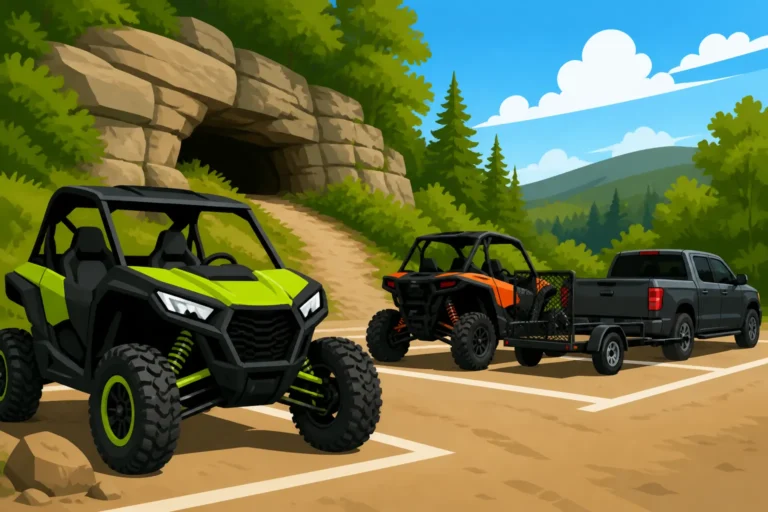
Also confirm trailer parking, unloading space, and overnight security. A small parking lot may be fine for a pickup but awkward for a truck towing a long enclosed trailer. If several families are traveling together, ask whether vehicles can be parked near the machines and whether there is room to turn around without backing onto a steep or narrow road.
Consider rider experience and machine size
The best town is not necessarily the one with the most famous name. A novice group may prefer a base that makes it easy to start with manageable routes and return without a long, difficult ride. Experienced riders may prioritize access to more technical terrain or a full day of exploring. For side-by-side owners, verify that the trails and access routes accommodate the machine’s width; do not assume every route suits every vehicle.
Build a realistic day around the least experienced rider. Agree on a turnaround point, carry water and basic recovery supplies, and avoid treating a trail map’s short-looking line as a promise of an easy ride. onX Offroad can be useful for reviewing a route before departure, especially when comparing trail locations, but riders should still follow official signs and the trail authority’s guidance.
Think through meals, fuel, and downtime
A convenient trail town can make a trip feel much easier when the group needs food, fuel, or a place to rest between rides. But services vary from town to town, and hours may not match your schedule. Check ahead for the essentials you rely on, and avoid planning a low-fuel ride around the assumption that a particular business will be open when you arrive.
It also helps to plan for a non-riding afternoon. Rain, mechanical trouble, a closure, or simple fatigue can change the day. Choose lodging where the group can relax, dry gear, and manage machines without creating a parking problem. For trip planning beyond the trailhead, [Fuel and Food Along West Virginia Trails] is a helpful companion.
A practical arrival and riding checklist
Before you book
- Choose the trail system that best fits your group and trip length.
- Identify the official trailhead or access point you expect to use.
- Ask lodging whether the connection is rideable or whether you must trailer.
- Confirm trailer dimensions, parking, unloading space, and overnight arrangements.
- Check that the trails suit your riders’ experience and your machine’s size.
- Review permits, trail rules, and current status before departure.
When you arrive
Walk through the route plan with your group before unloading. Make sure everyone knows the trailhead, the intended loop, and what to do if riders become separated. Follow posted signs and barriers, stay on marked trails, and do not use a road simply because it looks like the shortest way into town. If directions from a host and official trail signage appear to conflict, pause and verify the permitted route.
Keep a paper or offline map available in case phone coverage is unreliable. A digital map such as onX Offroad may help with orientation, but the posted trail information and official notices should guide decisions about access and closures. If the planned route is unavailable, choose an authorized alternative rather than improvising across private land or an unmarked connector.
A good West Virginia trail-town stay starts with one basic question: can your group legally and practically get from the place you are staying to the trails you intend to ride? Gilbert, Man, Williamson, Matewan, Bramwell, Pineville, and Mullens can each make sense for the right itinerary. Confirm the exact access, parking, and local riding rules before you commit, and the trip is far more likely to begin with a ride instead of a logistics scramble.
Disclaimer
This article is for general informational purposes only and does not constitute professional advice. Laws, prices and regulations vary by location and change over time. Consult a qualified professional for guidance on your specific situation.