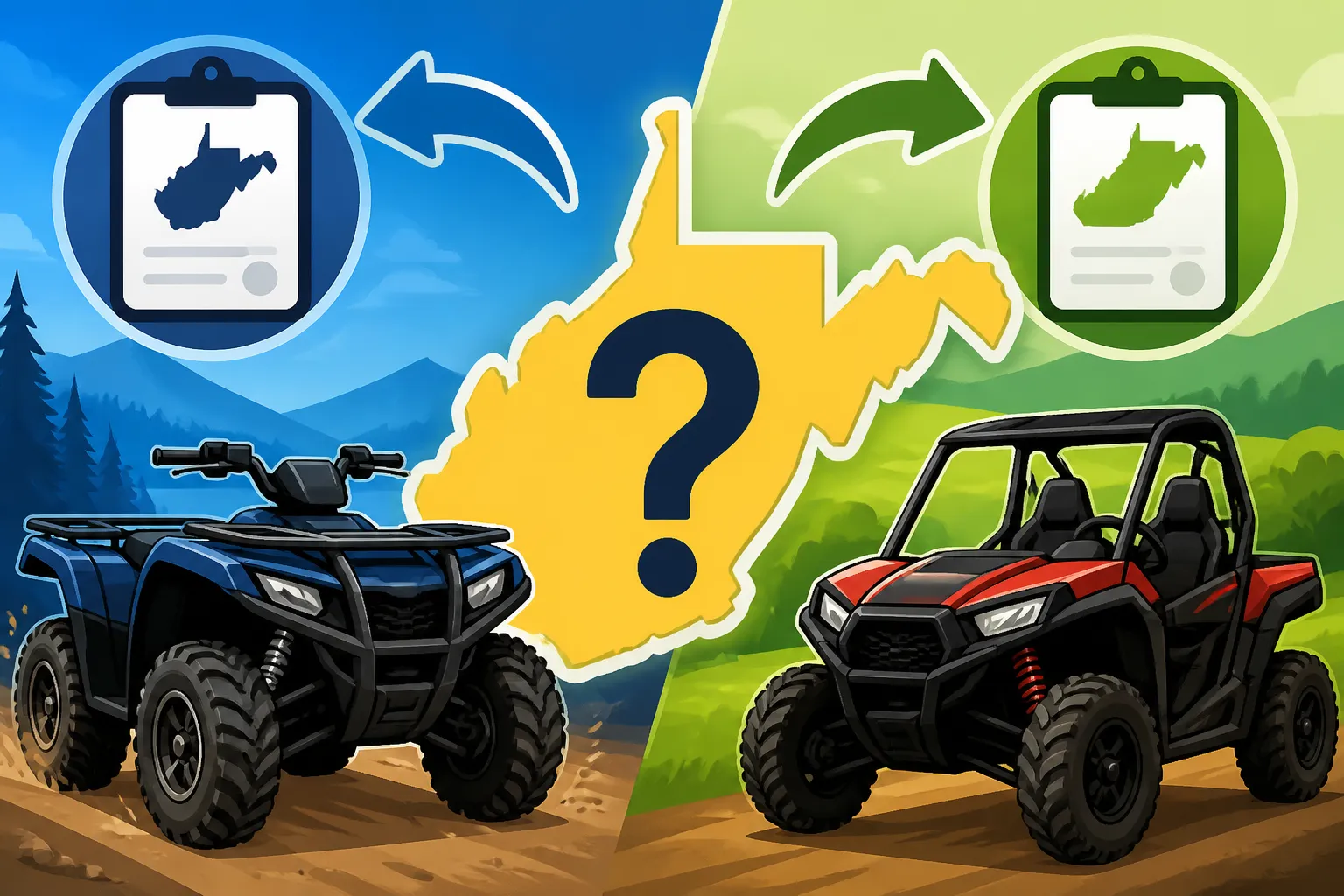
Do Other States’ Registrations Work in West Virginia?
A registration sticker from another state can look like permission to ride, but it may not cover the rules that matter in West Virginia. Trail permits, title paperwork and public-road access are separate questions, and the answer can change with the machine and where you plan to ride. Here’s how to sort out what your out-of-state documents do—and do not—allow.
What an Out-of-State Registration Actually Proves
“Registration” can mean different things depending on the state and machine. It might be a state-issued plate or sticker, an operating permit, or simply the way an owner refers to paperwork that proves a machine is recorded with a state agency. Before relying on it in West Virginia, check what the document actually authorizes in the state that issued it.
A registration is not the same as a title. A title generally records ownership and may show a lien or other brand. Registration, where a state requires it, usually relates to permission to operate a vehicle under that state’s rules. A trail permit is different again: it grants access to a particular managed trail system under its own conditions.
| Document | What it generally addresses | What it does not automatically provide in West Virginia |
|---|---|---|
| Out-of-state title | Ownership and title history | Trail access or permission to ride public roads |
| Out-of-state registration or operating permit | Authorization under the issuing state’s rules | A West Virginia trail permit or West Virginia road-use approval |
| West Virginia title | Ownership record under West Virginia’s title system | Trail access or road legality |
| Managed-trail permit | Access to the trail system named on the permit | A title, road plate or permission to use other trail networks |
| Insurance card | Evidence of an insurance policy | A trail permit, title or permission to ride anywhere |
West Virginia generally titles ATVs and other covered off-highway machines but does not register them for ordinary road use in the way passenger cars are registered. That distinction matters: an out-of-state registration does not simply convert an ATV into a West Virginia-registered road vehicle. For background on the state’s title-versus-registration system, see Why West Virginia Titles ATVs but Never Registers Them.
The practical answer is conditional. An out-of-state registration may be useful evidence that the machine is identified or authorized in its home state. It does not, by itself, settle whether you can ride a particular West Virginia trail, road or property. Treat each permission as a separate check.
The machine’s title status also matters. A title from another state may be relevant to ownership, especially if you buy a machine, move to West Virginia or later need to sell it. It does not function as a trail pass. If the machine needs to be titled in West Virginia, follow the title process rather than assuming a registration card substitutes for ownership documents. The steps are covered in West Virginia Title Rules for Out-of-State Machines.
Where You Plan to Ride Changes the Answer
West Virginia has different rules for managed trail systems, public roads, private property and other designated riding areas. A document that seems adequate in one setting may be irrelevant in another. First identify the exact place you intend to ride, then check its access and equipment requirements.
Managed trail systems
Managed trails have their own permit and rider rules. An out-of-state registration should not be treated as a substitute for a permit required by the trail operator. For example, riders planning to use the Hatfield-McCoy Trails should confirm the current permit requirements for each machine and rider through the official trail authority before traveling.
The permit is about trail access, not ownership. You may need to show that you have permission to use the system even if you have a title, a registration from home, and insurance. Requirements can differ between managed systems, so a pass or permit for one network does not automatically authorize riding on another. Start with West Virginia’s Hatfield-McCoy Trail Permit Explained and confirm details for the system you plan to visit.
Also check whether your rental, cabin package or organized trip includes a permit. Do not assume it does. Ask the operator which machine and riders are covered, and whether the permit is valid for the dates and locations on your itinerary. If you bring your own machine, make sure you understand whether you must obtain a separate permit.
Public roads
An out-of-state registration does not make an ATV or UTV legal on every West Virginia road. Road use is a separate legal question, and state requirements can depend on the machine, road, route and applicable equipment. A plate or sticker issued elsewhere cannot be assumed to satisfy West Virginia’s rules.
West Virginia has specific provisions for certain road riding and a separate process for qualifying machines seeking a street-legal special purpose vehicle plate. A machine’s road eligibility is not determined simply by whether it has a plate in another state. Check West Virginia’s Street-Legal Special Purpose Vehicle Plate and Riding an ATV on the Road in West Virginia before planning a road route.
Even where a road segment is legally available to ATVs, other requirements may apply, such as equipment, insurance, operator qualifications and route restrictions. Permission to ride one connector does not mean you can use any nearby highway or town street. Confirm the route rather than relying on a map, a seller’s claim or another state’s registration.
Private property and other riding areas
On private land, permission from the landowner is essential. A registration card does not grant access to someone else’s property, and it cannot override posted restrictions or a closed gate. Ask the property owner or land manager what documents, equipment and operating rules apply.
Public forests, parks and other riding areas may have their own access restrictions. Some routes are open to motorized use only under specified conditions; others may prohibit ATVs altogether. Check with the land manager for the exact road or trail, not merely the general area. A valid title and home-state registration do not change the land manager’s access rules.
Out-of-State Riders and Machines
Visitors and West Virginia residents with machines titled or registered elsewhere may have different paperwork questions. The key is to separate temporary travel from a move, purchase or change in ownership.
Visiting with a machine registered elsewhere
If you are visiting West Virginia, carry the documents that apply to your machine and your planned riding area. That may include the title or ownership record, home-state registration or operating permit if one is issued, proof of insurance where required, and any trail permit or safety document required by the place you will ride.
A home-state document can help identify the machine and show its status there. It does not establish that West Virginia accepts that document for every purpose. In particular, do not assume it waives a managed-trail permit, satisfies the requirements for a special purpose vehicle plate or authorizes road use.
If your home state does not issue ATV registration, do not try to create a substitute document or describe a title as a registration. Bring the ownership paperwork you do have and ask the relevant West Virginia agency or trail operator what it needs. Keep original documents secure and carry copies or digital records only if the receiving authority accepts them. A copy is useful for reference, but it may not replace an original document when an official transaction requires one.
Moving to West Virginia
A move can change what paperwork you need. A visitor may be using a machine temporarily under the rules applicable to a nonresident, while a person who establishes West Virginia residency may need to address state title requirements. Do not assume the previous state’s registration remains sufficient indefinitely after a move.
Check the current requirements for titling an out-of-state machine, including the documents needed to prove ownership and identify the vehicle. The machine’s year, type and existing paperwork can affect the process. A title, bill of sale or registration card may be relevant evidence, but one does not necessarily replace another. Moving to West Virginia With an Out-of-State ATV explains the related questions for new residents.
If the title is missing, has a lien, or does not match the machine’s identification number, resolve that before treating the paperwork as complete. For VIN concerns, see VIN Inspection Before a West Virginia Title. A mismatch can create delays or raise questions about ownership, regardless of whether another state previously issued a registration.
Buying a machine from another state
Buying an ATV or UTV across state lines adds a transfer-of-ownership issue. Ask for the title when the machine is one that should have one, and make sure the seller completes the transfer correctly. A registration card in the seller’s name is not automatically proof that the seller can transfer ownership free of problems.
Before paying, compare the machine’s VIN with the ownership documents. Check for liens and confirm that the seller’s name and signature meet the requirements for the transaction. Keep a bill of sale as supporting evidence, but do not assume it replaces a required title. See Buying a Used ATV in West Virginia: The Title Steps and Proof of Ownership for a West Virginia ATV Title for the paperwork side.
Once you own the machine, figure out separately whether it needs a West Virginia title, what trail permit is required and whether any planned road use is lawful. A seller’s statement that it is “registered” or “street legal” in another state is not enough to answer those questions.
Documents and Checks to Make Before You Ride
A little preparation can prevent a long trip from ending at a trailhead with the wrong paperwork. Build your checklist around the machine, the rider and the place you plan to visit.
- Identify the machine. Record its make, model, year, VIN and whether it is an ATV, UTV, dirt bike or another type of vehicle. Rules and paperwork can depend on what the machine is.
- Check the home-state document. Read the registration or permit itself. Note what it authorizes, who issued it, the machine it covers and any expiration or use limits.
- Confirm the ownership record. Make sure the title or other ownership proof matches the machine and seller. If you recently purchased it, verify that the transfer paperwork is complete.
- Name the exact riding location. Check the specific trail system, road or property. Ask the relevant authority or landowner about current access, permit and equipment rules.
- Check road use separately. If your route touches a public road, verify that the machine and route qualify under West Virginia rules. Do not infer road permission from an out-of-state plate.
- Confirm insurance. Ask your insurer whether the policy covers the machine and the kind of riding planned, including road exposure if applicable. An insurance card does not itself authorize access.
- Bring proof in a usable form. Carry the documents the trail operator or agency requires. Keep a backup copy separately, and do not leave irreplaceable originals exposed on the machine.
- Recheck before departure. Access, operating conditions and administrative requirements can change. Confirm current trail status and requirements close to the ride date.
For a trail trip, add permit and rider requirements to the machine paperwork checklist. One pass may not cover every rider or every machine, and rules may distinguish a driver from a passenger. If you are bringing multiple machines, verify how each must be covered rather than assuming a permit for one covers the group.
For a road trip, check the route itself. A route that appears to connect trails may include a public road with different restrictions. West Virginia’s road rules are not interchangeable with the rules in the state where the machine is registered. Which West Virginia Roads Allow ATVs can help frame the route question, but verify the current rule and local conditions before riding.
For paperwork storage, keep documents protected from rain, mud and damage. A waterproof document pouch—available from retailers such as Amazon—can keep copies together, but it does not make an unaccepted copy legally sufficient. Keep digital copies as backup where practical, and follow the agency or operator’s instructions about what must be presented.
Common Assumptions That Cause Problems
A few misunderstandings account for many paperwork surprises. Avoiding these assumptions is more useful than trying to carry every possible document.
“It has a plate, so it can use the road.” A plate from another state does not automatically establish road eligibility in West Virginia. Confirm the machine’s status and the specific route under West Virginia requirements.
“My registration is the same as a trail permit.” It is not. Registration relates to the issuing state’s system; a trail permit grants access under a particular trail authority’s rules. Check Permits West Virginia Riders Actually Need for the distinctions that matter on a riding trip.
“A title is enough to ride.” A title is about ownership. It does not grant access to a trail system, authorize travel on a public road, or replace permission from a private landowner.
“The seller said it was legal everywhere.” A seller may be describing how the machine was used in another state or on one specific route. Ask what document supports the claim and confirm it with the authority responsible for the West Virginia road or trail you plan to use.
“If the machine is insured, I’m covered for the ride.” Insurance and permission are different. Coverage can vary by policy and use, and an insurance policy does not provide trail access or road approval. Contact the insurer about the specific activity and location.
“A permit for one system works across the state.” Trail operators set their own access rules. A permit for one managed network should not be assumed to cover a different network, forest road or private riding area. Check every destination.
“Out-of-state paperwork means I don’t need to title the machine here.” That may not hold after a purchase or move. Ownership and residency circumstances matter. Confirm the current title process with the appropriate West Virginia office rather than relying on the registration card alone.
If you are unsure which office or operator to contact, describe the actual situation plainly: where the machine is titled, where it is registered if applicable, whether you are visiting or moving, the machine type, and where you plan to ride. That detail helps distinguish a title question from a trail-access or road-use question. For a DMV title transaction, What the West Virginia DMV Needs to Title an ATV is a useful starting point. For managed-trail access, contact the trail authority directly.
Frequently Asked Questions
Does an out-of-state ATV registration let me ride the Hatfield-McCoy Trails?
Do not treat it as a substitute for the trail system’s permit. Check Hatfield-McCoy’s current requirements for each machine and rider before going.
Does an out-of-state plate make my UTV street legal in West Virginia?
Not automatically. Road use depends on West Virginia requirements, the machine and the route. Confirm whether the machine qualifies and what approvals and equipment are required.
Is a title the same as registration?
No. A title is primarily an ownership record. Registration or an operating permit concerns authorization under a state’s system, while a trail permit concerns access to a specific riding area.
What should a visitor carry?
Carry the ownership and home-state operating documents that apply to the machine, plus any West Virginia trail permit, insurance evidence or safety documents required for the planned ride. Confirm what the operator or agency accepts.
Disclaimer
This article is for general informational purposes only and does not constitute professional advice. Laws, prices and regulations vary by location and change over time. Consult a qualified professional for guidance on your specific situation.