Eye Protection With an Open-Cab Machine
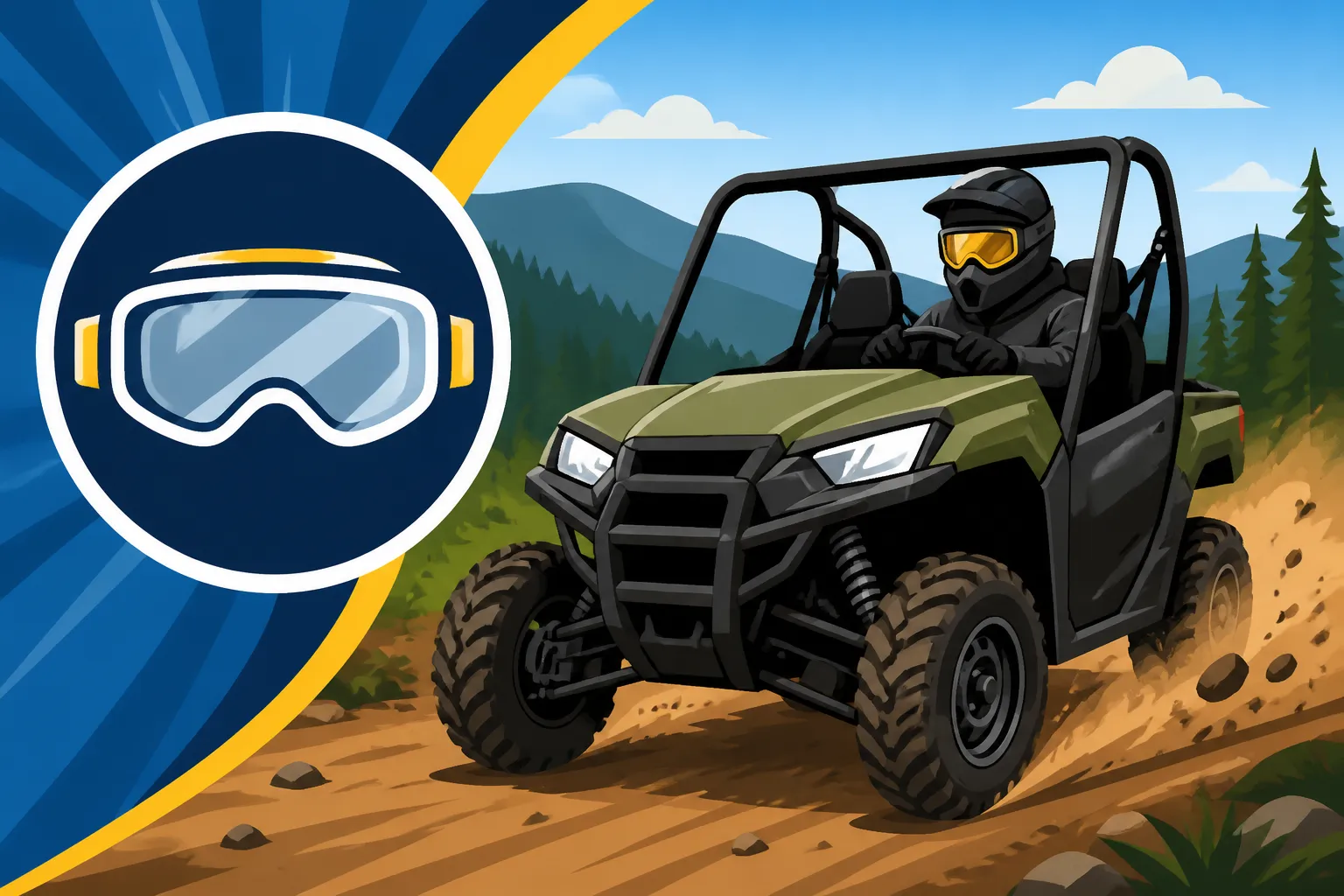
An open-cab ATV or UTV leaves your eyes exposed to wind, dust, grit, and debris. In West Virginia, eye protection can also matter to whether a street-legal special purpose vehicle needs a windshield. Here’s how to think about protective eyewear, what the rule says, and what to confirm before you ride.
When eye protection matters on an open-cab machine
An open cab offers little barrier between your face and the air moving around the machine. Dust, loose grit, bugs, and wind can make it harder to see comfortably, whether you are on a trail or a road. Eye protection is useful for more than comfort: a sudden obstruction or watery eyes can distract you when you need to pay attention to the terrain and other riders.
West Virginia has a specific windshield rule for street-legal special purpose vehicles. According to the West Virginia Division of Motor Vehicles, an SPV must have a windshield unless the operator wears compliant eye protection. That makes eyewear a possible alternative to a windshield for this particular requirement. It does not mean any glasses or goggles automatically qualify: the DMV rule uses the word “compliant,” and you should confirm what meets that standard before relying on eyewear in place of a windshield.
This requirement applies in the context of a street-legal SPV. West Virginia’s SPVs include all-terrain vehicles and utility terrain vehicles, among other machine types. Simply riding an ATV or UTV on private land or a trail is not the same as registering and operating it as an SPV on roadways. For the broader plate and vehicle requirements, see West Virginia’s Street-Legal Special Purpose Vehicle Plate and West Virginia SPV Plate Requirements List.
It also helps to separate the windshield rule from helmet rules. The West Virginia Division of Motor Vehicles says a DOT-approved helmet is required for ATV riders under 18. The agency also states that riding on any Hatfield-McCoy Trail System requires a user permit and a DOT- or SNELL-approved helmet. Those requirements do not, by themselves, explain which eyewear meets the SPV windshield exception. For more on protective gear rules, see Helmet and Eye Protection Rules in West Virginia and Eye Protection Requirements on West Virginia Trails.
| Situation | What to keep in mind |
|---|---|
| Street-legal SPV with an open cab | The West Virginia Division of Motor Vehicles says the machine needs a windshield unless the operator wears compliant eye protection. Confirm what the agency accepts as compliant. |
| ATV rider under 18 | The West Virginia Division of Motor Vehicles requires a DOT-approved helmet. Do not treat eyewear as a substitute for this helmet requirement. |
| Riding on a Hatfield-McCoy Trail System | The West Virginia Division of Motor Vehicles says a user permit and a DOT- or SNELL-approved helmet are required. Check the applicable trail rules separately for eyewear details. |
| Riding in a county or municipality | Local governments may impose stricter ATV rules, according to the West Virginia Division of Motor Vehicles. Check local requirements as well as state rules. |
A windshield and eyewear are not interchangeable in every practical sense, even where eyewear can meet the SPV exception. A windshield can block wind and some airborne material for the driver; glasses or goggles protect the eyes but leave the rest of the face exposed. The machine’s configuration, your riding conditions, and the rules for your route all affect what makes sense.
Choosing eyewear for an open cab
Start with fit and coverage, then check compliance. The eyewear should stay in place when you turn your head, look down, or move over uneven ground. If you use goggles, check that the strap fits securely around your helmet and does not shift during normal movement. If you use glasses, make sure they sit comfortably and do not slide when you look around.
Coverage matters because an open cab exposes you to more than wind straight ahead. Dust and grit can approach from the side, particularly when riding behind another machine or in a group. A close-fitting design can help limit gaps around the eyes. No pair of glasses or goggles can guarantee that debris will not get through, so adjust your speed and spacing when visibility or trail conditions are poor.
Choose a lens suited to the light you expect. Clear lenses are a practical option when light is low or likely to change. Tinted lenses may be more comfortable in bright conditions, but avoid a tint that makes it difficult to see in shade or as daylight fades. If you expect changing conditions, carry a clean alternative when practical. The important point is being able to see clearly throughout the ride, not choosing a particular lens color.
Ventilation and fogging deserve attention, too. A lens that fogs can quickly become a visibility problem. Look for a design that fits your helmet and face without being pushed against the skin, and check that it stays clear during ordinary movement. If the lens becomes fogged, scratched, or coated in dust, stop somewhere safe to clean or replace it rather than continuing with impaired vision.
Consider the rest of your gear as a system. A helmet, eyewear, and any windshield should fit together without forcing the helmet out of position or leaving a distracting gap. If you carry passengers, make sure each person has suitable eye protection for the machine and ride. The driver’s choice does not protect a passenger seated beside or behind them.
When shopping, read the product details carefully and avoid assuming that a label or marketing phrase proves compliance with West Virginia’s SPV rule. You can browse options through retailers such as Amazon, but verify the product’s specifications and fit, and confirm the state requirement with the West Virginia Division of Motor Vehicles before using it instead of a windshield. For a closer look at the trade-offs, see Goggles Versus a Face Shield on the Trail and Safety Glass Windshield or Goggles.
Before you ride
Make a quick check of your machine, eyewear, route, and paperwork before leaving. This is especially worthwhile if you are relying on eye protection instead of a windshield on a street-legal SPV.
- Confirm the machine’s status. If you plan to ride on a roadway, verify that the machine has gone through West Virginia’s SPV registration process. According to the West Virginia Division of Motor Vehicles, ATVs may be ridden on roadways when the operator has completed that process. Registration does not mean every road is open to the machine.
- Check that the eyewear is in good condition. Clean lenses are easier to use than scratched or dusty ones. Check the frame, strap, and fit, and bring a way to clean the lenses if the ride may be dusty.
- Ask whether the eyewear meets the SPV rule. If there is any doubt about whether your glasses or goggles count as compliant eye protection, do not assume they do. Contact the West Virginia Division of Motor Vehicles or use a windshield until you have confirmed the requirement.
- Check the route and local restrictions. The West Virginia Division of Motor Vehicles says county commissions and other local governments may adopt stricter ATV rules. A road or town that allows some ATV activity may still have restrictions that affect your trip.
- Keep separate requirements separate. A helmet, trail user permit, insurance, and SPV registration address different requirements. Meeting one does not automatically satisfy the others. For road riding, Riding an ATV on the Road in West Virginia and Insurance a West Virginia Street-Legal Machine Needs cover related issues.
If your ride is on a managed trail, check that trail system’s current rules rather than applying the SPV windshield exception to every situation. The DMV information provided here addresses the SPV requirement, while trail access and protective gear can involve separate conditions. Likewise, if you ride in an ATV-friendly town or on an approved road, check the conditions that apply to that specific route.
Good eyewear improves comfort and helps you keep your attention on the ride, but it is not a blanket permission to ride anywhere without a windshield. For an open-cab SPV, the key question is whether your eye protection satisfies the state’s compliance requirement. For every other ride, check the rules that apply to the machine, location, and people on board.
Sources
- WV Division of Motor Vehicles — ATV | WV Division of Motor Vehicles (checked November 3, 2026)
Disclaimer
This article is for general informational purposes only and does not constitute professional advice. Laws, prices and regulations vary by location and change over time. Consult a qualified professional for guidance on your specific situation.