West Virginia ATV Road Rules for Young Riders
Navigating the ins and outs of West Virginia's ATV and UTV road rules can feel like trying to untangle a knot of fishing line, especially when you're a parent trying to figure out what's safe and legal for your young rider. Many folks worry about their kids getting into trouble or worse, an accident, simply because the rules aren't crystal clear. This guide is here to cut through the confusion, offering a comprehensive look at what young riders can and cannot do on West Virginia's public roads, helping you keep them safe and on the right side of the law.
The Core Challenge: Why Road Rules for Young Riders Are So Tricky
It’s completely understandable why parents and young riders in West Virginia often feel like they’re walking on eggshells when it comes to riding ATVs or UTVs on public roads. The legal landscape isn't a single, clear path; it's a winding trail with different rules depending on where you are and how old you are. This complexity leads to genuine frustration and a lot of head-scratching moments for families who just want to enjoy the sport responsibly.
The Intersection of State Law and Local Ordinances
The biggest hurdle for many is figuring out which set of rules applies at any given moment. West Virginia, like most states, has overarching state laws that lay down a baseline for ATV and UTV operation. These laws cover things like titling, minimum age requirements for certain activities, and general safety guidelines. However, many communities and municipalities in West Virginia have the authority to enact their own ordinances regarding ATV use, especially on their local streets and roads.
This creates a patchwork effect. What might be perfectly acceptable in an ATV-friendly town like Gilbert, where riders can often access businesses directly from the trails, might get you a ticket in a neighboring town that has stricter local rules. For a young rider, or their parent, this means you can't just learn one set of rules and be done with it. You need to be aware of the specific regulations of every town or county you plan to pass through. It’s enough to make anyone feel like they need a lawyer on speed dial just to plan a simple ride.
Parental Responsibility and Liability Concerns
The weight of responsibility truly falls on the parents when it comes to young riders. Beyond the legalities, there's the profound concern for their child's safety. A ticket is one thing, but an accident involving a young rider on a public road can have devastating consequences, both for the child's well-being and the family's financial future. Parents worry constantly about the "what ifs"—what if their child gets hit by a car? What if they cause an accident? What if they get pulled over and the machine is impounded?
The costs associated with legal fees, fines, and potential liability for damages in an accident can be astronomical. This isn't just about a fun pastime; it’s about protecting your family and your assets. Ensuring your young rider understands and abides by every rule isn't just about compliance; it's a critical act of parental care. This pressure often forces parents to be overly cautious, sometimes even stopping their kids from riding altogether, simply because the risks of misunderstandings are too high.
State-Level Road Access Rules for ATVs in West Virginia
West Virginia has carved out some unique allowances for ATV and UTV use on public roads, largely due to the deep-rooted off-road culture and the sheer number of trail systems that crisscross the state. However, these allowances come with very specific stipulations, and critically, they are usually geared towards adult operators, not necessarily young riders. Understanding these foundational state rules is the first step in seeing how young riders fit into the picture—or often, how they don't.
The "10-Mile, 25 mph" Rule Explained
One of the most talked-about provisions for ATV road access in West Virginia is the "10-mile, 25 mph" rule. This state law permits an ATV or UTV to be operated on a public road without a marked centerline for a distance of up to 10 miles, provided the operator travels at a speed of no more than 25 miles per hour. This rule was established to help riders connect between trails, access fuel, or get to lodging in areas where official trail systems might not have continuous off-road paths.
It's a huge relief for many adult riders who are trying to get from one section of trail to another, or from a trailhead to a nearby gas station. However, it's absolutely crucial to remember that this rule applies to specific types of roads (no centerline) and has a strict speed and distance limit. Furthermore, this general road access rule does not override other requirements, such as driver's license mandates, which typically exclude younger operators from this privilege. This distinction is often missed, leading to false assumptions about what young riders can legally do. For more on this, check out [West Virginia's 10-Mile, 25 mph Road Rule].
Limitations and Exemptions for Farm Use
Beyond recreational riding, West Virginia law also provides certain exemptions for ATVs and UTVs used for agricultural purposes. If a machine is being operated solely for farming, ranching, or other bona fide agricultural activities, it might be exempt from certain registration or titling requirements, and in some cases, limited road use might be permitted for these specific tasks. This could mean a young rider assisting a parent with chores, such as checking fences or hauling feed on a rural road adjacent to their farm property.
However, these exemptions are very narrowly defined. The operation must be directly related to the agricultural enterprise, and the machine must be used for that specific purpose, not for recreational joyrides, even if they're on a farm road. The moment a "farm ATV" is used for anything other than agricultural work, it typically falls back under the standard rules, which can include age and licensing restrictions. These are not loopholes for underage recreational road riding. It's really about facilitating essential farm work. If you're using an ATV strictly for farm duties, you might want to look into [West Virginia Title Rules for Farm ATVs] for more information on how that impacts ownership paperwork.
Age and Driver's License Requirements for Road Riding
This is where the rubber truly meets the road, or more accurately, where many young riders unfortunately hit a roadblock. West Virginia is clear on who can operate an ATV or UTV on a public thoroughfare, and these rules are designed with safety and legal accountability in mind. For parents, understanding these requirements is non-negotiable to avoid serious legal trouble.
Driver's License as a Prerequisite for Public Roads
In almost all scenarios, if you're operating an ATV or UTV on a public road in West Virginia—even for those short, connecting stretches or in ATV-friendly towns—you need to possess a valid driver's license. This isn't a suggestion; it's a fundamental requirement. The state considers operating an ATV or UTV on a public road to be akin to operating any other motor vehicle, and therefore, the same licensing standards generally apply.
This means that a young rider, no matter how skilled or responsible they are on the trails, cannot legally operate an ATV on a public road if they do not hold a valid driver's license. This single rule often negates any other potential allowances for younger riders. The rationale behind this is simple: a driver's license signifies a certain level of maturity, knowledge of traffic laws, and proven ability to operate a motor vehicle safely in traffic. Without it, the risk to the young rider and other motorists is deemed too high. You can delve deeper into this topic by reviewing [Driver's License Rules for West Virginia Road Riding].
West Virginia's ATV Road Riding Age Minimum
Building on the driver's license requirement, the de facto age minimum for operating an ATV or UTV on a public road in West Virginia is tied directly to the minimum age for obtaining a driver's license. While West Virginia allows riders as young as 15 years old to obtain a learner's permit and drive with supervision, and a full driver's license at 16, the context of an ATV or UTV on a public road is often treated with extra caution.
Generally, you need to be at least 16 years old and possess a valid driver's license to legally operate an ATV on any public road where it's permitted. This means that even if a road has no centerline and is within the 10-mile, 25 mph allowance, a 14-year-old, for example, would still be ineligible to drive it. This is a critical distinction from trail riding, where supervised minors can ride much younger. The road environment presents different hazards, and the state's rules reflect that increased risk. For specific details on this, look up [West Virginia ATV Road Riding Age Minimum].
Can a 16-Year-Old Ride on a West Virginia Road?
This is a frequently asked question, and the answer is usually "yes, if they possess a valid West Virginia driver's license and follow all other applicable rules." A 16-year-old with a full, unencumbered driver's license would theoretically be able to operate an ATV or UTV on roads where such operation is permitted, such as those covered by the 10-mile, 25 mph rule or in specific ATV-friendly trail towns.
However, "theoretically" is a key word here. Even with a driver's license, 16-year-olds are still new drivers, and the complexities of operating an ATV on a public road, which often has less protection than a car, can be challenging. Furthermore, local ordinances can still impose additional restrictions. Some towns, for instance, might restrict ATV road access to certain hours or specific streets, regardless of the driver's age or license status. So, while the age and license might check out, it's always important to verify local rules. It's a nuanced topic, and further insights can be found in [Can a 16-Year-Old Ride on a West Virginia Road?].
Special Purpose Vehicle (SPV) Plates and Young Riders
West Virginia offers a fantastic program for making ATVs and UTVs "street legal" through a Special Purpose Vehicle (SPV) plate. This allows owners to outfit their machines with necessary safety equipment and register them for broader road use. It's a game-changer for many adult enthusiasts, but what does it mean for young riders? The short answer is: the SPV plate makes the machine street legal, but it doesn't automatically make an underage rider street legal.
What an SPV Plate Means for Road Legality
An SPV plate signifies that your ATV or UTV has met specific safety and equipment standards set by the state of West Virginia, allowing it to be legally operated on most public roads, not just the limited 10-mile sections without centerlines. This typically involves adding DOT-approved tires, turn signals, brake lights, a horn, mirrors, and often a windshield. Once equipped and registered, an SPV-plated machine can be driven like a regular vehicle on most roads, offering far greater freedom and connectivity between trails or destinations.
This program has truly opened up the state for riders, allowing them to access restaurants, stores, and lodging directly from trail systems, enhancing the overall experience. For many, it's worth the investment in upgrades and registration fees. The plate turns your off-road beast into a versatile street and trail machine. Learning more about this process can be very helpful for any ATV owner, and you can find detailed information at [West Virginia's Street-Legal Special Purpose Vehicle Plate].
Age and Licensing for SPV Operation
Here's the critical point for young riders and their parents: an SPV plate does not grant an exception to the standard driver's license and age requirements for operating a motor vehicle on public roads. If your UTV has an SPV plate, it means it's legal for road use, but the operator must still meet the qualifications of any other driver. This means they must possess a valid driver's license.
Therefore, an underage rider, even on a fully street-legal SPV, would still be prohibited from operating it on public roads unless they meet the state's minimum age for driving and hold a valid driver's license. The SPV designation addresses the machine's compliance, not the operator's. Parents sometimes mistakenly believe that once their side-by-side has an SPV plate, their teenager can drive it anywhere, but this is a dangerous misconception that can lead to fines, accidents, and insurance nightmares.
Equipment Requirements and Young Rider Safety
While the age and licensing requirements are paramount, the equipment needed for an SPV is also vital for safety, particularly if a qualified young adult (16+ with a license) were to operate it. SPV conversion kits often include reinforced components and enhanced lighting, which are inherently safer for any road use. Investing in quality parts from brands like SuperATV for items like robust A-arms, heavy-duty tie rods, or even full cabs can contribute to a safer machine, though these upgrades primarily serve the machine's durability and functionality rather than directly addressing age-related road legality.
The legal requirements for an SPV typically include headlights, taillights, brake lights, turn signals, a horn, mirrors (rearview and side mirrors), and a windshield. These features are designed to make the machine visible and controllable in traffic, reducing accident risk. Even if your child is legally old enough and licensed, ensuring the machine meets and exceeds these safety standards is just good practice. It's about minimizing risks as much as possible, regardless of who's behind the wheel. For a comprehensive list of what your SPV needs, refer to [Equipment a West Virginia SPV Must Carry].
Helmet and Safety Gear Rules for Young Riders on Roads
Safety gear is always important when riding ATVs, whether on or off-road. However, when it comes to road riding, West Virginia has specific mandates, particularly for younger individuals. These rules are in place to drastically reduce the risk of serious injury in the event of an accident, a risk that is statistically higher when operating a vehicle alongside cars and trucks.
Mandatory Helmet Use for Minors on Roads
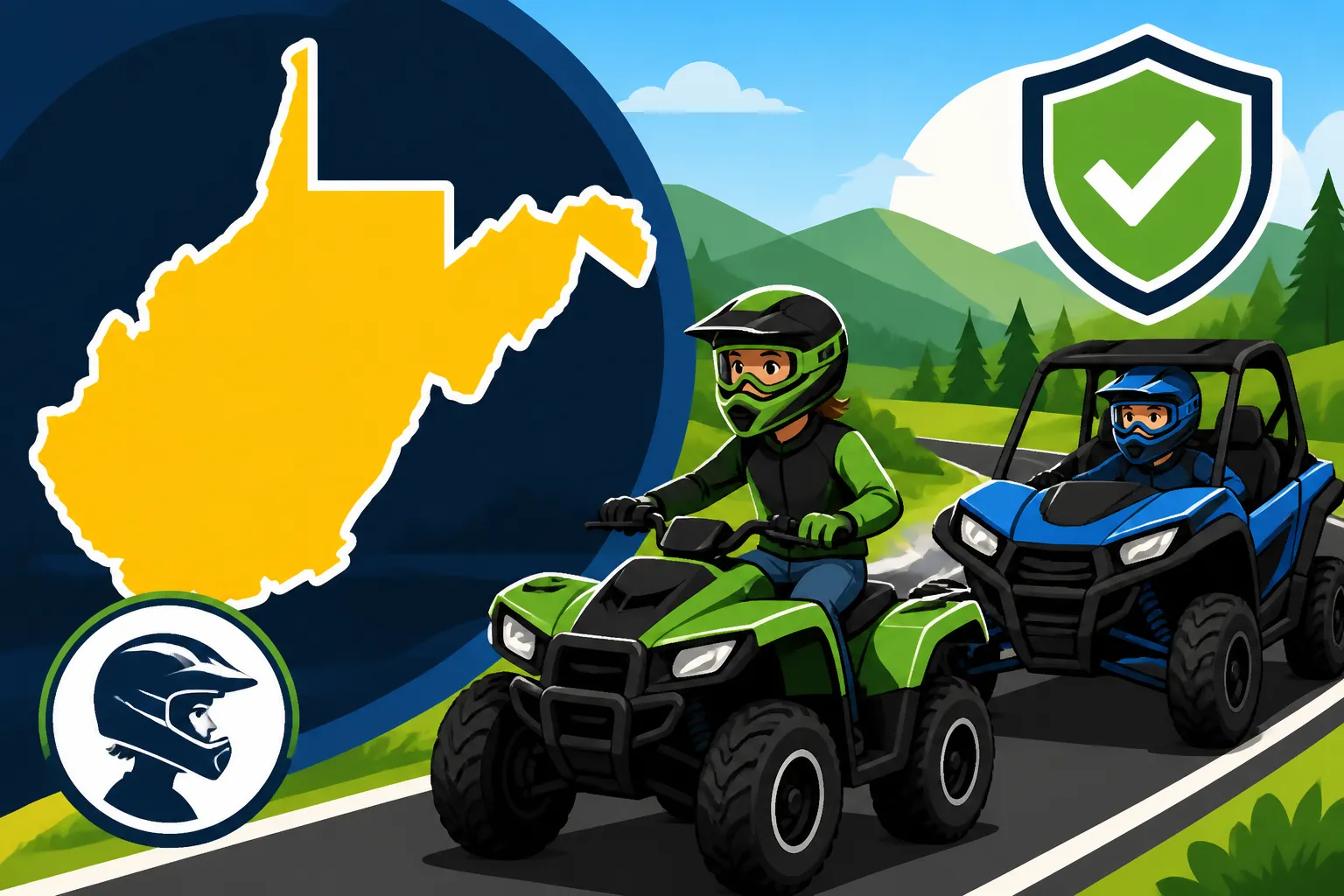
This rule is straightforward and leaves no room for interpretation: if you are under the age of 18 and operating or riding as a passenger on an ATV or UTV on a public road in West Virginia, you must wear a safety helmet. This isn't just a recommendation; it's a legal requirement. Deputies and state troopers will issue citations for non-compliance, and for good reason—helmets save lives and prevent severe head trauma.
This rule applies universally across all public roads, regardless of whether it's an unpaved county route or a paved connector in a trail town. Parents should not only ensure their young riders have a properly fitting, DOT-approved helmet but also insist on its consistent use. There's no exception for short distances, low speeds, or perceived lack of traffic. The law is absolute for minors on roads. For deeper insight into these rules, consult [West Virginia Helmet Rules for Riders Under 18].
Eye Protection and Other Gear
Beyond helmets, West Virginia law also mandates eye protection for all ATV and UTV operators and passengers on public roads, regardless of age. This means goggles, a face shield on a helmet, or safety glasses are required to protect your eyes from debris, wind, and insects. While often overlooked, eye injuries can be debilitating and are easily preventable with the right gear.
While not legally mandated for road riding in the same way helmets and eye protection are, other protective gear is highly recommended, especially for young, less experienced riders. This includes long pants, long-sleeved shirts, sturdy boots that cover the ankles, and gloves. This additional gear provides crucial protection against scrapes, bruises, and road rash in a fall or collision. Think of it as investing in an insurance policy for your child's skin and bones. Even if the machine is equipped with a windshield, dust and debris can still find their way in, making eye protection essential. The state takes eye safety seriously, and you can learn more about it here: [Eye Protection on a West Virginia Road Ride].
Consequences and Penalties for Non-Compliance
Ignoring West Virginia's ATV road rules for young riders isn't just about bending the rules a little; it can lead to significant legal, financial, and even social repercussions. The authorities take these laws seriously, and the consequences can be far-reaching for both the young rider and their parents. It's crucial for families to understand the potential fallout of non-compliance.
Tickets and Fines for Underage Road Riding
The most immediate consequence of a young rider operating an ATV or UTV illegally on a public road is a traffic citation. These tickets can carry substantial fines, and depending on the specifics of the offense, may also involve court appearances for the parents or legal guardians. For instance, if a young rider is caught operating an ATV on a public road without a valid driver's license, the penalties could be similar to those for an unlicensed driver in a car, potentially including fines that easily climb into the hundreds of dollars.
Furthermore, an officer might have the authority to impound the ATV or UTV, leading to additional towing and storage fees that quickly add up. This isn't just a slap on the wrist; it's a tangible financial hit. The frustration of paying for these avoidable expenses can be immense for families. It’s a lot easier and cheaper to simply know and follow the rules. To understand the potential monetary impact, you might want to look at [West Virginia ATV Ticket Costs].
Insurance Implications and Liability
Perhaps the most terrifying consequence of illegal road riding by a young person is the potential impact on insurance and personal liability in the event of an accident. Most standard ATV insurance policies are written with the expectation that the machine will be operated legally. If an accident occurs while a young, unlicensed rider is operating an ATV on a public road in violation of state law, the insurance company could deny the claim entirely.
This leaves the parents fully exposed to the financial burden of property damage, medical bills, and potential lawsuits if another party is injured or their property is damaged. Imagine facing tens of thousands, or even hundreds of thousands, of dollars in costs out-of-pocket because a rule was broken. It's a risk no family should ever take. Verifying your policy's coverage and limitations, especially concerning road use and operator age, is absolutely vital. Understanding the typical coverage limits in West Virginia is a good starting point, and [West Virginia ATV Liability Coverage Limits] can provide more context.
Losing Trail Privileges and Community Trust
Beyond the legal and financial penalties, there's a broader, less tangible but equally important consequence: the erosion of community trust and the potential loss of trail access for all riders. When young, unlicensed riders are seen flouting road rules, it creates a negative perception of the entire ATV community. Local residents, law enforcement, and even landowners might become less supportive of ATV use, leading to stricter ordinances, increased patrols, or even the closure of valuable trail connectors or public land access.
No one wants to be "that family" whose actions jeopardize the riding privileges for everyone else. Responsible riding, especially by young people, is a powerful ambassador for the sport. Conversely, irresponsible actions can lead to a backlash that impacts future generations of riders. Authorities are increasingly willing to impose severe penalties, including revoking trail permits or access, for those who continually disregard the rules. It's a stark reminder that the actions of a few can affect many. More information on how violations can impact access is available in [Losing West Virginia Trail Access After a Citation].
Practical Advice for Parents of Young ATV Enthusiasts
Given the complexities and potential pitfalls of young riders on West Virginia roads, a proactive and safety-first approach is essential for parents. It's about fostering a love for the sport while instilling unwavering respect for the rules and safety.
Prioritize Off-Road Riding and Managed Trails
The best and safest place for young riders to hone their skills and enjoy their ATVs is on designated off-road trails and managed trail systems. West Virginia is blessed with an incredible network, most notably the Hatfield-McCoy Trails, which offers hundreds of miles of diverse terrain suitable for all skill levels. These trail systems have clear, specific rules for age and supervision, allowing younger riders to participate safely and legally within their boundaries.
Focusing on these dedicated spaces not only keeps your child out of trouble on public roads but also provides a much richer and more appropriate riding experience. Many trail systems, like parts of the Hatfield-McCoy, even have specific youth-friendly trails. This allows kids to learn and grow in a controlled environment, surrounded by other enthusiasts. Explore the vastness of these systems and find the perfect spot for your family at [West Virginia's Thirteen Hatfield-McCoy Trail Systems].
Enroll in ATV Safety Courses
Formal safety training is invaluable for any rider, but especially for young, developing operators. West Virginia offers ATV safety awareness courses that teach fundamental riding techniques, risk assessment, and proper safety gear usage. While not always mandated for private land or managed trail riding for all ages, these courses build critical skills and instill a safety-first mindset that will benefit your child throughout their riding career.
Even if your child is too young for road riding, enrolling them in a safety course helps them understand the power and responsibility that comes with operating an ATV. It also demonstrates to them that you, as a parent, are serious about their safety and want them to be well-prepared for any situation. It’s an investment in their future enjoyment and well-being. You can find out more about these essential courses at [West Virginia ATV Safety Awareness Course].
The Role of Responsible Supervision
For young riders who are legally allowed to operate an ATV, whether on private land or permitted trail systems, responsible adult supervision is paramount. This means more than just being present; it means actively teaching, monitoring, and enforcing safe riding practices. Parents should lead by example, always wearing appropriate gear, riding within their limits, and adhering to all rules.
Supervision also involves having open conversations with your child about the dangers of road riding, the importance of patience, and the consequences of reckless behavior. It's about instilling a sense of judgment and responsibility so that even when they're not directly supervised, they make safe choices. This continuous mentorship is key to developing competent and safe riders.
Equipping Young Riders Safely
Beyond the legal minimums, consider investing in high-quality safety gear and machine enhancements. A DOT-approved helmet is non-negotiable, but also look for comfortable, protective riding apparel, boots, and gloves. For the machine itself, if it’s a side-by-side that will eventually be used by a licensed young adult on permitted roads, consider upgrades that enhance safety and visibility.
While most young riders will be off-road, if a machine is going to be used by a properly licensed 16-year-old on permitted roads, products from brands like SuperATV can significantly upgrade a UTV's safety features. Items like full doors, reinforced cages, or even upgraded lighting systems (beyond the minimum required for an SPV) can provide an extra layer of protection and visibility. These aren't about circumventing rules for young riders, but about ensuring that when a machine is legally operated on a road by a qualified individual, it's as safe as possible. Quality gear and machine maintenance are the cornerstones of a worry-free riding experience.
Summary of Key West Virginia ATV Road Rules for Young Riders
To help clarify the complex landscape of West Virginia ATV road rules for young riders, here's a table summarizing the critical points. This is not exhaustive, and local ordinances can add further restrictions, but it covers the core state-level requirements.
| Feature / Rule | General Requirement for Public Road Use (State Law) | Specific for Young Riders (Under 18) | Implications for Parents |
|---|---|---|---|
| Driver's License | Required for operator | Required (typically 16+ with license) | Must ensure licensed operator; liability for non-compliance. |
| Minimum Age to Operate | 16 years old with valid driver's license | Minimum 16 years old with valid driver's license | Younger riders cannot operate on public roads. |
| Helmet | Required for SPVs, often recommended otherwise | MANDATORY for all under 18 | Ensure DOT-approved helmet is worn consistently. |
| Eye Protection | Required | MANDATORY | Ensure appropriate eye protection (goggles/shield) is worn. |
| Road Type (10-mile rule) | Roads without a marked centerline (up to 10 miles, 25 mph) | Operator must be 16+ with license | No special exceptions for young, unlicensed riders on these roads. |
| SPV Plate | Required for general road access beyond 10-mile rule, in most situations | Machine-specific, not rider-specific | Does not negate age/license requirements for young operators. |
| Farm Use Exemption | Limited road use for agricultural purposes only | Operator may be younger if solely for farm use on own/adjacent land, but rules are strict. | Closely monitor usage; not for recreational road riding. |
| Local Ordinances | Can add further restrictions to state laws | Apply to all riders, including youth | Always check local town/county rules before riding. |
Disclaimer
This article is for general informational purposes only and does not constitute professional advice. Laws, prices and regulations vary by location and change over time. Consult a qualified professional for guidance on your specific situation.