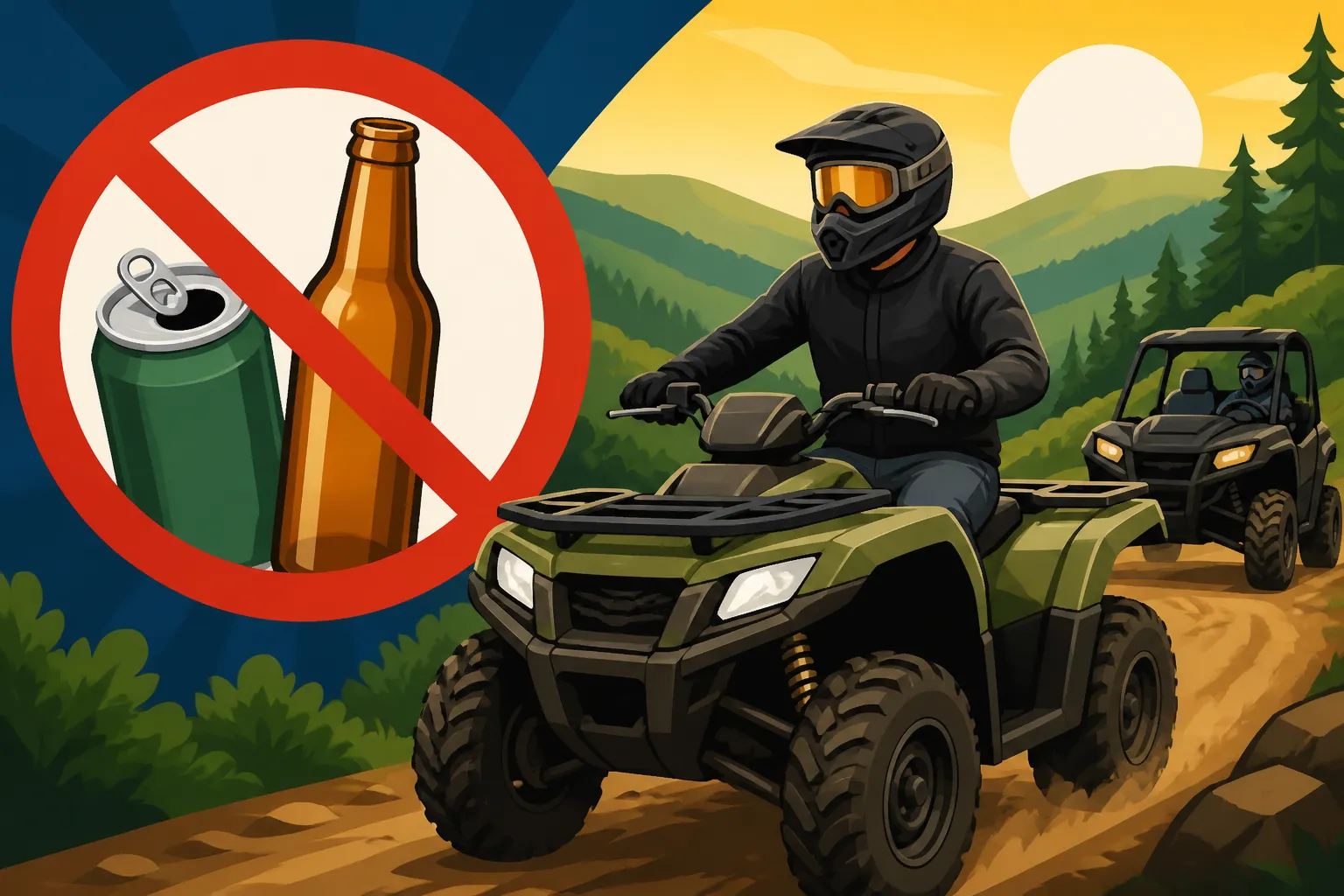
Open Container Rules on a West Virginia Quad
It's incredibly frustrating when you're trying to enjoy a weekend ride in West Virginia, maybe camping with friends or just unwinding after a long week, and you're not entirely sure about the rules around having a refreshing beverage with you. Nobody wants to accidentally break the law or put their riding privileges at risk. This guide will clarify West Virginia's open container laws specifically as they apply to operating a quad or side-by-side, helping you understand where you stand and how to stay on the right side of the law.
Understanding West Virginia's Open Container Laws for ATVs
West Virginia takes its open container laws seriously, and it's not always as straightforward as it seems, especially when you factor in the unique ways we use ATVs and UTVs here in the Mountain State. You might think, "I'm not driving a car, so it's different," but when you're on a public road or right-of-way, the law tends to see things in a very similar light. The core idea is to prevent impaired driving and maintain public safety, whether you're in a pickup truck or on a Polaris RZR.
What Constitutes an "Open Container" in West Virginia?
Let's break down what the law considers an "open container." It's not just about a half-empty beer can rolling on the floorboard of your truck. For alcoholic beverages, an open container generally means any bottle, can, or other receptacle containing any amount of alcoholic beverage that has been opened, has a broken seal, or the contents of which have been partially removed. This even extends to beverages that might be poured into a regular cup – if that cup contains an alcoholic drink, and you're on a public way, it's considered an open container.
This definition is crucial because it applies not just to the driver, but potentially to passengers as well, depending on the specific wording of the statute and where the vehicle is operating. If you're riding a side-by-side with a cooler in the back, and someone has cracked open a cold one, that machine now has an open container. This holds true whether you're just pulling out of a gas station in an ATV-friendly town or making your way to a trailhead. It's about the state of the container and its contents while in transit on public access areas.
The Broad Scope of "Public Ways" for ATV Operations
Here's where it often gets tricky for ATV and UTV riders. West Virginia's open container laws apply on any "public highway, street, road, or right-of-way." Many of us think of our ATVs as purely off-road machines, but the moment you put a tire on any publicly maintained or accessible route, you're subject to these laws. This includes paved county roads, state routes, and even those unpaved back roads that serve as connectors between trail systems.
Consider the reality of riding in West Virginia: many of our fantastic trail systems, like the Hatfield-McCoy Trails, often use sections of public road to connect different trailheads or allow riders to access towns. When you're on one of these designated connectors, or if you're riding in one of West Virginia's ATV-friendly towns under [West Virginia's 10-Mile, 25 mph Road Rule], those public road rules, including open container laws, are absolutely in effect. Even if you're just pulling out of a private driveway onto a public road to get to a private field, that brief moment on the public right-of-way can still make you liable. It’s a vital distinction to remember, as it influences where and when you can responsibly consume adult beverages.
Penalties and Consequences of Violating Open Container Laws on a Quad
Ignoring open container laws, even unintentionally, can lead to some pretty unwelcome surprises during your West Virginia ATV adventure. It's not just a slap on the wrist; there can be immediate legal and financial consequences that can put a serious damper on your trip and even impact your driving record. It's always better to be fully informed than to face a deputy on a trail connector with an open beer in your cup holder.
Immediate Repercussions and Legal Fines
If a law enforcement officer, whether it's a local sheriff, state police, or a West Virginia Natural Resources Police officer, observes an open container in your ATV or UTV while you're on a public way, you could be cited for a misdemeanor offense. The immediate repercussions typically involve a citation and fines. While I can't give you exact figures, these fines are usually not insignificant and can be compounded by court costs and administrative fees.
Beyond the financial hit, the officer might confiscate the alcoholic beverage. In some situations, depending on the officer's discretion and any other observed behavior, it could lead to further questioning or even a more thorough inspection of your machine or group. It's a disruption you definitely want to avoid when you're out trying to enjoy the stunning West Virginia scenery. These aren't just "warnings" – they are often official tickets that go on your record. If you're unsure about what is required on your machine when you're on a road section, it's worth reviewing [Equipment West Virginia Requires on a Road Ride] to ensure you're fully compliant.
The Overlap with DUI/DWI Laws for ATV Operators
Here's where an open container violation can quickly spiral into something far more serious: if the operator of the ATV or UTV is also found to be impaired. In West Virginia, operating an ATV or UTV on a public way while under the influence of alcohol or drugs is treated with the same severity as operating a car under the influence. This means the legal alcohol limit for operating an ATV is the same as for a conventional vehicle.
An open container in your machine immediately raises suspicion, and if there's any indication of impairment, you could be facing a DUI charge. The penalties for [A DUI on an ATV in West Virginia] are incredibly harsh, including significant fines, potential jail time, suspension of your driver's license (yes, even for an ATV DUI), and mandatory participation in alcohol education programs. It's a common misconception that ATVs are somehow exempt from serious DUI penalties, but they absolutely are not. An open container is often the first sign that prompts an officer to investigate further, potentially turning a minor infraction into a life-altering legal battle.
Practical Advice for Responsible Riding and Avoiding Issues
When you're planning a trip to the trails, whether it's to the [The Hatfield-McCoy Trails, West Virginia's 1,200-Mile Network] or another fantastic riding area, safety and legality should always be top of mind. Enjoying your ride responsibly means understanding how to handle everything from your gear to your beverages. Here are some pointers to help you avoid any run-ins with the law regarding open containers.
Best Practices for Transporting Alcohol on Your ATV
If you plan to have alcoholic beverages at your campsite or private lodging after a day of riding, the key is to transport them legally. This means keeping all alcohol sealed, unopened, and stowed away in a secure, non-passenger compartment of your ATV or UTV. Think about using a cargo box, a secure storage bin, or a cooler that's strapped down in your bed or cargo rack. The goal is to keep it out of the immediate reach and sight of anyone in the vehicle and, most importantly, with its original seal intact.
Many riders invest in durable, weather-resistant storage solutions designed for ATVs and UTVs. For instance, brands like SuperATV offer a range of cargo boxes, cooler racks, and storage bags that can help you keep items secure and out of the way. If your beverage needs to stay cool, make sure the cooler is securely latched, and the drinks inside are still sealed. The moment a seal is broken, and you're on a public road, you're at risk. Don't carry any opened drinks, even if you just plan to finish them at your destination. Always wait until you're safely off public access roads and on private property before opening anything. This simple step can save you a lot of trouble.
Planning Your Ride: Public vs. Private Land Consumption
The clearest way to avoid open container violations is to strictly separate your riding time on public ways from your consumption of alcoholic beverages. Reserve all consumption for private land, designated private campgrounds, or your private lodging. Before you even think about opening a beer, be absolutely certain you are not on a public road, trail connector, or any area that is legally considered a public right-of-way.
This means if you're riding from a trailhead into a town for lunch, or using a county road to connect to another trail system, you and your passengers absolutely cannot have any open alcoholic beverages. Even if you're just riding [Riding Home From the Trailhead Legally] for a short distance to your cabin, you must comply. Plan your day so that any "unwinding" with a drink happens after the machines are parked for the day, away from any public access points. It really boils down to knowing your location: public property means no open containers, private property (where allowed) means you're usually in the clear.
Common Misconceptions and Specific West Virginia ATV Rules
Navigating the rules for ATVs and UTVs can sometimes feel like a maze, especially with the unique blend of trail riding and road access we have in West Virginia. There are a few key areas where riders often misunderstand the open container rules, and clearing these up can help you avoid unwelcome citations from [West Virginia Sheriff Patrols in Trail Towns].
Hatfield-McCoy Trails and Other Managed Trail Systems
One of the biggest misconceptions revolves around the idea that "on the trails" means anything goes. While the Hatfield-McCoy Trails and other managed off-road parks are fantastic places to ride, they are still subject to broader state laws, and many sections of these trails often cross or even utilize public roads. Even if you're deep in the wilderness on a designated trail, if that trail crosses a county road, or temporarily uses a public right-of-way as a connector, open container laws apply. Furthermore, the Hatfield-McCoy Trail Authority has its own strict rules against alcohol consumption on the trails themselves.
It's crucial to understand that even within large trail systems, there are explicit rules regarding alcohol. For instance, the Hatfield-McCoy Trail System has very clear [Alcohol Rules on West Virginia Trails] that prohibit consumption while riding on their trails. While some private campgrounds or businesses within the trail town areas might permit open containers on their private property, you cannot carry those open containers onto the actual trail system or any public road access point. The best practice is to always keep alcoholic beverages sealed and stored until you are at your private destination for the day, completely off any public trail or road.
The "Passenger" Factor on a Side-by-Side
Another common misunderstanding is the "passenger exemption." Many people believe that if the driver of a side-by-side (UTV) is sober and compliant, a passenger can freely have an open alcoholic beverage. Unfortunately, this is generally not the case on public roads in West Virginia. Open container laws typically apply to all occupants of a vehicle, whether driver or passenger, when the vehicle is operating on public highways, streets, or rights-of-way.
This means if you're cruising down a public road in your four-seater UTV, and your buddy in the back has an open can of soda that's been spiked, or even just an open beer, it can still result in a citation for an open container violation. The law is designed to prevent open containers from being present in vehicles on public ways, regardless of who possesses them. So, if you're planning a group ride, make sure everyone in your party is aware of these rules. Ignorance of the law is no excuse, and nobody wants to face [West Virginia ATV Ticket Costs] for an easily avoidable mistake.
Summary of Open Container vs. DUI for ATV Operators
To quickly clarify the distinctions, here's a helpful table:
| Aspect | Open Container Violation | DUI/DWI Violation |
|---|---|---|
| Definition | Any opened alcoholic beverage in a vehicle on a public way. | Operating a motor vehicle (including ATV) while impaired by alcohol/drugs above legal limits. |
| Presence of Alcohol | Alcoholic beverage must be open/seal broken. | Operator's BAC (Blood Alcohol Content) is above legal limit or visibly impaired. |
| Operator State | Operator does not necessarily have to be impaired. | Operator is impaired. |
| Primary Penalty | Misdemeanor, fines, potential confiscation of alcohol. | Misdemeanor/Felony, significant fines, jail time, license suspension, mandatory education, increased insurance. |
| Impact on License | Generally no direct driver's license suspension. | Automatic driver's license suspension. |
| Public Way Rule | Applies on all public roads/rights-of-way. | Applies on all public roads/rights-of-way, and can apply on private property if a serious accident occurs. |
| Risk Escalation | Can lead to DUI investigation if impairment suspected. | Usually results in arrest and severe penalties. |
Always remember that operating an ATV or UTV while impaired, especially with an open container present, significantly increases your risk for [Penalties for Reckless Riding] and other serious charges. Stay safe, stay smart, and enjoy the trails responsibly.
Disclaimer
This article is for general informational purposes only and does not constitute professional advice. Laws, prices and regulations vary by location and change over time. Consult a qualified professional for guidance on your specific situation.