Golf Cart Rules in a West Virginia Town
It can be incredibly confusing trying to figure out where you can and can't legally ride your golf cart in West Virginia, especially when you're just trying to run a quick errand or enjoy a sunny afternoon. Many folks assume a golf cart is just a low-speed vehicle that can go anywhere, but the reality is much more complicated, with rules often changing from one town line to the next. This guide will help you understand the common regulations and distinctions you'll encounter when trying to use your golf cart on public roads in West Virginia's various towns.
The Patchwork of Local Ordinances and State Law
One of the biggest frustrations for golf cart owners in West Virginia is the lack of a single, statewide rulebook for street use. Unlike ATVs or UTVs that might fall under more centralized state laws for certain road access, golf carts primarily exist in a gray area governed heavily by local municipal ordinances. This means that what's perfectly legal in the small town of Gilbert, deep in the trail country, might get you pulled over just a few miles away in a town that hasn't adopted similar rules.
This local control is a double-edged sword. On one hand, it allows towns to tailor regulations to their specific needs, traffic patterns, and community desires. For towns that have embraced the tourism brought by ATV and UTV riders, allowing golf carts on certain streets often makes sense to facilitate easy movement between lodging, restaurants, and trailheads. On the other hand, it places the burden squarely on you, the golf cart owner, to know and understand the specific ordinances of every single town you plan to operate your cart within. You can't just assume; you absolutely must verify. Ignoring this can lead to tickets, fines, and a lot of unnecessary hassle. [Golf Cart Ordinances in West Virginia Towns] are not always easy to track down, either, sometimes requiring a call to the local city hall or police department.
Why Local Rules Vary So Much
The reasons for differing rules are varied. Some towns might have narrow streets, heavy pedestrian traffic, or simply a historical resistance to what they perceive as recreational vehicles on public ways. Others, especially those that benefit economically from outdoor recreation, have actively worked to create welcoming ordinances. These "ATV-friendly" towns, as they're often called, recognize that if side-by-sides can navigate their streets, a golf cart often presents even less of a challenge. They've put in the effort to understand how to allow these vehicles safely, balancing the needs of residents with the desires of visitors. This often involves specific speed limits, hours of operation, and designated routes. Understanding [How a West Virginia Town Becomes ATV-Friendly] can shed light on the process these communities go through to adapt their local laws.
How to Research a Town's Specific Rules
Before you even think about putting tires to pavement, the most crucial step is research. Don't rely on hearsay or what you saw someone else doing. Your best bet is to contact the town's administrative office, often the city clerk or recorder, or the local police department. Ask them directly about their golf cart ordinance. Specifically inquire about:
- Designated Streets: Are golf carts allowed on all town streets, or only specific ones? Some towns might only permit them on roads with a speed limit of 25 mph or less.
- Operating Hours: Can you operate your golf cart at night, or only during daylight hours? If at night, what lighting requirements are there?
- Equipment Requirements: Do you need headlights, taillights, turn signals, a horn, seat belts, or a rearview mirror? Many towns that allow golf carts on public roads will mandate these safety features. If you're looking to upgrade your cart to meet these requirements, companies like SuperATV offer a range of universal light kits and accessories that can help you become compliant.
- Permits or Registration: Is a local permit required? Does the golf cart need to be registered with the town?
- Driver Requirements: Is there a minimum age for the driver? Do they need a valid driver's license? [West Virginia Golf Cart Age Requirement] varies significantly.
- Insurance: Is specific liability insurance required for operating a golf cart on public roads?
Having this information in writing, or at least noting who you spoke with and when, can save you a lot of trouble.
Distinguishing Golf Carts from Other Low-Speed Vehicles
Here's where things get tricky, and it's vital to understand the difference. In West Virginia, a "golf cart" isn't the only type of low-speed vehicle you might see on town roads. There are also Low-Speed Vehicles (LSVs) and Street-Legal Special Purpose Vehicles (SPVs). Each has different requirements and legal statuses, and towns might treat them very differently. Confusing one for the other can lead to immediate violations. [Golf Carts and Low-Speed Vehicles in West Virginia] are often lumped together, but legally, they're distinct.
Golf Carts: The Recreational Standard
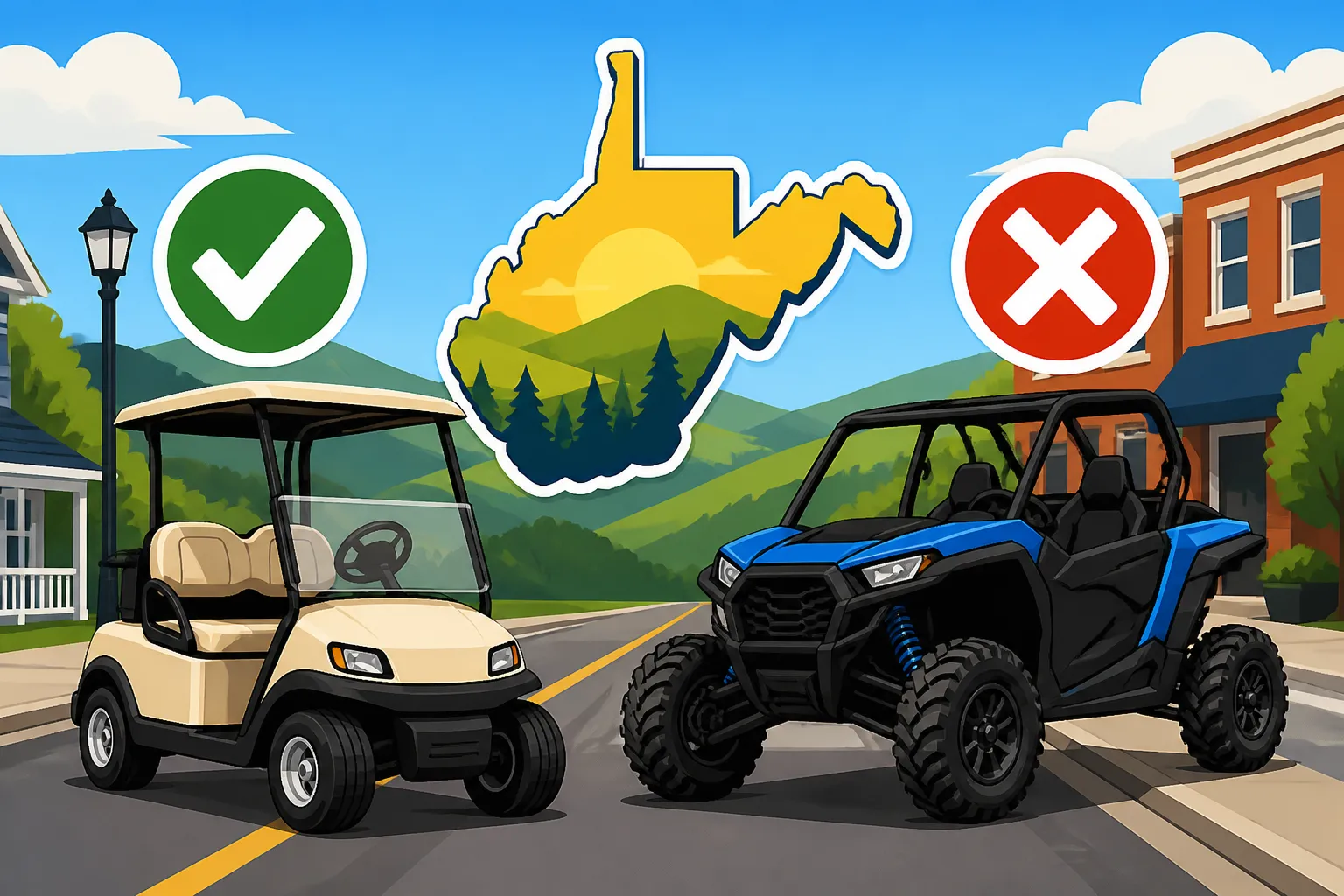
Generally, a golf cart is a small, motorized vehicle designed primarily for use on a golf course. They usually have a top speed somewhere between 15 and 25 miles per hour. When a West Virginia town allows golf carts on its roads, it's typically under very specific local rules, often requiring them to stay on slower streets and be equipped with basic safety features. They are not automatically street-legal statewide simply because they have a slow top speed. They require local ordinances to permit their use on public roads.
Low-Speed Vehicles (LSVs): Federally Regulated for Roads
An LSV, on the other hand, is a four-wheeled vehicle with a top speed greater than 20 miles per hour but not greater than 25 miles per hour. Critically, LSVs are manufactured to meet specific federal safety standards for low-speed vehicles. This means they often come from the factory equipped with:
- Headlamps
- Stop lamps
- Turn signal lamps
- Taillamps
- Reflex reflectors
- A rearview mirror or mirrors
- A parking brake
- A windshield
- Seat belts
- A Vehicle Identification Number (VIN)
Because LSVs meet these federal standards, they can often be titled and registered with the state DMV, much like a car. This state-level recognition gives them a clearer path to legal road use, though local ordinances can still impose restrictions on where they can be operated within town limits. [Low-Speed Vehicle Registration in West Virginia] allows these vehicles to operate on roads where the speed limit is 35 mph or less, unless a local authority restricts them further. This is a key difference from a standard golf cart.
Street-Legal Special Purpose Vehicles (SPVs): Modified for West Virginia Roads
Then there are SPVs. This category is unique to West Virginia and typically applies to modified ATVs or UTVs that have been made street-legal according to specific state requirements. These machines are often much more robust than golf carts and are explicitly designed to bridge the gap between off-road recreation and limited on-road travel. To qualify as an SPV, a machine must meet a rigorous list of equipment requirements, get a state-issued plate, and often carry specific insurance. [West Virginia's Street-Legal Special Purpose Vehicle Plate] allows these vehicles limited road access, usually on roads with speed limits of 25 mph or less, and often with a 10-mile, 25 mph rule for connections between trails. While an SPV might look similar to a souped-up golf cart to an untrained eye, its legal framework and capabilities are entirely different.
| Feature | Golf Cart (Standard) | Low-Speed Vehicle (LSV) | Street-Legal Special Purpose Vehicle (SPV) |
|---|---|---|---|
| Primary Design | Golf courses, private property | Low-speed public roads | Off-road recreation, limited road use |
| Top Speed | Typically 15-25 mph | 20-25 mph (by definition) | Varies, but road use often capped at 25 mph |
| Federal Standards | Generally no | Yes, meets NHTSA standards | No, modified ATV/UTV |
| State Title/Reg. | No (unless a specific LSV) | Yes, with WV DMV | Yes, with WV DMV (SPV plate) |
| Street Legal | Only with specific local ordinance | Generally on 35 mph roads or less | On specific roads with 25 mph limit or less |
| Equipment | Basic, local additions needed | Built-in safety features | Extensive modifications required (lights, horn, etc.) |
| Driver's License | Varies by local ordinance | Yes, valid driver's license | Yes, valid driver's license |
| Insurance | Varies by local ordinance | Required (state minimum) | Required (state minimum for SPV) |
Understanding these distinctions is crucial. A town's ordinance might explicitly refer to "golf carts" or "low-speed vehicles," and those terms have specific meanings under West Virginia law or federal standards.
Common Rules for Golf Carts in West Virginia Towns
Even with the local variability, there are some common threads you'll find in towns that do permit golf cart use on their streets. These rules are usually in place for safety, to minimize traffic disruption, and to differentiate golf carts from higher-speed traffic.
Speed and Road Restrictions
Most towns that allow golf carts will restrict them to roads with a posted speed limit of 25 mph or less. This is a common-sense safety measure, as golf carts are not built for higher speeds and cannot keep pace with faster vehicles. You'll rarely, if ever, find a town that permits golf carts on a state route or highway with higher speed limits. Sometimes, towns even specify which exact streets are permissible, often avoiding main thoroughfares. This is similar to [West Virginia's 10-Mile, 25 mph Road Rule] for ATVs, limiting where and how far these vehicles can travel on public roads.
Driver Age and Licensing
It's common for towns to require that golf cart operators on public roads possess a valid driver's license. This ensures that the person behind the wheel has at least a basic understanding of traffic laws and road etiquette. While some private communities or golf courses might allow younger, unlicensed drivers, public roads are different. Always assume a driver's license is required unless you've confirmed otherwise with the specific town. [West Virginia ATV Road Riding Age Minimum] often aligns with needing a driver's license for street use, and many towns apply a similar standard to golf carts.
Equipment Requirements
If a town allows golf carts on its roads, they will almost certainly have a list of required safety equipment. This often includes:
- Headlights and Taillights: Essential for visibility, especially if the town permits evening operation.
- Brake Lights: To signal stops to vehicles behind you.
- Turn Signals: For indicating turns. This is a major one, as many basic golf carts don't come with them. If you're adapting your cart, SuperATV and other aftermarket suppliers offer comprehensive turn signal kits that can be installed.
- Rearview Mirror: To see traffic approaching from behind.
- Horn: For signaling other drivers or pedestrians.
- Seat Belts: Depending on the design and passenger capacity, seat belts might be mandatory for all occupants.
- Reflectors: Additional visibility, particularly from the sides.
Think of it this way: if you're going to share the road with cars, your golf cart needs to be as visible and communicative as possible. This aligns with [Equipment West Virginia Requires on a Road Ride] for other recreational vehicles.
Hours of Operation
Many towns, even those that are ATV-friendly, may limit golf cart operation to daylight hours. If nighttime operation is allowed, it will be strictly contingent on having fully functional headlights, taillights, and other reflective gear. This is purely a safety measure to reduce the risk of accidents in low-light conditions. Always check for specific curfew or operating hour restrictions.
Insurance
While not always explicitly mandated by a town's golf cart ordinance, carrying liability insurance for any vehicle you operate on public roads is always a smart idea. If an accident occurs and you are at fault, that insurance will protect you from potentially devastating financial claims. Even if a town doesn't require it, consider it an essential part of responsible operation.
Navigating ATV-Friendly Towns with Your Golf Cart
Many West Virginia towns that welcome ATV and UTV riders have also extended their hospitality to golf carts, understanding their utility for visitors moving between lodging, food, and local attractions. Towns like Gilbert, Man, or Mullens often have ordinances that are more lenient or clearly defined for low-speed vehicles.
In these trail towns, golf carts can be a fantastic way to cruise to a restaurant after a long day on the trails, grab groceries, or simply explore the small-town charm. However, even in these welcoming communities, you cannot assume a free-for-all. They still have specific rules to ensure safety and order. For example, while you might be able to ride your golf cart to a restaurant in Gilbert, you still need to adhere to speed limits and parking regulations. [Riding to a Restaurant in Gilbert] with your golf cart can be a fun experience, but knowing the local street rules is paramount.
Always remember that these local rules can change. Town councils meet, new ordinances are passed, and old ones are amended. What was true last year might not be true today. A quick call to the city clerk's office before your visit can save you a lot of headache and ensure you're riding legally and safely.
Disclaimer
This article is for general informational purposes only and does not constitute professional advice. Laws, prices and regulations vary by location and change over time. Consult a qualified professional for guidance on your specific situation.