Hill Climbs in Southern West Virginia
A steep climb can look straightforward from the bottom, then turn slick, rocky, or rutted halfway up. That is a real concern on Southern West Virginia trails, where weather and terrain can change the ride quickly. This guide explains how to assess a hill, prepare your ATV or UTV, choose a sensible line, and respond safely if the climb stops going to plan.
What Makes Hill Climbs in Southern West Virginia Challenging
Expect changing surfaces rather than one consistent slope
A hill climb is rarely just a steep patch of ground. The approach may be packed dirt, while the slope itself has loose rock, exposed roots, mud, or deep ruts. A line that looks manageable from below can become harder when the tires reach a slick section or the machine loses momentum.
Southern West Virginia’s wooded trails can also have limited sightlines. You may not be able to see the full climb, the landing area, or what lies beyond the crest. Before committing, consider whether you can see enough of the route to make a safe decision. If the top or your intended path is hidden, stop somewhere secure and assess it rather than charging upward to find out.
Rain makes these changes more consequential. Water can loosen dirt, fill ruts, expose rocks, and leave roots slick. Even after the surface dries, shaded sections may stay damp. If the slope looks churned up or has fresh runoff channels, assume traction may be less predictable than it was earlier in the day.
Trail difficulty is not a promise that every obstacle will suit you
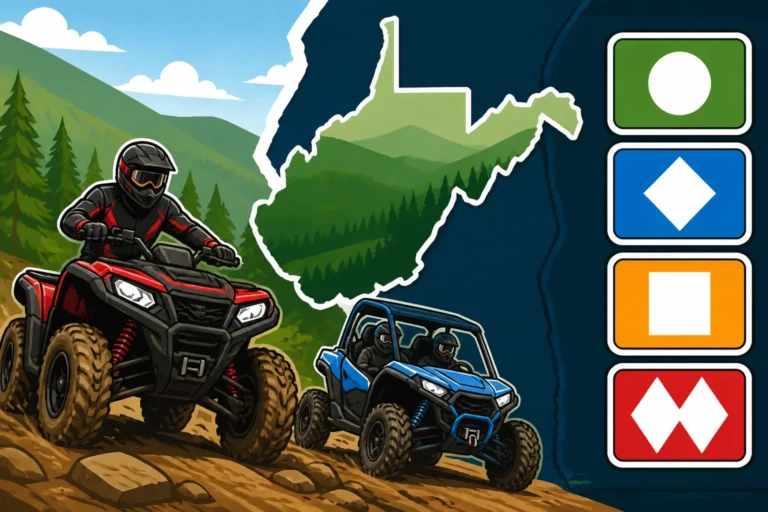
Trail ratings help riders make choices, but a rating cannot account for every rider’s experience, machine setup, or the day’s weather. A trail that felt comfortable on a dry morning may feel very different after heavy rain or several machines have passed through. Review West Virginia Trail Difficulty and How It Is Marked before your trip, and pay attention to posted signs and trail markings at the site.
It also helps to think beyond the label. Ask yourself whether your machine fits the route, whether you are comfortable controlling it on a slope, and whether your group can manage a safe retreat if the climb proves too difficult. If any answer is uncertain, choose a different route. There is no obligation to attempt a hill simply because it is open or because another rider is heading up.
If a route includes loose rock or uneven steps, those obstacles bring their own demands. The guide to Technical Rock Sections in West Virginia can help you think through the added challenge of uneven footing and tire placement. A steep hill with rocks or ledges is not the same as a smooth incline, and it may call for a different decision about whether to proceed.
Choose climbs that match the least experienced rider
Group rides can make it tempting to follow the person in front, even when you are unsure of the terrain. Before the ride, talk openly about skill levels and agree that anyone can pass on a climb without pressure. This matters especially when riders are on different machines or have different experience with steep, loose surfaces.
A newer rider may be more comfortable on a wide, visible slope than on a narrow route with ruts, rocks, or a blind crest. A capable adult may also be new to a particular machine. Familiarity with a quad does not automatically translate to confidence in a side-by-side, or vice versa. Give everyone room to choose a suitable route.
If you are considering a system around Logan or Gilbert, check the current trail information and local guidance before selecting a route. The Hatfield-McCoy Trailheads and Where to Start guide can help orient your planning, while The Hatfield-McCoy Trails, West Virginia’s 1,200-Mile Network offers broader context about the trail network. Do not treat a large network as a guarantee that every trail is open or appropriate for your group that day.
How to Assess a Climb Before You Commit
Stop in a safe place and read the slope
Approach a challenging hill slowly enough to stop before the incline, without blocking a trail junction or putting yourself in the path of other riders. Look over the route from the bottom. If it is safe and allowed to do so, check whether there is a clear path, a visible crest, and enough space to stop or turn around at the top.
Notice features that could affect control: loose gravel, wet leaves, ruts, roots, embedded rocks, a sharply uneven edge, or a narrow section with little room to correct your line. Also consider what is above the hill. A blind crest can hide another rider, a turn, a drop, or an obstacle. If you cannot tell what is waiting at the top, that uncertainty is part of the risk.
A rider who has already gone up can share useful observations, but their success does not prove the route is right for you. Their machine, tires, riding experience, and chosen line may differ from yours. Ask what the surface was like, whether they encountered a difficult section, and what the landing area looked like. Then make your own decision.
Use maps as a planning aid, not a substitute for judgment
Planning can prevent avoidable surprises, particularly when your group is unfamiliar with an area. A map can help you understand where a trail leads, find nearby alternatives, and avoid relying on memory alone. Tools such as onX Offroad can be useful for reviewing a route before the ride and keeping a sense of where you are while navigating.
A digital map does not tell you whether a particular slope has become muddy, whether a trail has a temporary closure, or whether an obstacle is suitable for your machine. Check the trail authority’s current notices and posted signs, and be prepared for conditions to differ from what a map suggests. If you use onX Offroad, download or prepare the information you need before entering areas where cell service may be unreliable. Do not stop in an unsafe spot to troubleshoot a phone.
It is also smart to carry a backup navigation plan. A paper map or trail information saved for offline use can help if a device loses power or reception. West Virginia Trail Maps and Signage and Getting Lost on a West Virginia Trail are useful topics to review when planning a route, especially if your group will be riding unfamiliar connectors.
Decide what would make you turn around
A useful climb assessment includes a clear stopping point. For example, decide before you start that you will turn back if the surface is wetter than expected, the machine begins to lose traction, or the route narrows beyond your comfort level. This prevents a common mistake: continuing only because you have already invested effort in the climb.
If there is no safe way to turn around or reverse course, that is important information before you begin. Avoid starting a climb when you cannot identify a safe plan for stopping or retreating. Never assume the only option will be to keep going. A hill that leaves no practical exit can turn a manageable challenge into a dangerous situation.
| What to check | Why it matters | Safer response |
|---|---|---|
| Surface and recent rain | Mud, loose rock, and wet roots reduce predictable traction | Choose another route if the surface feels beyond your ability |
| Visibility to the crest | You may not see a rider, turn, or obstacle ahead | Do not charge up a blind climb |
| Room to stop or retreat | A stalled machine may need a safe way back down | Skip the climb if there is no practical exit plan |
| Machine fit and condition | Tires, brakes, and controls affect how confidently you can manage a slope | Check the machine and choose terrain that suits it |
| Group spacing | A rider below can be endangered by a machine that rolls or slides | Keep the climb clear and send riders one at a time |
Riding a Hill With Control
Set up before the front tires reach the slope
Make your key decisions before you start climbing. Select a suitable line, make sure the path is clear, and give the rider ahead enough space to finish. Avoid bunching up at the bottom: if a rider stops or has trouble, others need room to wait without being directly underneath the machine.
Approach in a controlled way. The goal is not to hit the hill as fast as possible, but to maintain manageable movement and avoid abrupt inputs. Follow the operating guidance for your particular ATV or UTV, and do not experiment with a technique you have not learned in a lower-risk setting. Controls and recommended body position can vary by machine.
Keep your attention on the route you chose and the terrain immediately ahead. A sudden change in direction or throttle can upset balance or traction. If the line becomes unsafe, prioritize stopping in the safest available place and reassessing rather than trying to force the machine through an obstacle.
Avoid turning a stalled climb into a recovery emergency
A machine that loses momentum or traction can be difficult to manage on a slope. Do not assume you can safely back down, turn around, or get off while it is pointed uphill. The correct response depends on the machine, the terrain, and the rider’s training, so follow the manufacturer’s guidance and get instruction on recovery before attempting steep terrain.
If you cannot continue safely, communicate with your group and keep other riders clear of the slope. Do not stand directly below a machine that could roll or slide. Avoid asking someone to pull or push a vehicle from a position where they could be caught between it and the ground, a tree, or another obstacle. When a recovery requires equipment or experience you do not have, stop and seek appropriate help rather than improvising.
For more remote areas, think ahead about what your group would do if a machine became disabled. What to Carry on a Remote West Virginia Ride can help with preparation, while Recovery and Towing on West Virginia Trails covers the broader challenge of getting help or equipment to a machine on a trail. A phone may not be enough if reception is poor, so tell someone your planned area and expected return time before you head out.
Keep the climb clear and respect other riders
Only one machine should be attempting a narrow or steep climb at a time. Riders waiting below should stay well back from the slope and outside any likely path of a rolling or sliding machine. Riders at the top should leave space for the person climbing and avoid stopping in a way that blocks the landing area.
Do not create a new route around a difficult spot by cutting across vegetation or leaving the marked trail. Going around a muddy or rocky obstacle can widen the trail, damage the slope, and put riders on land where they may not be permitted. Stay on marked routes and follow signs, gates, and closures. West Virginia Trail Etiquette on Shared Routes provides useful context for sharing trails responsibly.
If a climb is too difficult for someone in your group, treat that as a route-planning issue, not a reason to pressure them. Turn around together if needed, or use an authorized alternate route. A good group ride is one where every rider can make a cautious choice without being hurried or shamed.
Preparing Your Machine and Ride Plan
Check the machine before leaving the staging area
A pre-ride check is especially worthwhile when you expect hills, rocks, or muddy sections. Look at the tires for visible damage and confirm that they appear properly inflated according to the manufacturer’s guidance. Check that the brakes respond normally, controls move as expected, and there are no fresh leaks or loose components.
Carry only what you need, and secure any gear so it cannot shift while climbing. For a UTV, make sure occupants use the machine’s safety equipment as directed by the manufacturer. For an ATV, consider whether the machine and your riding position are appropriate for the terrain. A machine that has a mechanical problem on level ground can become harder to manage on a slope.
Preparation also means understanding the limits of your setup. Oversized or poorly suited tires do not guarantee better traction, and added cargo can change how a machine handles. If you are uncertain whether a modification or load is appropriate, check the owner’s manual or ask a qualified mechanic before taking it onto difficult terrain.
Plan around weather, daylight, and the whole group
A climb may be manageable early in the day and substantially harder after rain or repeated traffic. Check the forecast, but also pay attention to local trail conditions and recent reports. If the route is muddy or visibility is poor, scaling back your plans is often the most practical choice.
Leave enough time to ride the route without rushing. Trying to squeeze in one more difficult climb near the end of the day can lead to hurried decisions, fatigue, and reduced visibility. Be especially conservative if anyone in the group is tired, cold, overheated, or unfamiliar with the area. Build in breaks and agree on a meeting point if riders become separated.
Before setting out, confirm that your planned trails are open to your machine and that you understand applicable permits, access rules, and any trail-specific restrictions. The route you see on a map is not permission to ride it. Trail Closures on West Virginia’s Trail System and West Virginia Trail Rules Every West Virginia Rider Signs Up To are relevant planning topics to review before heading out.
Know when choosing a different route is the right call
There is no single correct way to enjoy Southern West Virginia riding. Some people like technical climbs; others prefer a steady route with better visibility and fewer obstacles. Both can make for a rewarding day. The best choice is the one that matches the people, machines, and conditions you actually have—not the ride you hoped the weather would allow.
If you find yourself repeatedly asking whether a hill is too steep, too slick, or too narrow, pause and take that uncertainty seriously. Check whether there is an approved alternate route, wait for conditions to improve, or return another day. A cautious decision at the bottom is much easier than a difficult recovery halfway up.
Use onX Offroad or another navigation tool to help organize your route, but pair it with current trail notices, signs, and a willingness to change plans. In Southern West Virginia, good judgment is part of the ride. A successful day does not require conquering every climb; it means getting your group back safely with the machine in good shape and the trail left as you found it.
Disclaimer
This article is for general informational purposes only and does not constitute professional advice. Laws, prices and regulations vary by location and change over time. Consult a qualified professional for guidance on your specific situation.