Mud Holes Riders Talk About
A muddy rut on a West Virginia trail can look like a quick splash until it hides a rock, a deep pocket, or a machine’s undercarriage. That uncertainty is why riders talk about mud holes long after a trip. This guide explains how to judge a muddy section, choose a safer line, protect your machine, and know when turning around is the smart call.
Why West Virginia Mud Holes Get So Much Attention
Mud is a changing trail condition, not a fixed attraction
Riders sometimes talk about a “mud hole” as if it were a permanent feature with a predictable depth. In reality, a muddy section can change substantially with rainfall, temperature, traffic, drainage, and the shape of the ground beneath it. A spot that was a shallow puddle during one ride might become a deep rut after repeated passes. A trail that seemed firm on the way out might be slicker and more chewed up on the return.
The Appalachian terrain adds to the uncertainty. Water can run down a slope and collect in a low spot, while soft soil and exposed rocks make traction hard to predict. Even a puddle that looks small may cover a rut or a change in grade. The surface can also vary across a single muddy stretch: one tire may meet firm ground while another drops into a softer track.
That is why reports about a particular mud hole are best treated as clues, not guarantees. A rider’s account can help you anticipate the type of terrain, but it cannot tell you exactly what you will find on your ride. Before heading out, check current trail information and read West Virginia Trail Conditions After Rain alongside trip-specific updates.
What makes a mud hole risky
The danger is not simply getting wet. A machine can lose traction, slide sideways, or become stuck if the tires spin in deep mud. Hidden rocks, branches, and ruts can catch a tire or strike the underside of an ATV or UTV. If water obscures the ground, it can be difficult to judge whether the trail continues at the same depth or drops into a deeper pocket.
There is also a group-riding risk. A rider who stops abruptly in a narrow muddy section may leave the next machine with little room to react. A machine trying to pass can damage the trail edge or expose riders to a steep bank. If someone becomes stuck, a casual pull by another machine can create a second problem: the recovering vehicle may lose traction or be pulled toward a rut, slope, or unstable edge.
Mud, rock, and water often appear together, so it helps to understand how those features interact rather than treating every wet section as a simple puddle. Mud, Rock and Creek Crossings in West Virginia offers useful context for evaluating mixed terrain and choosing a cautious approach.
How to Judge a Muddy Section Before You Enter
Stop, look, and assess the whole approach
If you can safely stop before the muddy section, take a moment to observe it. Look for the trail’s overall direction, the slope, the exit point, and any visible ruts or exposed obstacles. Check whether water is standing still or moving, but do not assume clear-looking water is shallow. A clean surface can conceal an uneven bottom just as easily as cloudy water can.
Look for signs of what other machines have done. Deep tire trenches, sharply cut edges, or churned-up soil can indicate that the ground is soft or that riders have been struggling. Those marks are not invitations to follow the same line. A rut that worked for a larger machine may be too deep or awkward for a smaller ATV, and the most-used line may be the most damaged one.
If you cannot see a safe path through, avoid walking into deep or fast-moving water to check it. A walking inspection can be dangerous if the ground is slippery or the bottom drops away. When the depth, footing, or exit is uncertain, treat that uncertainty as information. It may be safer to wait for another rider’s guidance, choose a permitted alternate route, or turn back.
Choose a line for control, not for spectacle
Riders sometimes feel pressure to follow the deepest rut because it appears to be the established route. But ruts can trap a tire, pull the machine off balance, or leave too little clearance underneath. If the trail allows a firmer and clearly safe line, use it without widening the trail or cutting through vegetation. Do not create a new route around a muddy obstacle; that can damage the land and turn one difficult section into several.
Before moving, decide how you will enter, where you expect to exit, and what you will do if traction disappears. Keep your speed controlled and avoid sudden steering or throttle inputs. A rapid burst of power can spin tires, dig deeper holes, and make it harder to regain control. If you are riding a UTV, account for its size and turning space; a narrow rut or tight edge may leave little room to correct a slide.
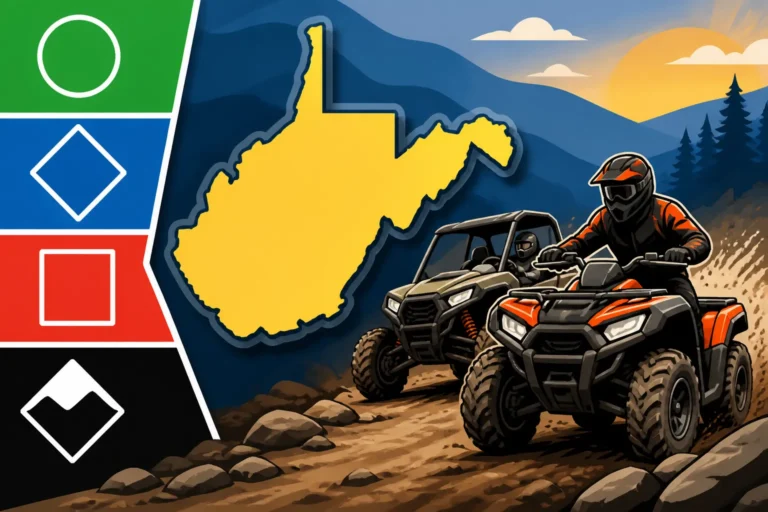
Trail markings and difficulty designations can help with route planning, but they do not promise that every section will be easy in current conditions. A trail’s difficulty may feel different after rain or heavy use. Review West Virginia Trail Difficulty and How It Is Marked before choosing a route, and remember that your machine, experience, passengers, and the day’s conditions all matter.
| What you notice | What it may mean | A cautious response |
|---|---|---|
| Deep, sharply cut ruts | The surface may be soft or heavily disturbed | Avoid entering until you can identify a controlled line and clear exit |
| Water covering the trail surface | The bottom and depth may be hidden | Do not assume it is shallow; seek a safer option if you cannot assess it |
| A steep or slick exit | The machine may struggle to regain traction | Reconsider the crossing rather than committing without a recovery plan |
| Several riders stopped ahead | The section may be blocked or difficult | Keep a safe distance and wait for clear communication |
| A damaged trail edge | Repeated bypassing may be widening the route | Stay on the marked trail and do not create another bypass |
Riding Through Mud Without Making the Problem Worse
Keep the group organized and give each rider space
On a group ride, do not crowd the machine ahead. A rider may need time to choose a line, slow down, or stop. Leave enough distance to react without putting your own machine into the same rut or forcing the rider in front to hurry. If the section is narrow, agree on a simple communication plan before the group reaches it. Riders should know whether the group is proceeding one at a time and where everyone will wait.
A spotter can be helpful when there is a clear, safe place to stand and the rider can see and hear the guidance. The spotter should not stand in the machine’s path, on an unstable edge, or where a slipping vehicle could strike them. Keep passengers inside a UTV during movement unless the operator’s manual and the situation provide a safe reason otherwise. Never ask someone to push from a position where the tires, belts, or moving parts could reach them.
If a rider is stuck, pause and make a plan rather than immediately adding throttle or pulling hard. Repeated wheelspin can dig the machine deeper and churn the trail. Use recovery equipment only if the people involved know how to use it safely, and attach it only to appropriate recovery points. Avoid improvised pulls from parts that can bend or break. If the situation is beyond the group’s ability, a recovery service may be safer than escalating a risky attempt.
Protect the trail and respect other riders
Mud is part of off-road riding, but damaging a trail to get through one wet spot is not a harmless shortcut. Do not drive around a barrier, bypass a flooded or closed section, or widen the trail to avoid a rut. A new track can damage plants and soil, encourage others to leave the marked route, and create a larger maintenance problem.
Stay on designated routes and follow posted signs, even when a detour looks convenient. Staying on Marked Trails in West Virginia is a useful reminder that avoiding trail damage is part of responsible riding, not just a courtesy. If you encounter a closure or unsafe section, do not assume you can cross it because other riders have left tire marks nearby.
Give oncoming riders room, communicate clearly, and avoid revving or spinning tires while someone is assessing a section. A person who is standing beside a trail may be checking footing, helping a companion, or waiting for space to proceed. West Virginia Trail Etiquette on Shared Routes can help set expectations for courteous riding when the trail is busy or visibility is limited.
Planning for Mud and Knowing When to Turn Around
Prepare for conditions before leaving the trailhead
Mud changes what you need to carry. A small repair kit, basic first-aid supplies, water, a charged phone, and recovery gear suited to your machine can make a delay less stressful. Pack so that essential items remain accessible if the machine is parked or stuck. Let someone know your planned route and expected return, especially if your ride includes remote sections.
Navigation can also be useful when the ride does not go as planned. A map helps you understand where you are relative to trail junctions and possible return routes, but it should not tempt you to leave the designated trail. Riders who use onX Offroad can review their planned route before setting out and keep orientation information available during the ride. It is sensible to carry a backup map as well, since phones and other electronics can lose power or signal.
Make your plan flexible. If rain has made the route much slicker than expected, shorten the ride or choose a more suitable marked route instead of trying to keep to a timetable. Before setting off, review trail access information and Trail Closures on West Virginia’s Trail System. Closures and conditions can change, and a route that was open during a previous visit may not be appropriate for today’s ride.
Turn back when the risks outweigh the reward
Turning around can feel disappointing, especially if your group has traveled a long way or planned the ride around a specific area. But a muddy obstacle is not a test of commitment. If you cannot identify the depth, the bottom, a stable exit, or a safe recovery option, you have a reasonable basis to stop. The same is true if a rider in the group is uncomfortable, the machine is struggling, or the trail is becoming more damaged with every attempt.
Before your trip, agree that anyone can call for a pause without being pressured to continue. This matters for newer riders, young riders, and anyone operating a machine they are still learning to control. A group that discusses this in advance is less likely to turn a sensible safety decision into an argument on a slippery trail.
Mud holes can be memorable parts of an off-road trip, but they are not worth risking an injury, damaging a machine, or leaving a trail worse than you found it. Read the terrain, keep your decisions conservative, and choose routes that match the group’s experience and equipment. For broader preparation, What to Carry on a Remote West Virginia Ride can help you think through supplies and contingencies before leaving the trailhead.
Disclaimer
This article is for general informational purposes only and does not constitute professional advice. Laws, prices and regulations vary by location and change over time. Consult a qualified professional for guidance on your specific situation.