West Virginia’s ATV Safety Awareness Course
West Virginia’s ATV safety awareness course is easy to confuse with a trail permit, title requirement or road-riding license. It is a separate safety requirement, especially important for young riders and families planning a trip. This guide explains who may need the course, what it covers, how to keep proof of completion and what to check before riding on a managed trail or public road.
What the West Virginia ATV Safety Awareness Course Does
The ATV safety awareness course is intended to teach riders how to operate an all-terrain vehicle responsibly and reduce avoidable crashes. It is particularly relevant to young operators, but its lessons are useful to any rider who is new to ATVs, UTVs or West Virginia trail conditions.
For riders who are required to take it, completing the course is a safety step as well as a compliance step. The course does not, by itself, give you permission to ride anywhere. You still need to follow the rules for the property, trail system or road you plan to use.
That distinction matters because several different kinds of paperwork can come up before a ride:
| Item | What it generally addresses | What it does not replace |
|---|---|---|
| ATV safety awareness course or card | Rider safety education and proof of completion when required | A trail permit, title, insurance or road authorization |
| Trail permit | Access to a particular managed trail system | Safety-course requirements or machine ownership documents |
| Title | Legal ownership of a machine when titling rules apply | Permission to ride on a particular trail or road |
| Insurance | Financial protection under the policy’s terms and any applicable requirements | A trail permit, course card or title |
| Street-legal registration or plate | Authorization for a machine that qualifies to use certain public roads | Trail access rules or the general course requirement |
If you need to sort out ownership paperwork, start with Titling an ATV in West Virginia. For trail access, see West Virginia’s Hatfield-McCoy Trail Permit Explained. Neither process should be treated as a substitute for checking whether a rider needs safety training.
The course also does not automatically make a machine street legal. A rider may complete the course and still be prohibited from taking an ATV onto a particular public road. Road use depends on the machine, the road, the applicable law and any required equipment or registration. For the separate road-use question, see Riding an ATV on the Road in West Virginia.
A practical way to think about it is:
- The course concerns the rider. It teaches safe operation and may provide proof of training.
- The permit concerns access. It applies to a particular trail system or riding area.
- The title concerns ownership. It helps establish who legally owns the machine.
- The registration or plate concerns road use. It applies only where the machine and use qualify.
- The insurance policy concerns coverage. Its protection depends on the policy terms and the situation.
A family heading to the trails may need to check more than one of these items. Before leaving home, confirm the current requirements for the rider, the machine and the destination rather than relying on a single card or sticker to cover everything.
Who May Need the Course and When Exceptions Matter
West Virginia’s safety-course rules are especially important for riders under 18. The requirement and any exceptions can depend on where and how the ATV is being operated, so families should not assume that one answer applies to every setting.
Private property, public roads and managed trail systems may be treated differently. A rider who is allowed to operate on a private parcel is not automatically cleared to ride on a public road or a managed trail. Likewise, a rule that applies at one trail system may not settle the requirement for a different riding area.
Under-18 riders
If a child or teenager will operate an ATV, check the current state requirement before the trip and confirm whether it applies to the particular riding location. Do this even if the young rider has completed another state’s course, has ridden for years or will be supervised by an adult. Experience and adult supervision are valuable, but they should not be assumed to replace a required course.
Families should also separate the course question from the machine-size question. A course card does not mean a child can safely operate any ATV. Manufacturers give age and size guidance for their machines, and a young rider needs a vehicle that fits their reach, strength and experience. Read Youth ATV Size Rules for West Virginia Families and Manufacturer Age and Size Requirements before choosing a machine.
Managed trail systems
West Virginia has specific provisions involving managed trail systems, and a course exemption may apply in some managed-trail circumstances. Do not turn that into a blanket assumption that every rider at every managed trail is exempt. The relevant details may include the rider’s age, the type of use and the particular site’s rules.
Before relying on an exemption, verify it with the official state source and the trail authority or operator. Ask a direct question: “Does this rider need the West Virginia ATV safety awareness course for this machine and this specific trail system?” If you are visiting Hatfield-McCoy, also check the authority’s current rider rules and permit information. The trail permit and the course requirement are separate issues.
The list of requirements a rider signs up to follow is discussed in Trail Rules Every West Virginia Rider Signs Up To. For the specific relationship between the course and managed trail use, see Why Managed Trails Are Exempt From the Course. Read the current guidance rather than relying only on a past trip, a friend’s experience or an old social media post.
Private land and public roads
A rider using a machine only on private land may be in a different position from one riding on a public trail or road. That does not mean that private-land use has no safety obligations, landowner rules or liability concerns. It means the location can affect which statutory requirements apply.
Public-road use is another separate category. A safety course is not a driver’s license, and it does not authorize an ATV to use roads. West Virginia road-riding rules include limits on where and how a machine may travel. Review Which West Virginia Roads Allow ATVs and Driver’s License Rules for West Virginia Road Riding before planning a road section.
When you are unsure, use the more cautious approach: confirm the rule before riding, carry any proof that may be relevant and do not let a course exemption for one location stand in for checking another.
What the Course Covers and Why It Matters on West Virginia Trails
A safety course is more useful when riders treat it as practical preparation, not just a requirement to get out of the way. West Virginia’s terrain can include steep grades, narrow routes, loose rock, mud, water crossings and changing visibility. A rider who can handle a machine on a flat field may still need to adjust speed, line choice and braking on a mountain trail.
Course content and delivery can vary, so check the current course materials for the official topics. In general, ATV safety education is designed to help riders understand the machine, make safer decisions and avoid putting themselves or others at unnecessary risk.
Know the machine before moving
A rider should know where the controls are and how the machine responds before entering a trail. That includes the throttle, brakes, gear selection, parking brake, lights and engine shutoff. A young operator should be able to reach and use the controls without stretching, leaning awkwardly or losing a stable position.
The rider should also understand the limits of the vehicle. An ATV or UTV can feel stable on level ground but behave very differently on a side slope, during a sharp turn or when carrying a passenger or cargo. Added weight changes handling and stopping distance. A machine that is appropriate for an adult may be too large for a child to control.
Choose speed for the conditions
A marked trail is not a promise that every section is easy. Speed should reflect the rider’s experience, sight lines, traction, trail width and the presence of other riders. On a blind curve, crest or narrow ledge, the safe speed may be far below the posted maximum or what the machine could physically reach.
Leave enough room to stop without sliding into another rider or running off the trail. On wet ground, loose gravel or steep descents, braking and steering can become less predictable. Smooth inputs are generally easier to control than sudden acceleration, hard braking or sharp turns.
Read the trail and respect boundaries
Trail markers, gates and signs are not suggestions. They can identify permitted routes, closures, hazards or restrictions on vehicle type. Going around a closed gate or riding beyond a marked boundary can create safety risks and jeopardize access for everyone.
Before the ride, learn how the trail system marks difficulty and closures. West Virginia Trail Difficulty and How It Is Marked explains how to use trail ratings as one part of your decision. A rating is not a guarantee that a trail will feel the same in every weather condition or for every machine.
Make protective equipment routine
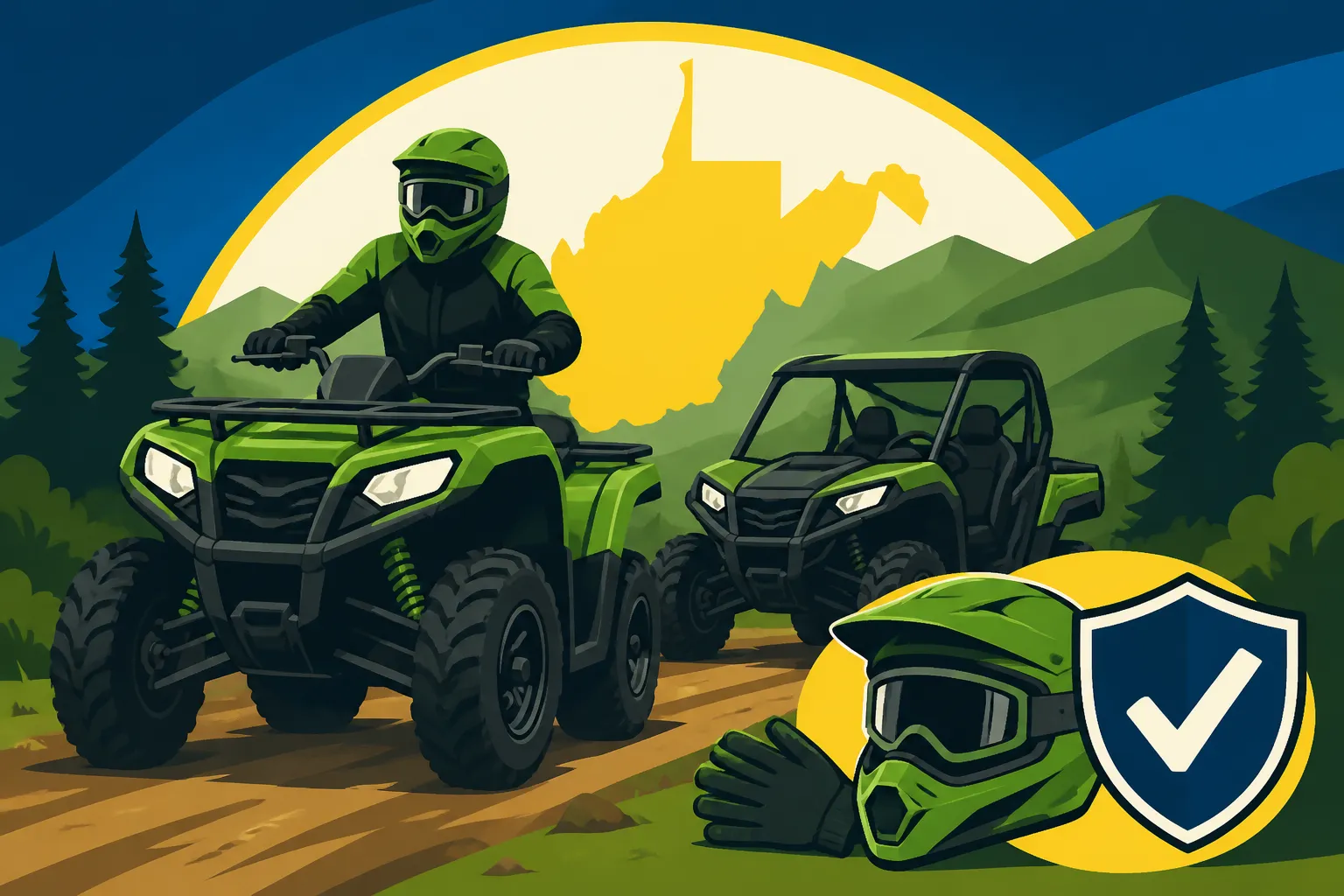
A properly fitted helmet and suitable eye protection are essential parts of a safe ride. The right equipment depends on the rider, machine and applicable rules. Riders should use protective gear that fits securely and stays in place, rather than treating a helmet as something to wear only when a ranger or law-enforcement officer is nearby.
Course completion does not replace helmet requirements. Check the rules for the specific trail or road, including any age-specific requirements. See Helmet and Eye Protection Rules in West Virginia for a broader look at protective equipment.
Ride as a group with a plan
Group riding can create pressure to keep pace with faster or more experienced riders. Set a pace that suits the least experienced operator, keep a safe following distance and agree on what to do if the group gets separated. A lead rider should not assume that everyone behind can see the route or react to hazards at the same speed.
For families, the adult should be able to supervise without riding so far ahead that the child is effectively on their own. The course can provide a shared starting point for discussing safe choices, but the adult still needs to reinforce those choices throughout the ride.
How to Complete the Course and Keep Proof
Course availability, format and the process for obtaining proof can change. Check the West Virginia DMV’s current ATV safety information before choosing a course or making travel plans. Do not assume that a third-party course, a course from another state or an online video will automatically meet West Virginia’s requirement.
The West Virginia DMV ATV Safety Awareness Course page is a useful place to begin. Confirm the current instructions there, including whether the course is available online, in person or through another approved method. If the rider is close to a trip date, check early enough to resolve any questions about scheduling, identity information or documentation.
A sensible process looks like this:
- Identify who will operate a machine. List every rider, not just the person whose name is on the title or rental agreement.
- Check each rider’s age and circumstances. The requirement may be different for a minor than for an adult, and the location may affect whether a provision or exception applies.
- Confirm the riding location. Ask the relevant trail authority or land manager whether its rules add anything to the state requirements.
- Use an accepted course. Follow the current directions from the official source. Do not assume a generic safety certificate will be accepted.
- Complete every required step. If the course includes a test, required in-person component or identification step, finish it rather than stopping after viewing the material.
- Save proof of completion. Keep the card or other official evidence in a secure place and make a clear backup copy.
- Check what must be carried or displayed. A course card, helmet sticker or other proof may have a specific use. Confirm what the rules actually require instead of guessing.
- Recheck before the ride. Verify that the course proof, trail permit and other documents are ready for the specific trip.
Keep the original and a backup
If the rider receives a safety card, keep the original where it will not be damaged or lost. A photograph or digital copy can be useful as a backup, but do not assume that a photo is accepted in place of the original if an official asks for proof. Check the current instructions for the accepted form.
If the program issues a sticker or other marker, follow the official directions about where and how to use it. A sticker is not the same as a trail permit. Riders should not cover, alter or move required identification without checking the instructions.
A small document pouch or waterproof holder can help keep cards and trip information together. If you shop for one on Amazon, choose a product that keeps the documents dry without making them hard to retrieve. That is a convenience, not a substitute for knowing which proof the trail authority accepts.
If proof is lost or a record is unclear
If a rider completed the course but cannot find the card, contact the issuing agency and ask how to verify or replace the record. Do not wait until the morning of a trip. Processing times and replacement procedures can vary, and a screenshot of an old email may not be enough to resolve a question at the trailhead.
If a name, date or other detail is wrong, ask the issuer how to correct it. Keep any confirmation you receive. Avoid editing a document yourself, even if the error seems minor.
Planning for Children and Teen Riders
For a family, course completion is one piece of a larger safety plan. A child needs a machine that fits, adult supervision appropriate to the child’s ability and a route that matches the rider’s experience. Completing a course is worthwhile, but it does not guarantee that a young rider is ready for a demanding trail.
Match the machine to the rider
A child should be able to sit comfortably, reach the controls and operate them without losing balance. They should have enough strength to steer and brake under realistic conditions, not only while stationary. If a rider cannot comfortably control the machine, an adult’s presence cannot make the machine a good fit.
Pay attention to manufacturer recommendations. Engine size alone does not tell the whole story: weight, power delivery, seat height, control layout and the child’s coordination matter too. See Best First Quad Size for a Ten-Year-Old and 90cc Versus 110cc for a Young Rider for more on sizing decisions.
Supervision should be active
“An adult is nearby” is not the same as active supervision. The supervising adult should be able to see or quickly reach the young rider, understand the route and intervene if the child gets stuck or overwhelmed. A very fast group ride, a long gap between riders or a complicated trail network can make supervision less effective.
Before setting off, agree on a few simple rules:
- Stop where the adult can see you if you become separated.
- Do not pass the lead adult unless instructed.
- Do not leave the marked route.
- Slow down before blind turns and steep descents.
- Tell the adult immediately about a problem with the machine or protective gear.
- Do not ride a route that feels beyond your ability just to keep up with the group.
Choose beginner terrain honestly
Families sometimes choose a route based on the experience of the adults and underestimate how difficult it may feel to a new rider. Look at trail ratings, width restrictions, current conditions and the child’s actual skills. A route that is technically open to the family’s machine may still be a poor choice for a young operator.
Build in breaks and turn back before fatigue or frustration affects judgment. If a child is tired, cold, overheated or scared, continuing to finish a planned loop is not worth the risk. For more planning help, see Riding West Virginia Trails With Kids and Family Loops at Hatfield-McCoy.
Check passenger rules separately
A course does not decide whether a child may ride as a passenger. Passenger rules can depend on the machine, the rider’s age, the vehicle’s seating and the rules of the location. Never carry a passenger on a machine designed for one person, and do not assume that a child can safely hold on without a proper passenger seat and appropriate restraints where required.
For a UTV, check the manufacturer’s seating guidance, seat belts and passenger limits. See Riding With a Child in a Side-by-Side for the separate considerations that apply when a child rides as a passenger.
Visitors, Reciprocity and the Difference Between a Course and a Permit
Visitors often ask whether an out-of-state safety card is enough to ride in West Virginia. The safest answer is to verify acceptance with the relevant West Virginia authority before travelling. Course recognition can depend on the specific credential and the type of riding. Do not assume that a certificate from another state is accepted simply because it covers similar topics.
The same principle applies in reverse: a West Virginia course card should not be assumed to satisfy another state’s rules. If a trip crosses state lines, check the requirements in each jurisdiction and for each riding location.
A few distinctions help avoid common misunderstandings:
- A safety course is not a trail permit. A visitor may need both.
- A trail permit is not course proof. Buying one does not necessarily satisfy a rider-training requirement.
- A machine’s home-state registration does not settle every West Virginia requirement. It may not answer questions about course completion, permits or road use.
- A rental company’s instructions may be helpful but are not a substitute for the official rules. Ask what is included and what each rider must provide.
- A managed-trail exception should not be assumed to apply off the managed trail. A short connecting road or a ride on other land may have separate requirements.
Visitors can use [Out-of-State Riders on West Virginia Trails] and Do Other States’ Registrations Work in West Virginia? to sort out related access questions. If the trip includes a road section, review the road rules separately; trail access does not make every connecting road legal for ATV use.
Ask a precise question before travelling
Instead of asking only, “Do I need a course?” explain the situation:
- What is the rider’s age?
- Is the rider operating or riding as a passenger?
- What kind of machine is involved?
- Will it be used on private property, a managed trail or a public road?
- What state issued the rider’s safety certificate?
- Does the planned trail operator have an additional rule?
This makes it easier for the agency or trail authority to give an answer that fits the actual trip. Keep a note of the guidance and the date you checked it, especially if you are coordinating several riders.
Common Mistakes and a Practical Pre-Ride Checklist
The course requirement is not usually the only thing that can derail a trip. Families and visitors often focus on getting a card, then overlook whether the rider is covered by an exception, whether the machine is appropriate or whether the destination has additional rules.
Mistakes to avoid
Assuming the course is optional because an adult is supervising. Supervision is important, but do not presume it replaces a formal requirement.
Assuming every managed trail has the same exception. Verify the rule for the specific trail system and rider.
Treating a permit as course proof. A trail pass generally addresses access, not training.
Assuming an out-of-state card automatically transfers. Confirm recognition before travelling.
Believing course completion makes a road ride legal. Road rules, machine qualifications, equipment and registration are separate issues.
Leaving proof at home. Even when the rider completed the course, missing or unclear proof can create avoidable delays.
Waiting until the trip to check details. A course record, replacement card or clarification may take time to obtain.
Letting a child ride beyond their abilities. A completed course does not replace supervision, appropriate machine selection or conservative route planning.
Pre-ride checklist
Before the vehicle is loaded, work through this list:
- Identify every person who will operate a machine.
- Check whether each operator needs the West Virginia course for the planned activity.
- Confirm that any course completed elsewhere is accepted for that use.
- Verify any managed-trail exception with the current official guidance and trail authority.
- Pack the rider’s safety card or other accepted proof.
- Confirm each person has the correct trail permit, if one is required.
- Check the rules for the machine type, passenger seating and rider age.
- Inspect helmets, eye protection and other protective equipment.
- Review the route rating, closures, width restrictions and current conditions.
- Make sure the adult supervising a young rider can stay close enough to help.
- Keep emergency contact and vehicle information available.
- Recheck the trail authority’s notices before leaving, since access conditions can change.
If you shop for helmets or goggles on Amazon, verify the product’s fit, certification markings and suitability for the intended use rather than relying on a product title alone. A good-looking item is not necessarily a compliant or protective one. Try equipment on before the ride, and replace anything damaged or poorly fitting.
Some families keep a basic trip folder with course proof, permits, emergency contacts and machine details. Amazon may have waterproof document pouches or organizers that serve this purpose, but the important part is that the documents are legible, protected and easy to find. A second copy stored separately can help if a paper card is misplaced.
Finally, make the course part of an ongoing conversation rather than a one-time task. Talk with riders about the trail, the machine and what to do when conditions change. Refresh the basics before a new season or an unfamiliar system. For an introductory overview of where riders may go, see Where to Ride an ATV in West Virginia; then check the rules for the specific destination and each person in the group.
Disclaimer
This article is for general informational purposes only and does not constitute professional advice. Laws, prices and regulations vary by location and change over time. Consult a qualified professional for guidance on your specific situation.