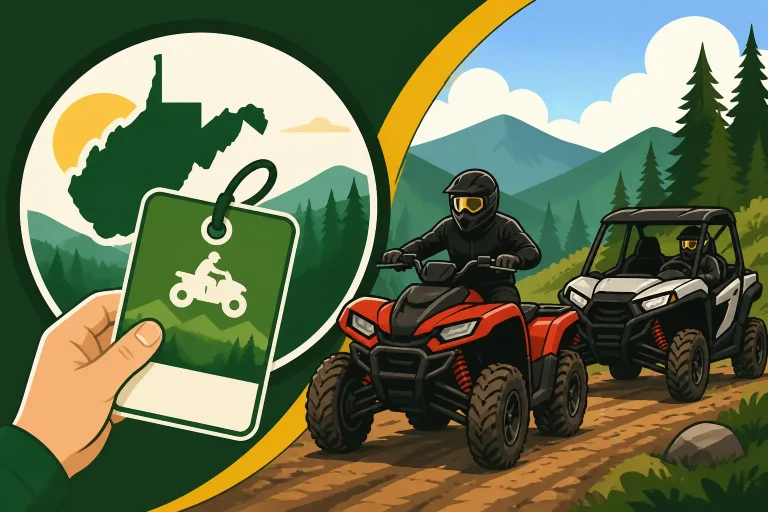
Safety Card and Helmet Sticker in West Virginia
A West Virginia ATV safety card and helmet sticker are easy to confuse with a trail permit or proof of ownership. They serve a different purpose: documenting safety-course completion and, where applicable, showing that completion on a helmet. Knowing who needs them, when an exception may apply, and what to carry can prevent a paperwork mix-up before a ride.
What the safety card and helmet sticker mean
The safety card and helmet sticker are connected to West Virginia’s ATV safety-awareness course, but they are not interchangeable with every other document a rider may need. The card is evidence that a rider completed the course. The sticker is a visible marker associated with that safety requirement; it does not establish ownership, authorize trail access, or make a machine street legal.
The exact process for receiving the card and sticker, including what a rider must carry or display, should be confirmed with the West Virginia DMV or the agency administering the course. Start with West Virginia’s ATV Safety Awareness Course and Getting an ATV Safety Card at the DMV for the course and card details.
| Item | What it is for | What it does not prove |
|---|---|---|
| ATV safety card | Evidence that the rider completed the required safety course | Ownership, trail access, insurance, or road legality |
| Helmet sticker | A visible marker connected with the safety-course requirement | That a helmet meets the required safety standard or fits correctly |
| Trail permit | Permission to use a particular managed trail system, when required | Course completion or ownership |
| Title | The machine’s ownership record | Permission to ride a trail or public road |
| Insurance proof | Evidence of coverage under a policy | Course completion or trail permission |
A rider may have a safety card but still need a trail permit. A properly permitted machine may still be operated by someone who needs to meet the applicable safety-course requirement. Likewise, a sticker on a helmet is not a substitute for wearing a suitable helmet.
This distinction matters because ATV paperwork is not one all-purpose license. Different rules apply to the rider, machine, location, and activity. For a broader explanation of which documents may apply to a ride, see Permits West Virginia Riders Actually Need. For title and ownership questions, Titling an ATV in West Virginia covers a separate part of the paperwork.
Who may need a card or sticker
West Virginia’s ATV safety-awareness requirements are particularly relevant to younger operators. The precise requirement can depend on the rider’s age and the kind of place where the machine is being operated. Do not assume that a card is required of every adult in every riding situation, or that an exemption in one setting applies everywhere.
Before a young rider goes out, check the current course rules and any applicable exception. Who Needs the West Virginia Safety Course explains the age-related requirement, while West Virginia Age Rules on the Trails covers a separate set of trail age rules. Age rules about operating a machine, riding as a passenger, or being supervised are not necessarily the same as the safety-course rule.
The rider’s age matters
For a rider under 18, treat the course requirement as a question to resolve before riding, rather than something to check only if an officer asks. Confirm whether the rider must complete the course for the specific ride and whether the card, sticker, or both must be available or displayed.
Age is not the only factor. The machine’s size and the manufacturer’s recommended age range may also matter, particularly for children. Completing a safety course does not make an oversized machine suitable for a young rider. Review Manufacturer Age and Size Requirements and Youth Machine Engine Size Limits in West Virginia when choosing a machine.
If an adult is supervising a young rider, supervision does not automatically replace a course requirement. And completing a course does not automatically allow a child to ride without the supervision that may be required in a particular setting. Check each rule separately.
The riding location matters
A rider may encounter different requirements on private land, public roads, and managed trails. A course exception that applies on a managed trail should not be treated as a general waiver for all West Virginia riding.
For example, the rules for a managed trail system may differ from those for riding elsewhere in the state. Read Why Managed Trails Are Exempt From the Course alongside the current trail rules before deciding that a card is unnecessary. Confirm the exemption’s scope, including which operators and locations it covers. Do not extend it to a road ride, another trail network, or private property without checking.
A trail permit is another separate issue. A course card does not grant trail access, and a permit does not by itself prove that the rider has met a course requirement. For system-specific access and permit questions, see The Hatfield-McCoy Trails, West Virginia’s 1,200-Mile Network and West Virginia’s Hatfield-McCoy Trail Permit Explained.
How to complete the course and get the card
Use the official course instructions rather than relying on an old card, a friend’s recollection, or an informal online quiz. The course provider’s process should explain eligibility, course format, completion records, and how to obtain the card or any related sticker.
A practical sequence is:
- Check whether the rider needs the course. Confirm the rider’s age and the location and type of riding planned. If an exception may apply, verify its limits with the appropriate official source.
- Use the official course route. Begin with Where West Virginia Teaches ATV Safety or the DMV’s current ATV safety-course information. Make sure the course is the one recognized for the intended use.
- Complete the required material and assessment. Follow the provider’s instructions from start to finish. Save any completion confirmation until the card and sticker are in hand.
- Ask how the card and sticker are issued. Confirm whether they are provided together, sent separately, or collected through a DMV process. Procedures can change, so check current instructions before making a trip.
- Check the identifying details. Make sure the card belongs to the rider who completed the course and that any name or other information is legible and correct.
- Keep the card and sticker in usable condition. Store the card where it can be found, and follow instructions for applying and caring for the sticker.
If the course is available online, completing it does not necessarily mean the rider immediately has every required item. A completion screen or email may not be equivalent to the final card or sticker. Find out what proof is accepted during the period between passing the course and receiving the credential.
For an online option, see Taking the West Virginia ATV Course Online. If the rider needs a replacement or has misplaced the card, Replacing a Lost ATV Safety Card is a useful next step. Do not assume a photo of a card, an email receipt, or another state’s certificate will be accepted as a substitute unless the relevant authority confirms it.
Keep the credential tied to the rider
A safety card documents the person who completed the course; it is not a machine document that transfers with a sale or loan. One family member’s card should not be treated as covering another rider. If several people in a group may operate machines, check the requirement for each person individually.
This is especially important when one machine has multiple drivers over a weekend. A parent’s card does not establish that a teenager completed the course. A youth rider’s card does not satisfy a separate requirement for a sibling. Keep names and records straight when planning a group ride.
Carrying the card and using the helmet sticker
Follow the current official instructions on whether the card must be carried while riding, shown on request, or kept available in another way. A protective case or secure pocket can help prevent a card from becoming wet, torn, or unreadable. If the rider uses a digital copy as a backup, do not assume it replaces a physical card if the official rule calls for the card itself.
The helmet sticker is a separate practical issue. Apply it only as directed by the issuing authority. If the instructions specify a location, use that location rather than choosing one based on convenience. Avoid placing it over a manufacturer label, a helmet certification mark, a vent, a seam, or another area where it could interfere with inspection or care.
A sticker does not certify that a helmet is safe. It does not turn a bicycle helmet, damaged helmet, or incorrectly sized helmet into appropriate ATV head protection. Check the helmet’s own labeling and the riding rules that apply to the trip. For trail-specific requirements, see Helmet and Eye Protection Rules in West Virginia.
If a sticker is peeling, damaged, lost, or placed incorrectly, ask the issuing office what to do. Do not cover it with extra layers of tape or replace it with a homemade copy unless the authority says that is acceptable. If you buy a replacement helmet through a retailer such as Amazon, check its certification label, fit, condition, and suitability for the rider; a marketplace listing or safety-course sticker alone is not proof that the helmet meets the applicable requirement.
Keep the helmet comfortable and identifiable
A sticker should not make a helmet harder to inspect or wear. Use a clean, dry surface and follow any application directions. Do not cut, drill, reshape, or modify the helmet to make a sticker fit. If the placement instructions are unclear, ask before applying it.
For a growing child, check fit each time the helmet is used. A helmet that shifts, sits too high, or cannot be fastened correctly may not provide proper protection. The card and sticker are administrative proof; they do not replace a fit check, eye protection, or sensible riding supervision.
What to bring on a ride
For a trip involving a young rider, it can help to prepare a small document checklist before loading the machines. Depending on the ride, that might include:
- The rider’s safety card, if required
- The rider’s helmet with any required sticker correctly applied
- Any trail permit or pass needed for the system
- Ownership or purchase paperwork if relevant to the situation
- Insurance information where required or prudent
- Emergency contact details and a plan for the group
Not every document belongs in a pocket on the trail, and carrying an original title is often unnecessary for an ordinary ride. Keep sensitive paperwork secure and take only what the applicable rules or circumstances call for. For advice specific to trail documentation, see Do You Need Paperwork on the Trail in West Virginia?.
Reciprocity, exceptions, and common mix-ups
Visitors and riders with certificates from another state should verify acceptance before traveling. A safety course completed elsewhere may be useful, but acceptance depends on West Virginia’s current rules and the credential involved. Do not infer that a visitor is exempt just because the machine is titled or registered in another state.
The same caution applies in reverse: a West Virginia card may not automatically satisfy another state’s requirement. If a trip crosses state lines or includes more than one trail system, check each destination’s rules. Out-of-State Safety Certificates in West Virginia addresses whether another state’s certificate may be recognized in West Virginia. For machine paperwork rather than rider training, see Do Other States’ Registrations Work in West Virginia?.
The safety card and sticker also do not replace a trail permit. A permit is tied to access rules for a system or location; the safety credential is tied to the rider and course. Some managed trails have a course exception, but that does not mean every trail operator waives permits, age requirements, helmet rules, or supervision requirements. Confirm each item independently.
Frequent mistakes to avoid
Assuming every rider needs the same paperwork. Requirements can vary by age, activity, and location. Check the rider and route rather than applying one answer to the entire group.
Treating the card as a permit. The card shows course completion. It does not authorize entry to a managed trail system.
Treating the sticker as proof of helmet compliance. The sticker is not a substitute for an appropriate, correctly fitted helmet.
Assuming an exception travels with the rider. A course exception in a particular managed setting may not apply on public roads, another trail network, or private land.
Relying on a course receipt indefinitely. Ask what proof is accepted before the official card arrives, and keep any temporary confirmation only as directed.
Waiting until the trailhead to sort it out. Verify the requirement before traveling, especially when a child or out-of-state visitor is in the group.
Confusing the safety credential with machine title documents. A card belongs to the rider; title paperwork concerns the machine. Each answers a different question.
When official instructions and older advice conflict, confirm the current requirement with the West Virginia DMV or the trail authority responsible for the place you intend to ride. Ask a specific question: Does this rider need the course for this location, what proof must they carry, and how should the helmet sticker be displayed? Clear answers to those three points prevent most last-minute confusion.
Frequently Asked Questions
Does every ATV rider in West Virginia need a safety card?
Not necessarily. Requirements depend on the rider and riding context, and exceptions may apply. Check the current rule for the rider’s age and the location where the machine will be operated.
Is the helmet sticker a trail permit?
No. The sticker is connected with the safety-course requirement. A trail permit, when required, is a separate authorization for access to a particular trail system.
Can one family member’s card cover another rider?
No. The card is evidence that the named rider completed the course. Check the requirement for each person who may operate a machine.
Does an out-of-state safety certificate count?
It may be recognized, but do not assume it is. Confirm acceptance with the relevant West Virginia authority before riding.
What should I do if the card or sticker is lost?
Contact the office or course provider that issued it and ask how to replace it. Do not use a homemade sticker or assume that a photograph is an acceptable replacement unless the authority confirms it.
Disclaimer
This article is for general informational purposes only and does not constitute professional advice. Laws, prices and regulations vary by location and change over time. Consult a qualified professional for guidance on your specific situation.