Where West Virginia Teaches ATV Safety
Where West Virginia Teaches ATV Safety
If you need West Virginia’s ATV safety course, the hard part is often figuring out whether you must take it and where to complete it. The state’s DMV is the place to start, but a DMV office is not necessarily a classroom. Here’s how to check for an approved course, confirm whether it applies to your ride, and keep the proof you may need.
Start With the West Virginia DMV
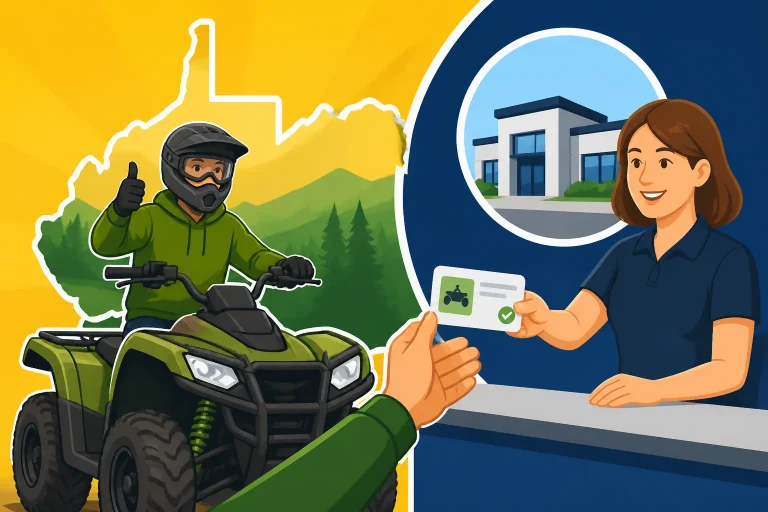
West Virginia’s ATV Safety Awareness Course is associated with the state DMV, so the DMV is the best first stop for current course directions and proof-of-completion requirements. Look for the course through the official West Virginia DMV information, or contact the agency if the instructions are unclear.
The key distinction is that an agency may administer or provide access to a course without teaching it in person at every office. Don’t assume you can walk into any DMV location and take a class, test, or pick up a safety card. Course delivery, appointment requirements, and the process for receiving proof can differ.
Before you travel to an office, confirm:
- Whether the course is available online, in person, or in both formats
- Which location, if any, is currently offering an in-person class
- Whether you need to register or make an appointment
- What identification or information the student must provide
- How the student receives a completion record, card, or other proof
- Whether the proof must be carried, displayed, or presented only if requested
These details matter especially for families traveling with a young rider. A parent may find the right general course page but still need to verify how a child is registered, who must supervise the course, and whether a card is issued immediately or later.
For an overview of the course and the rules it connects to, see West Virginia’s ATV Safety Awareness Course. If your question is specifically about the minimum age or supervision, review West Virginia Age Rules on the Trails and Direct Supervision Rules for West Virginia Riders Under 16 as well. Course completion does not replace age, supervision, helmet, or machine-size rules.
Is there a classroom near you?
In-person classes may be offered at selected locations or through approved arrangements, but availability can change. The practical answer to “Where does West Virginia teach ATV safety?” is therefore: check the DMV’s current course information before choosing a location. Do not rely on an old event listing, a dealership’s past class schedule, or the assumption that a local DMV branch offers instruction.
If the DMV information doesn’t clearly identify a class site, ask the agency where to find currently authorized instruction. When you contact a potential course provider, confirm that the class meets West Virginia’s requirement and ask how completion is reported. A general ATV safety class, manufacturer video, or private training session may be useful preparation, but it should not be treated as an approved state course unless the relevant authority confirms that it qualifies.
What if the online course is available?
An online option can be convenient when a class is not offered nearby or when the student needs to complete the requirement before a trip. Use the official course route specified by West Virginia rather than choosing a course simply because it appears in search results. A course hosted by another organization may teach good safety practices but still fail to provide the state-recognized proof you need.
Check whether the student must complete the course alone, whether an adult needs to help with registration, and what device or information is required. Save the completion confirmation, and follow the instructions for receiving any safety card or sticker. If the proof does not arrive or the confirmation page is lost, contact the course administrator promptly instead of assuming that the result is automatically visible to every trail operator.
For more detail on format and eligibility, see Taking the West Virginia ATV Course Online and Who Needs the West Virginia Safety Course. If you are planning to ride on a managed trail system, also check Why Managed Trails Are Exempt From the Course rather than assuming the same rule applies everywhere.
Check Whether Your Ride Requires the Course
The course question is not just about where instruction happens. It is also about whether the course applies to the rider and the place where the machine will be used. Rules can depend on age, riding location, and whether the route is part of a managed trail system. A course completed for one reason may not be the only permission or proof needed for another ride.
Start by identifying the planned riding setting:
- Managed trails: Check the trail system’s current rules and any course exemption that may apply. An exemption from one course requirement does not waive the system’s other rules.
- Public roads: Road use has separate requirements. A course card does not make an ATV street legal or grant permission to use a road.
- Private property: Permission from the owner does not automatically settle every safety or legal requirement. Check the rules that apply to the rider and the property.
- Other public land or organized events: Ask the land manager or event organizer what proof is required. Requirements may differ from those for a managed trail.
The safest approach is to confirm the rule for the exact rider and route before leaving home. If a ride includes more than one type of land or trail, check each part rather than treating the whole outing as a single category.
Managed trails have their own rule set
West Virginia’s managed trail systems may have a course exemption, but that should not be read as a blanket exemption for every ATV ride in the state. It applies only where the relevant rule says it applies. The trail system may still require a permit, impose age and supervision requirements, and enforce helmet and eye-protection rules.
A permit and a safety-course record are different things. A permit grants access under the trail system’s rules; it does not necessarily prove that a rider has completed a course. Similarly, course completion does not act as a trail permit. If you’re heading to Hatfield-McCoy, check the current permit requirements alongside the course rules. Permits West Virginia Riders Actually Need explains how to think about permits for different riding situations.
The course is not a road-use approval
Taking an ATV safety course does not make an off-road machine eligible for public-road use. Public-road riding has its own requirements for the machine, equipment, operator, and road. A safety card cannot substitute for a title, insurance, a required plate, or road-specific equipment.
If your plan includes connecting trails by road, check the road rules separately before riding. Start with Riding an ATV on the Road in West Virginia and Making a UTV Street Legal in West Virginia. Trail access and road access are separate questions, even when a route appears to connect them.
How to Find a Class and Confirm It Counts
Finding a course is easier when you treat it as a verification task rather than searching for the nearest class and hoping it qualifies. Use the state’s current information to identify the approved course, then confirm the format and how the student will receive proof.
- Check the DMV’s current course information. Use West Virginia DMV information as the starting point for the state course and its approved completion process.
- Confirm the student’s situation. Check the rider’s age and intended riding location. These can affect whether the course is required or whether an exception applies.
- Ask about the format. If you want classroom instruction, confirm the specific site and date directly. If you plan to take it online, confirm that the online course is the recognized West Virginia option.
- Ask what counts as completion. Find out whether the student receives a card, certificate, sticker, or electronic confirmation, and whether there are steps to obtain it after finishing.
- Keep the proof. Save a digital copy and any physical card or sticker. Make sure the rider or supervising adult knows where it is.
- Recheck before the trip. Confirm the riding location’s current rules, including permit, age, supervision, and protective-equipment requirements.
A local ATV dealer, club, school, or community group may know about upcoming safety events. Those organizations can be useful places to ask for leads, but the course should still be checked against DMV guidance. A class being advertised locally does not, by itself, prove that it satisfies the state requirement.
Questions worth asking before enrolling
A quick call or message can prevent a wasted trip or an unusable course record. Ask direct questions rather than relying on a listing that may be incomplete:
- Is this course recognized for West Virginia’s ATV safety requirement?
- Is it available to the rider’s age group?
- Does the student need to attend in person, or can the course be completed online?
- Is pre-registration required?
- What proof is issued after successful completion?
- How long does it take to receive the proof?
- What should the student bring?
- If the ride is on a managed trail, does that location have a specific course exemption?
For a child or teen, ask whether a parent or guardian must register, attend, or sign any paperwork. Make sure you have the student’s name recorded consistently. A mismatch between a registration record and a card can create confusion when the proof is needed later.
Don’t confuse course providers with course recognition
There are many useful ATV safety resources, including owner’s manuals, training videos, and private instruction. They can help riders build skills, understand controls, and learn safe habits. But educational value and official recognition are not the same thing.
If a course is offered by someone other than the DMV, ask how West Virginia recognizes it. If you cannot get a clear answer, check with the DMV before paying or enrolling. That small check is especially worthwhile when a class is being promoted as an equivalent, accepted certificate, or substitute for the state course.
Keep the Safety Record With the Right Ride Paperwork
After a rider completes the course, keep the proof in a place where it can be found. Families often store ATV paperwork in different places: a parent’s phone, a machine’s storage compartment, a trailer folder, or a home file. Choose one reliable system and tell the supervising adult where the record is.
A useful paperwork set may include:
- The safety-course card or completion confirmation
- The machine’s ownership documents, where applicable
- Any trail permit and related proof
- Emergency contact information
- The trail system’s current rules and route information
Do not assume a title or registration proves course completion. Those documents deal with ownership or road-use status, not rider training. Likewise, a safety card does not prove ownership or serve as a trail permit. Keeping the records separate makes it easier to answer questions at the right time.
If you are preparing for a managed-trail trip, review Trail Rules Every West Virginia Rider Signs Up To and Helmet and Eye Protection Rules in West Virginia. Families traveling with young operators can also review Manufacturer Age and Size Requirements. The course is one part of preparing a rider; correct machine fit and supervision remain essential.
Carry proof in a practical way
Follow the course’s instructions about whether proof must be carried or shown. If the card is physical, keep it protected from water and damage. If the record is digital, save it for offline access rather than relying on cell service at a trailhead. Keep a backup at home or with the adult responsible for the ride.
A sticker, if one is issued, should be placed exactly as instructed. Do not improvise a location or cover other required labels. If a card or sticker is lost, ask the DMV or course administrator about replacement procedures. Avoid taking another course simply because you cannot find the original proof until you have checked whether a replacement record is available.
Safety training is only one preparation step
A course can introduce hazards and responsible operating practices, but it cannot make an inexperienced rider ready for every trail. A young operator still needs an appropriately sized machine, direct supervision where required, protective gear, and a route suited to their ability. Adults should explain how to stop, how to avoid riding beyond skill level, and what to do if the group becomes separated.
Equipment deserves a separate check. A properly fitted helmet and suitable eye protection are more important than appearance or convenience. If you shop through Amazon or another retailer, verify that the gear meets the applicable safety standard and fits the intended rider; product listings and customer reviews are not proof of certification. Follow the rules for the specific place you will ride.
Common Mistakes When Looking for ATV Safety Instruction
The biggest avoidable problems come from treating course information as interchangeable. A rider may complete a class that is helpful but not accepted, travel to an office that does not offer instruction, or assume that a trail-system exception applies to every ride.
Assuming every DMV office offers classes
The DMV is a reliable starting point for course information, but that does not mean every branch teaches the course in person. Verify the location, schedule, and registration details before making a trip. If the office cannot answer, ask where the current class information is maintained.
Taking a course without checking its status
A private course may be excellent training and still not count toward a state requirement. Before enrolling, confirm recognition with the DMV or the authority responsible for the requirement. Keep any course description and completion receipt until the student’s official proof arrives.
Treating an exemption as statewide
An exception for a managed trail system is not necessarily an exception for public roads, private land, or other riding areas. Confirm the rule for the actual route, not simply the destination. A trip that crosses from a managed trail to a public road can involve more than one set of rules.
Thinking a course card replaces a permit
The course record and trail permit serve different purposes. If a trail system requires a permit, course completion alone does not provide access. Conversely, having a permit does not necessarily settle a rider’s course, age, or supervision requirements. Check both.
Waiting until arrival to sort it out
Course proof, permit questions, and equipment checks are easier to resolve before travel. If a family discovers a missing record at a trailhead, there may be limited options to retrieve it or complete a course. Verify the requirements and save the proof before loading the machine.
Frequently Asked Questions
Where does West Virginia teach ATV safety?
Start with the West Virginia DMV’s current course information. It can direct you to the available format and any current in-person options. Confirm a specific location before traveling; not every DMV office should be assumed to offer a class.
Can I take West Virginia’s ATV safety course online?
An online option may be available through the state’s designated course process. Check the current DMV instructions to make sure you are using the recognized course and understand how completion proof is delivered. See Taking the West Virginia ATV Course Online for related details.
Does every ATV rider in West Virginia need the course?
The requirement can depend on the rider and where the machine will be used. Managed trail rules may include an exemption, but that does not automatically apply to other settings. Check the rules for the rider’s age and the exact route.
What proof should I keep after finishing?
Keep the completion record, safety card, or other proof issued through the course process. Follow instructions about carrying or displaying it. If it is lost, contact the DMV or course administrator to ask about a replacement.
Does the safety course let me ride an ATV on a public road?
No. Course completion does not make a machine street legal or replace road-use requirements. Check the applicable rules for the machine, operator, equipment, and road before using a public road.
Disclaimer
This article is for general informational purposes only and does not constitute professional advice. Laws, prices and regulations vary by location and change over time. Consult a qualified professional for guidance on your specific situation.