West Virginia ATV Speed Limit on a Public Road
Riding your ATV or UTV on public roads in West Virginia can feel like navigating a minefield of rules and regulations. It’s a common frustration for riders who just want to connect trails, grab a bite to eat, or access their hunting land without breaking the law. Getting pulled over for speeding on a public road, even if you’re just trying to get from point A to point B, is a headache nobody needs. This comprehensive guide will cut through the confusion and explain West Virginia's specific ATV speed limits on public roads, differentiating between standard machines and street-legal Special Purpose Vehicles (SPVs), and offering practical advice to keep you legal and safe.
Understanding West Virginia's Core Road Riding Law for ATVs/UTVs
Before we dive into the specific speed limits, it's crucial to understand the foundational law that dictates when and how an ATV or UTV can even touch a public road in West Virginia. Many riders assume that if a road isn't a major highway, it's fair game, but that's simply not the case. The state has very particular stipulations for off-highway vehicles (OHVs) that are not fully street-legal. Ignoring these can quickly lead to fines or worse.
The 10-Mile, 25 mph Rule: What It Means
For most standard ATVs and UTVs—machines that haven't been specially modified and registered as a Special Purpose Vehicle (SPV)—West Virginia law provides a very narrow window for public road use. This is often referred to as the "10-mile, 25 mph rule." Essentially, it allows you to operate your ATV or UTV on certain public roads only for specific purposes and within strict limits.
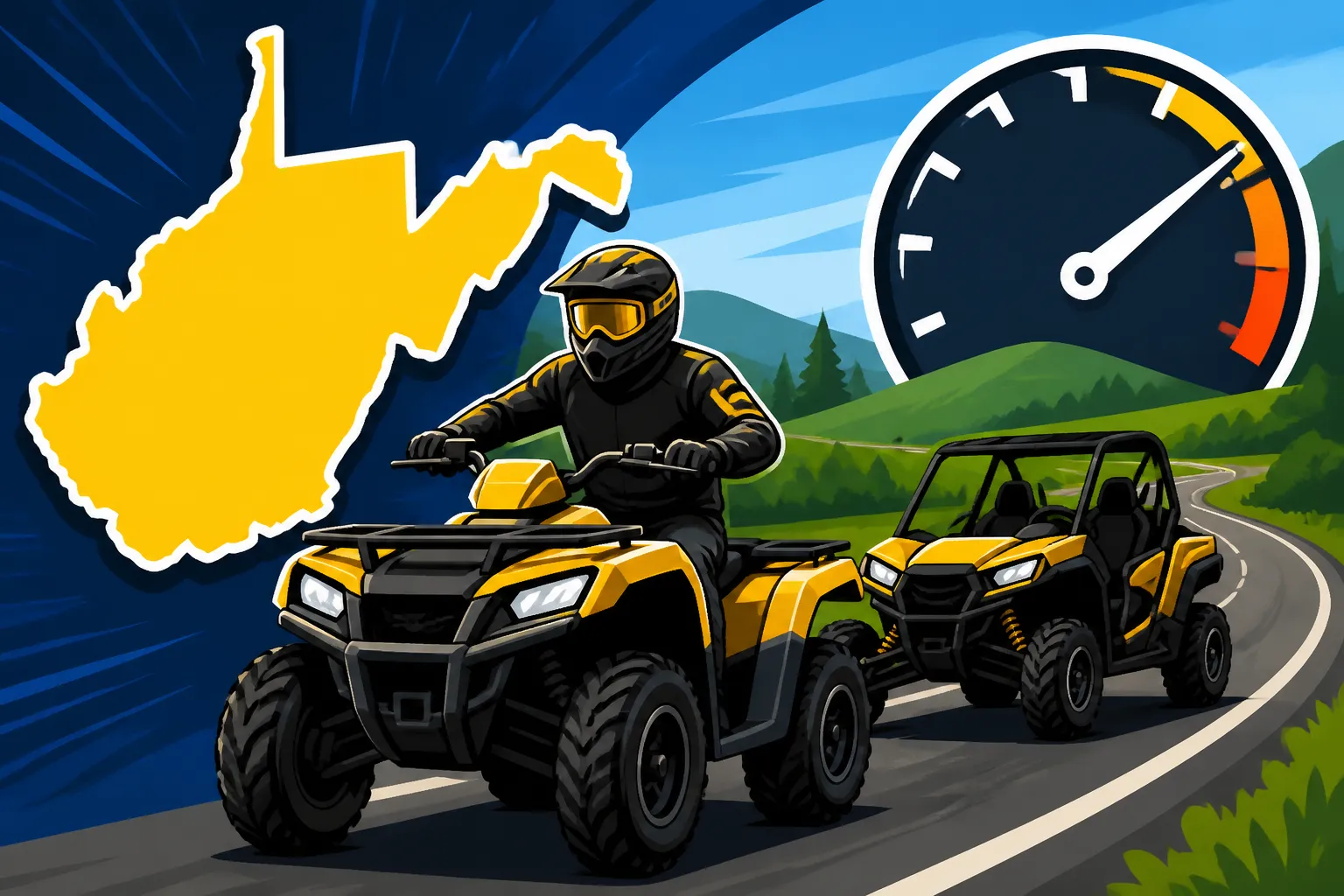
You are permitted to operate your machine on a public road with a posted speed limit of 55 miles per hour or less, but with two critical constraints: you cannot exceed 25 miles per hour, and your travel on such roads is limited to a distance of no more than 10 miles. This isn't a free pass to cruise; it's designed to facilitate necessary movements. Think about scenarios like crossing a highway to get to another trail section, traveling a short distance down a county road to reach a gas station or a local restaurant in a trail-friendly town, or moving your machine from a trailhead parking area to your lodging. Each of these situations falls under the umbrella of this specific rule, and each requires you to adhere to both the speed and distance limitations. If you're caught going 30 mph on a county road, even for a short stretch, you've violated [The 25 mph Cap on a West Virginia Road Ride]. The intent behind this rule is not to allow recreational road riding, but rather to provide practical access points and connections for riders. It’s a fine line to walk, and deputies are often on the lookout for riders who abuse this privilege.
Distinguishing Between State Roads and County Routes
The application of this 10-mile, 25 mph rule can feel a bit murky when you consider the vast network of roads in West Virginia. From busy state highways to quiet, winding county routes, and even unmarked logging roads, the landscape is diverse. For the most part, the core rule applies universally across public roads with a posted speed limit of 55 mph or less, regardless of whether it's a state-maintained route or a local county road. There isn't a separate, more lenient speed limit for county routes versus state roads when it comes to standard ATVs and UTVs. The 25 mph maximum applies to both.
However, the enforcement and practical riding experience can differ. On quieter county routes, especially those that form connectors between trail systems or lead to remote trailheads, you might encounter less traffic and a more relaxed atmosphere. Yet, the law remains the same. [West Virginia's 10-Mile, 25 mph Road Rule] still governs your speed and distance. In many of West Virginia's ATV-friendly towns, local ordinances might be in place that allow greater access to certain streets to reach businesses or lodging, but these local rules generally don't override the state's fundamental speed and distance limits for non-SPV machines on public roads. It's crucial not to confuse local access allowances with a blanket permission to ignore state speed limits. Even in a town that openly welcomes ATVs, straying over 25 mph on a public street is a violation of state law. This is particularly true on roads without a centerline, which might feel less formal but are still public roads subject to the same regulations. Riders should pay close attention to [West Virginia's Rule for Roads Without Center Lines] as these can sometimes be a trap for those thinking the rules are softer there.
Speed Limits for Street-Legal Special Purpose Vehicles (SPVs)
Now, here's where things get a little different and often confuse riders. West Virginia has a distinct classification for "Special Purpose Vehicles" (SPVs), which are essentially ATVs or UTVs that have undergone specific modifications to make them street-legal and are registered with a special plate. If you’ve invested the time and money to convert your machine into an SPV, your road riding privileges and, critically, your speed limits, expand significantly compared to a standard off-highway vehicle.
The SPV Designation and Its Impact on Speed
Becoming an SPV means your ATV or UTV has met a comprehensive list of requirements, transforming it from an off-road machine into something that can legally share the road with cars and trucks under most circumstances. This isn't just about sticking a license plate on your quad; it involves installing DOT-approved tires, turn signals, brake lights, a horn, mirrors, a windshield, and often other safety equipment. Many riders turn to aftermarket parts providers like SuperATV for kits and individual components that meet these rigorous specifications, ensuring their build passes muster for [West Virginia's Street-Legal Special Purpose Vehicle Plate]. Once your machine is titled and registered as an SPV, you gain the ability to operate it on any public highway, road, or street in West Virginia with a posted speed limit of 55 miles per hour or less.
This is a monumental difference from the 25 mph cap for regular ATVs. As an SPV owner, you are generally allowed to travel at the posted speed limit of the road, up to 55 mph, where permitted. This freedom allows SPV owners to truly connect trails over longer distances, access towns more easily, and use their machines for practical transportation without constantly worrying about going too fast. However, it's not an unlimited license. SPV owners still need to be aware of the specific legal framework that governs [West Virginia's Street-Legal Special Purpose Vehicle Law], which includes certain restrictions within municipalities. But on the open road, where permitted, your speed limit is effectively the same as a car's, up to that 55 mph threshold. This flexibility is a huge draw for many riders who want to maximize their machine's utility.
The 20-Mile Centerline Limit for SPVs
While an SPV unlocks higher speed limits, there's another crucial nuance that often trips up riders: the "20-mile centerline limit." This rule doesn't dictate your speed on a road, but rather the type and extent of roads an SPV can traverse within a municipality. The law states that "no special purpose vehicle shall be operated upon any public highway, road, street, or other public right-of-way with a total aggregate centerline mileage of more than 20 miles located within a municipality."
What does this mean in plain English? It means that even though your SPV can go 55 mph on allowed roads, you cannot continuously ride it through a large town or city if that municipality has more than 20 miles of public road centerline. This restriction prevents SPVs from becoming primary commuter vehicles in larger urban areas. It's designed to keep them primarily in more rural settings or smaller trail towns where their use is more appropriate. For example, you might be able to ride your SPV at 55 mph on a state route connecting two trail systems, but once you enter a larger town, even if the posted speed limit is 45 mph, you might be restricted from traversing all of its main streets due to this centerline mileage rule. It's a key distinction to keep in mind, and [West Virginia's 20-Mile Centerline Limit for Street-Legal Machines] is an important piece of legislation for SPV owners to understand fully. The spirit of the law for SPVs is still largely about connecting to trails and accessing trail-friendly communities, not widespread urban transit.
Penalties, Enforcement, and Safe Practices
Knowing the speed limits is only half the battle; understanding the consequences of ignoring them and practicing safe road riding is equally vital. West Virginia law enforcement takes road riding regulations seriously, particularly in and around popular trail systems where ATV and UTV traffic is common. A momentary lapse in judgment can quickly escalate into a costly ticket or, worse, a serious accident.
What Happens If You Exceed the Speed Limit
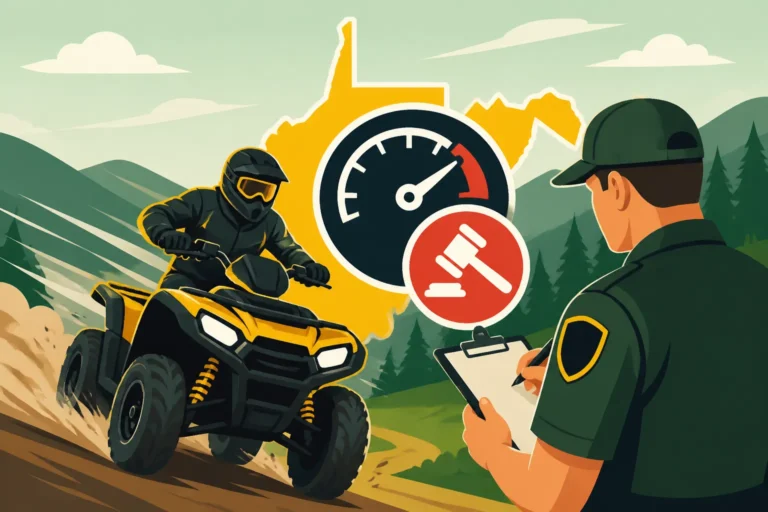
If you're caught exceeding the 25 mph limit on a public road with a standard ATV or UTV, or going over the posted speed limit (up to 55 mph) with an SPV where permitted, you're looking at a traffic citation. Just like speeding in a car, this will likely involve a fine, and depending on the severity and local jurisdiction, could also carry points on your driver's license. The exact cost of the fine can vary significantly by county and specific infraction, but it's rarely a negligible amount. In some cases, if you're found to be operating your machine illegally on a public road in other ways (e.g., without a title where required, or without proper safety gear), a speeding ticket could be compounded by other violations. For instance, if your machine should have a title but doesn't, you could also face penalties described in [West Virginia Penalties for an Untitled Machine].
It’s not uncommon for local sheriff's deputies and State Police to monitor roads, especially those near trailheads or within trail towns, specifically for ATV and UTV violations. They are familiar with the rules and are diligent about enforcing them to ensure public safety. A hypothetical scenario: imagine you're riding your standard side-by-side a couple of miles down a county road to meet friends at a local diner. You're feeling good, the road is clear, and you let your speed creep up to 35 mph. Suddenly, you see flashing lights in your rearview mirror. Not only have you exceeded the 25 mph limit, but if you're also over the 10-mile distance, you're facing multiple violations. It's an easy mistake to make when you're used to open trails, but on a public road, every mph counts.
General Safety and Best Practices for Road Riding
Even when adhering strictly to West Virginia's ATV speed limits, road riding presents inherent risks that trail riding typically doesn't. You're sharing space with much larger, faster vehicles, often on paved surfaces that can be unforgiving. Therefore, adopting a defensive riding posture and outfitting your machine for maximum visibility and safety is paramount.
First and foremost, visibility is your best friend. Always ride with your headlights on, even during the day. Consider adding reflective tape to your machine and wearing bright, highly visible clothing, especially if you anticipate riding near dusk or dawn. SuperATV and similar companies offer a range of aftermarket light bars and turn signal kits that can dramatically improve your presence on the road. Secondly, always wear appropriate protective gear. While adults aren't always mandated to wear helmets on certain roads, [West Virginia Helmet Rules for Riders Under 18] are very strict, and wearing a DOT-approved helmet and eye protection is always a wise choice, regardless of age or legal requirement. [Eye Protection on a West Virginia Road Ride] is crucial for clear vision and protecting against debris.
Finally, be acutely aware of your surroundings. Paved roads offer less traction than dirt, and the corners you might blast through on the trail require careful, slower negotiation on asphalt. Pay close attention to blind curves, especially on narrow mountain roads, and anticipate oncoming traffic. In [West Virginia's ATV-Friendly Towns and What You Can Ride], while the atmosphere is welcoming, you're still sharing the road with cars, pedestrians, and sometimes even children. Keep your speed appropriate for the conditions and the environment, not just the legal limit. Ensuring your machine has proper mirrors and a horn, which are often part of the SPV conversion process (and items SuperATV offers), are also essential pieces of [Equipment a West Virginia SPV Must Carry] and for general safety. Using your horn to alert drivers to your presence and having clear visibility behind you via well-adjusted mirrors, as detailed in [Mirrors and Horns on a Street-Legal Build], can prevent many close calls.
Here’s a quick summary of the different road riding speed limits:
| Vehicle Type | Permitted Road Speed Limit | Distance Restriction for Road Use | Primary Use Case | Key Modifications Required |
|---|---|---|---|---|
| Standard ATV/UTV | Maximum 25 mph on roads with a posted limit of 55 mph or less | Limited to 10 miles for connecting trails or accessing services. Not for continuous cruising. | Crossing roads, connecting short trail segments, accessing gas/food/lodging near trails. | None, if used within strict limits. |
| SPV (Street-Legal) | Posted speed limit of the road, up to 55 mph. | Restricted by "20-mile centerline" rule within municipalities (not a speed restriction). | Extensive road travel, trail connection, accessing towns. | DOT tires, lights, horn, mirrors, windshield, title/plate. |
Disclaimer
This article is for general informational purposes only and does not constitute professional advice. Laws, prices and regulations vary by location and change over time. Consult a qualified professional for guidance on your specific situation.