What Direct Supervision Means on the Trails
Taking a child on an ATV or UTV trail ride involves more than choosing a suitable machine. West Virginia trail rules may require direct adult supervision for younger riders, but the phrase can be easy to misread. Here’s how to think about supervision in practice, what to verify before you ride, and how to keep an adult close enough to respond.
What direct supervision means in practice
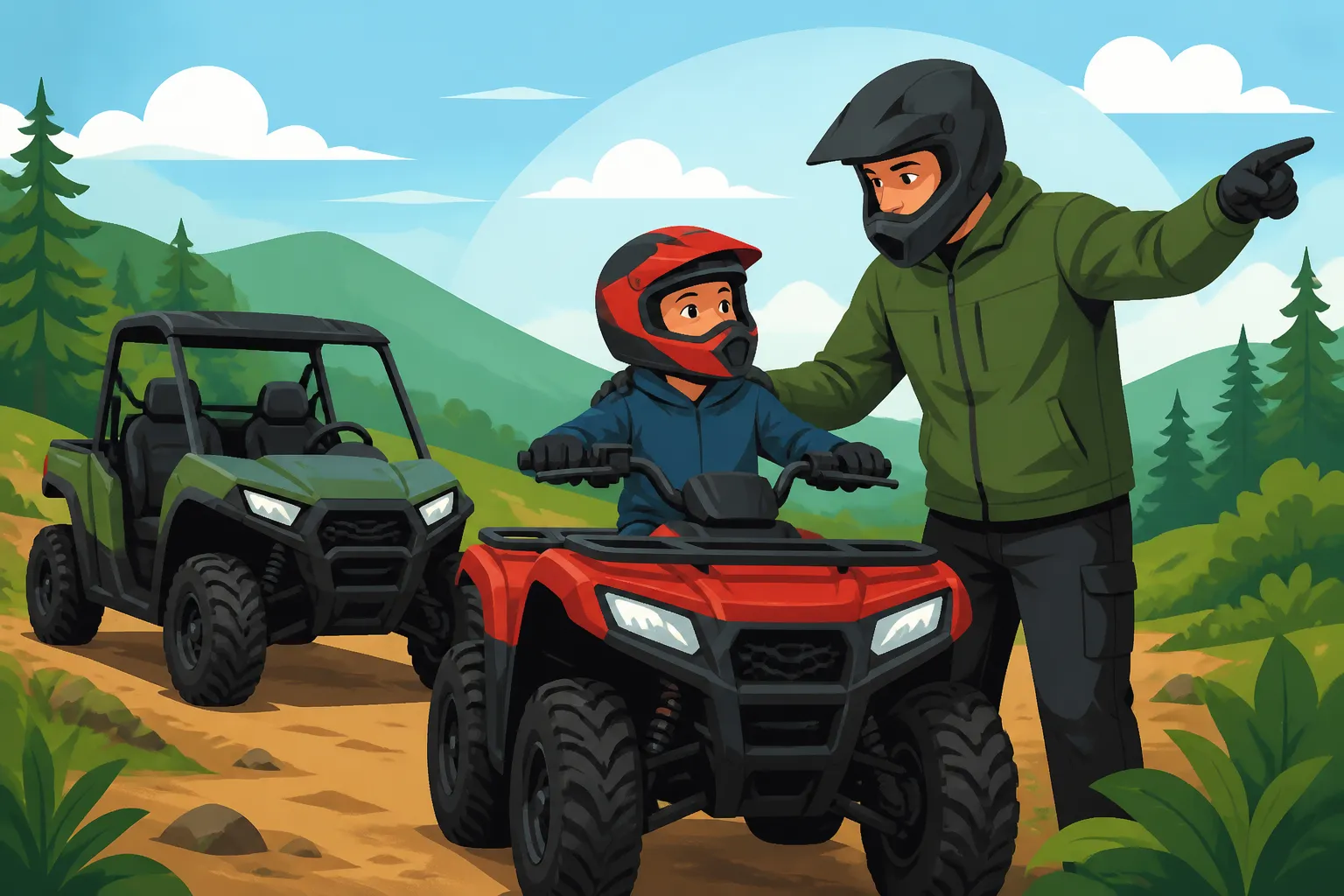
“Direct supervision” is best treated as an active, ongoing responsibility—not simply being somewhere on the same trail system. A supervising adult should be close enough to watch the young rider’s decisions and respond promptly if something goes wrong.
That means more than waiting at the trailhead, following a route on a phone, or being available by text. Trails can split, climb, narrow, and pass through places where visibility and phone service are limited. If a child rounds a bend and disappears from view for a long stretch, the adult may not be able to intervene when it matters.
A useful practical test is: Could the adult see the young rider, notice a problem, and reach them quickly without needing to catch up from far behind? If the answer is no, the group should adjust its spacing, pace, or route.
Direct supervision is not the same as controlling every move. Children still need room to learn, but they should ride within boundaries an adult can actively manage. That could mean setting a conservative pace, stopping before a difficult section, and choosing a route the child can handle rather than relying on the adult to rescue a rider who is already in over their head.
Supervision is continuous, not occasional
A young rider may be confident on a familiar stretch and still need close attention when conditions change. Loose rock, mud, steep grades, creek crossings, traffic at a road crossing, and other riders can quickly make a simple section more demanding.
The supervising adult should pay attention to:
- How far ahead or behind the child is riding
- Whether the child can see and follow the group
- Whether the child is keeping a safe speed and stopping when asked
- Signs of fatigue, fear, distraction, or frustration
- Changes in trail conditions or difficulty
- Whether the child’s machine is operating normally
A phone can support a ride plan, but it is not a substitute for being close enough to supervise. Nor is it enough to assume that another adult somewhere in the group is watching the child. Agree in advance who is responsible for each young rider, especially if the group spreads out.
Direct supervision does not automatically mean riding on the same machine
Rules and operating details can depend on the trail system, the rider’s age, and the type of machine. Do not assume that “direct supervision” always means a child must ride as a passenger, or that an adult riding a separate machine automatically satisfies the requirement. Confirm the applicable rule with the trail authority before the trip.
Even where separate machines are permitted, the practical standard remains important: the adult needs to stay close enough to observe and respond. Riding far ahead, letting the child ride out of sight, or splitting into separate groups can defeat the point of supervision.
For a broader look at age-related trail rules, see West Virginia Age Rules on the Trails. If your question is specifically whether a six-year-old may ride at Hatfield-McCoy, Can a 6-Year-Old Ride at Hatfield-McCoy? covers that age question. Permission to ride at a particular age does not mean every machine, route, or riding arrangement is appropriate.
Check which rules apply before you choose a trail
“West Virginia trails” is not one single operating area with one universal set of rules. A managed trail system, a private off-road park, a public road, and land with a different owner or operator may each have separate requirements. A rule that applies at one location should not be assumed to apply everywhere.
Before riding, identify the specific trail system and check its current rules for:
- Minimum rider ages
- Adult supervision requirements
- Machine types and size restrictions
- Passenger rules
- Safety course or safety-card requirements
- Permits and machine identification
- Required helmets and eye protection
- Trail hours, closures, and route restrictions
For Hatfield-McCoy, use current information from the trail authority and confirm any age or supervision question directly if the wording is unclear. The general information in The Hatfield-McCoy Trails, West Virginia’s 1,200-Mile Network can help orient you to the system, but a broad overview is not a substitute for checking rules for the specific ride.
Do not confuse a permit with permission to ride any way you choose
A trail permit, where required, does not necessarily settle age, supervision, safety-course, or machine-eligibility questions. Each rider and machine may have separate requirements. If you are bringing a young rider from another state, check that rider’s requirements rather than assuming an out-of-state credential or registration answers every question. Out-of-State Riders on West Virginia Trails explains the visitor angle.
Likewise, a child being allowed onto a trail does not automatically mean the child can operate any ATV or UTV. Manufacturer age and size guidance matters, as do the machine’s controls, speed, weight, and handling. See Manufacturer Age and Size Requirements before choosing a youth machine.
When rules are unclear, ask the trail operator or permit authority a specific question. For example: “May a rider of this age operate this machine on this system, and what does the system require for adult supervision?” A precise question is more likely to produce a useful answer than asking only whether children are allowed.
Trail difficulty still matters
Age eligibility is a starting point, not a route recommendation. A child who may legally ride can still be unready for a steep, narrow, or technically demanding trail. Check trail ratings and route descriptions, and choose a route with room to stop or turn back if the child becomes uncomfortable.
A route that looks manageable on a map may feel very different at riding speed, especially after rain or when visibility is reduced. Check current conditions and closures before setting out. West Virginia Trail Difficulty and How It Is Marked can help with reading difficulty information, and Checking West Virginia Trail Status Before You Drive is useful when conditions or closures may affect the plan.
Set up the ride so supervision is possible
Good supervision starts before anyone turns a key. Make a plan that keeps the adult responsible for the child, gives the child clear instructions, and leaves room to change course.
- Choose the supervising adult. Name the person responsible for watching each young rider. If several children are riding, do not assume one adult can monitor all of them equally while also navigating or leading a fast-moving group.
- Agree on a pace and position. Decide whether the child will ride behind the supervising adult or in another position that allows steady observation. Avoid arrangements where the child is likely to be separated or hidden from view.
- Set simple stop rules. Explain where to stop, how to signal a problem, and what to do if the group gets separated. A child should know not to continue alone after losing sight of the adult.
- Choose a route within the child’s ability. Start with a manageable section and leave time to turn back. Do not let the group’s preferred pace or a planned destination pressure a child into riding beyond their comfort.
- Check the machine and protective gear. Confirm that controls fit the child, the machine is in sound working order, and the rider has properly fitted protective equipment. Helmet and Eye Protection Rules in West Virginia explains the protective-equipment topic.
- Review the route and stopping points. Use the trail map or kiosk to identify junctions, crossings, and places where the group can safely regroup. West Virginia Trail Maps and Signage can help with navigation planning.
A simple riding order often helps: the supervising adult rides close to the child, while another adult leads or follows the rest of the group. The exact arrangement depends on terrain and the group, but the child should not be left to navigate alone or expected to keep up with faster riders.
Agree on signals before the ride
Do not rely on shouting, especially when helmets, engines, distance, and terrain make voices hard to hear. Agree on a few basic signals for stopping, slowing down, or needing help. Make sure the child knows what to do if they cannot see the adult: stop in a safe spot and wait rather than continuing to search down the trail.
Two-way radios can be useful on longer rides, but they do not replace close supervision. A radio may lose signal, and a child may not be able to explain a problem clearly under stress. If you choose to use radios, practice with them before leaving the trailhead. Simple two-way radios are available from outdoor retailers and Amazon; check that the controls are easy for the child to use and that the equipment suits the ride.
Plan for fatigue and changing conditions
Children may not recognize when they are tired, cold, overheated, or becoming anxious. Watch for slower reactions, missed instructions, poor focus, or repeated mistakes. Take breaks before the child is exhausted, and shorten the ride if conditions become harder than expected.
Mud, rain, darkness, and crowded trails can make close supervision more difficult. If the adult cannot keep the child in sight or maintain a safe pace, stop and regroup. It is better to change the plan than to push on because the group has already started.
Common mistakes and what to do instead
The most common supervision problems are not complicated; they happen when a group assumes someone else is paying attention or treats a ride as if everyone has the same ability.
| Common mistake | Why it causes trouble | Better approach |
|---|---|---|
| Letting the child ride far ahead | The adult may not see a fall, wrong turn, or stalled machine quickly | Keep the child within clear sight and a short response distance |
| Following well behind | The child may reach a hazard before the adult can intervene | Put the responsible adult close to the child |
| Assuming a permit settles every rule | Permits do not necessarily answer age, machine, or supervision questions | Check each applicable requirement with the trail authority |
| Choosing a route based only on age eligibility | A legal rider may still lack the skill for difficult terrain | Match the route to ability and current conditions |
| Using a phone as the supervision plan | Service and visibility can be unreliable on trails | Set a meeting plan and keep the rider close |
| Allowing the group to split without an assigned adult | Responsibility becomes unclear | Name the supervising adult and keep the group organized |
| Continuing after the child is overwhelmed | Fatigue and stress make errors more likely | Stop, take a break, and turn back if needed |
A short pre-ride conversation can prevent many of these problems. Tell the child to stop when asked, stay in the agreed position, and wait safely if separated. Tell the rest of the group that the child’s pace sets the pace for the supervised section. That expectation makes it easier to slow down without pressure.
If the trail authority’s written rules do not make the adult’s required age, position, or role clear, do not guess. Confirm the rule before riding. Also check whether a safety course or card is needed for the child. West Virginia’s ATV Safety Awareness Course explains the course topic, while Why Managed Trails Are Exempt From the Course addresses a specific managed-trail distinction. Do not assume an exemption or requirement applies to a different location.
Direct supervision is most useful when it is visible in the way the ride is organized: a responsible adult stays close, watches continuously, chooses appropriate terrain, and is ready to stop or change plans. That approach supports both compliance and a safer experience for the child.
Disclaimer
This article is for general informational purposes only and does not constitute professional advice. Laws, prices and regulations vary by location and change over time. Consult a qualified professional for guidance on your specific situation.