Riding Off a Marked Trail
Riding off a marked trail in West Virginia can seem like a harmless shortcut, especially when a route is muddy, blocked, or hard to follow. But a trail permit is not permission to roam wherever you like. Staying on the authorized route protects your ride, other riders, and the landowners who make trail access possible.
What “off a marked trail” means
On a managed trail system, the authorized route is the route identified by the system’s signs, markers, maps, and current closure notices. Riding beyond that route can include leaving the trail to bypass a muddy section, taking an unofficial path, crossing a gate, or following tracks that appear to lead somewhere useful.
A visible tire track is not proof that a route is open. It may be an old trail, a work path, a private road, or a route that has been closed. Likewise, a missing or damaged marker does not automatically give riders permission to choose their own way through.
West Virginia has both managed trail systems and other land where motorized access may be restricted or allowed under different rules. The details can depend on the property, land manager, and route. A rule for one trail system does not necessarily apply to a nearby forest road, private road, or connector.
| Situation | Safer interpretation | What to do |
|---|---|---|
| The trail marker points along a clear route | Follow the marked route | Continue only if the route is open |
| A route is gated or marked closed | Treat it as unavailable | Turn around and check current notices |
| You see tire tracks beyond the marked trail | Tracks alone do not establish permission | Stay on the signed route |
| A marker is missing or unclear | The route is uncertain | Stop, check your map, and retrace if needed |
| You need to cross or briefly use a public road | The crossing or road segment may have separate rules | Follow signs and confirm the applicable road rules |
| You are near private land | A trail permit does not grant general access | Do not enter unless access is clearly authorized |
The safest habit is straightforward: ride only where the trail system or land manager currently authorizes motorized travel. A permit may let you use designated trails, but it is not an all-access pass to surrounding land. For more context on what a permit does and does not authorize, see What a Trail Permit Does Not Cover and Staying on Marked Trails in West Virginia.
Why leaving the route can cause trouble
It can become trespass
An unmarked route may cross private property or land that is not open to motorized riding. Even if you did not intend to trespass, following an unofficial track can take you across a boundary without permission. Boundaries may not be obvious in steep, wooded terrain, so riders should not rely on the absence of a fence or sign as evidence that access is allowed.
The same caution applies near coal company property, work roads, and land beside an authorized trail. A trail running close to private land does not mean riders can leave it to explore nearby slopes, roads, or clearings. Read Trespass Beyond the Trail Boundary and Riding Onto Private Coal Company Land if you need to understand those risks in more detail.
It can damage land and trail access
A marked route concentrates riding on paths selected for that use. Leaving it can widen the disturbed area, damage vegetation, increase erosion, or create ruts that send water and mud onto nearby land. A short detour around a wet or rough patch can gradually become a second trail as more riders follow it.
That damage can also undermine access. Managed trail systems rely on agreements and cooperation with landowners and other partners. Unauthorized riding can create problems for the people responsible for maintaining routes and can affect future access. Respecting a closure or staying on the signed path is part of keeping riding opportunities available.
It can put you in a hazardous place
An unofficial route may end at a steep drop, unstable slope, washout, fence, road, or dead end. It may also enter a work area where vehicles or equipment are active. A route that looks passable from the seat can be difficult or dangerous to turn around on, especially with a group or a wide side-by-side.
Trail markers also help riders understand where a route goes and how it connects to the wider system. Once you leave the marked network, your map position and expectations may no longer match the terrain. That can make it harder for your group to stay together or for help to find you if something goes wrong. For preparation in remote areas, see What to Carry on a Remote West Virginia Ride and Getting Lost on a West Virginia Trail.
It can lead to enforcement or loss of riding privileges
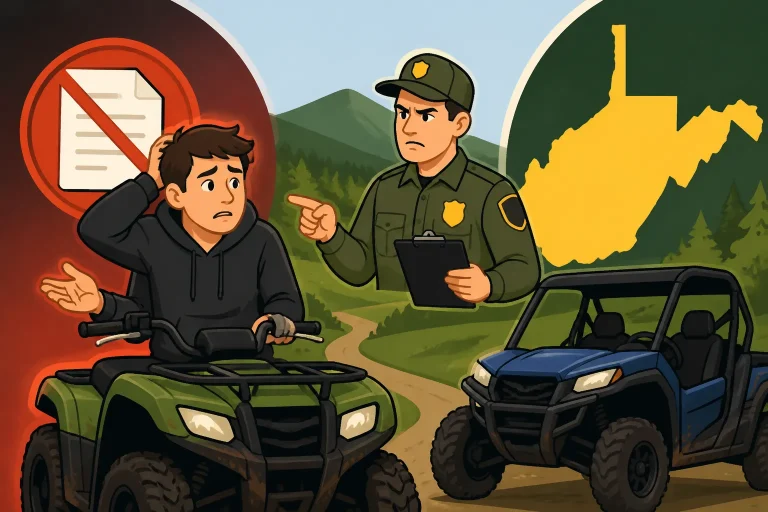
Trail staff or law enforcement may treat riding beyond an authorized boundary as a violation, particularly if a rider passes a gate, ignores a closure, or enters private land. Possible consequences depend on the location and circumstances; do not assume that having a permit resolves an off-route problem.
A citation or loss of riding privileges can disrupt a trip and affect future access. The precise response may vary, so check current rules and notices from the authority that manages the route. West Virginia Trail Rangers and What They Check explains why it is wise to have your permit and follow system requirements rather than relying on assumptions.
What to do when a route is blocked or unclear
A closure, washout, fallen tree, or confusing junction can force a decision. The best response is not to make a new trail. Pause, keep your machine out of the way, and confirm whether the route is closed or whether a marked detour is available.
- Stop before the obstruction. Do not ride around a closure sign, barrier, or gate. Avoid blocking the trail while your group discusses what to do.
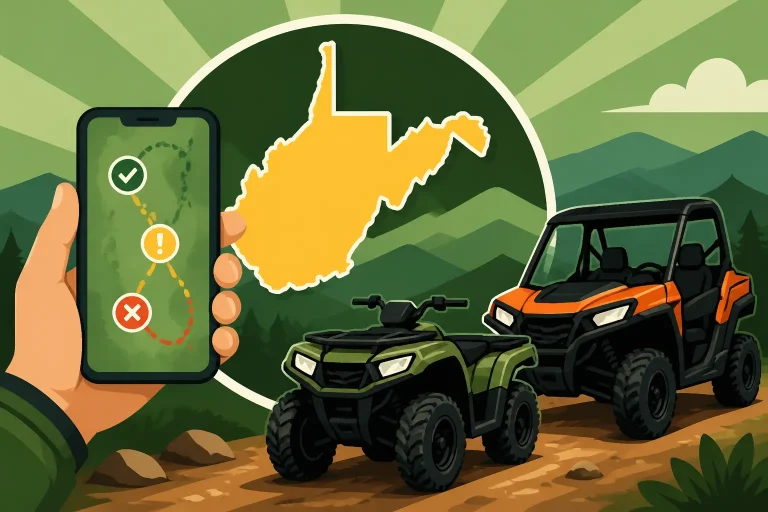
- Check your map and trail information. Use the current map or official status information for the system, not an old screenshot or a line of tracks on the ground. For practical map-reading help, see West Virginia Trail Maps and Signage and Checking West Virginia Trail Status Before You Drive.
- Look for an authorized detour. Follow it only if it is clearly marked or confirmed by the trail authority. A route that seems to reconnect may still cross land that is not open to riding.
- Retrace your route if you are uncertain. Backtrack to the last clear marker instead of guessing at a turn. If turning around safely is difficult, move slowly and keep the group together.
- Ask the responsible authority for guidance. If signs conflict or a marker is missing, contact the relevant trail office or operator when practical. Report the problem so the route can be checked.
- Respect the closure even if it disrupts your plan. A closed trail may be unsafe, under repair, or unavailable because of an access issue. Do not treat the inconvenience as permission to find your own way through.
If you cannot confirm that a road or connector is open to your machine, do not assume it is part of the riding route. Public roads have separate requirements, while private roads may have access restrictions. For guidance on legal connectors, see West Virginia Rules for Riding Trail to Trail and Which West Virginia Roads Allow ATVs.
How to stay on authorized routes
Good route planning starts before the first ride. Choose the trail system and trails that fit your group, obtain the required permit, and review current maps and notices. Make sure each rider knows how the system marks routes and what to do when signs are unclear. A printed map can be useful when a device loses power or signal, but it should not replace current closure information.
During the ride, use a simple group rule: no one leaves the marked route unless the trail authority directs riders onto a signed detour. If the lead rider reaches a closure or uncertain junction, the group stops together. Do not let the last rider follow a different set of tracks while the rest of the group continues.
Keep these practices in mind:
- Treat barriers and closure signs as instructions. Do not squeeze around them or move them.
- Do not use another rider’s tracks as proof of access. The person ahead may be lost or may have entered the route improperly.
- Avoid creating informal bypasses. Walk or inspect a safe option only where permitted, and do not ride off the route to test whether it is passable.
- Stay alert at junctions. Confirm the direction of travel before the group moves on.
- Carry a way to navigate without relying on cell service. In remote terrain, coverage may be unreliable.
- Report damaged or missing markers. A clear report can help the trail manager address confusion for later riders.
- Recheck notices before riding. Conditions and access can change, and older maps may not show a recent closure.
A trail permit is only one part of riding responsibly. It does not replace the need to obey route signs, age and safety rules, or property restrictions. If you ride with visitors, explain the route boundaries before you start. For permit basics and other requirements, see Trail Rules Every West Virginia Rider Signs Up To and Permits West Virginia Riders Actually Need.
When in doubt, turn around and confirm access rather than pressing on. Staying on marked routes may mean changing your planned loop, but it avoids turning a confusing junction into a trespass, a safety problem, or a reason for further trail restrictions.
Disclaimer
This article is for general informational purposes only and does not constitute professional advice. Laws, prices and regulations vary by location and change over time. Consult a qualified professional for guidance on your specific situation.