Which West Virginia Roads Have No Center Line
It's a common dilemma in West Virginia: you're out on your ATV or UTV, trying to get from one trail section to another, or maybe just heading to a gas station in a trail-friendly town, and you come across a paved road. The big question looms: can you ride here? And specifically, what about those roads that just don't seem to have a painted yellow or white line down the middle? This lack of clear markings can be incredibly confusing and often leads to riders scratching their heads, wondering if they're about to break the law. This guide is all about untangling the rules for riding your machine on West Virginia roads that appear to have no center line, helping you ride confidently and legally.
Understanding West Virginia's ATV Road Rules: The Core Challenge
Riding ATVs and UTVs on public roads in West Virginia can feel like navigating a minefield of regulations. You hear bits and pieces – "10 miles here," "25 mph there," "SPV plates are different" – and it's enough to make anyone's head spin. The fundamental challenge for many riders is the sheer variety of roads and the different rules that apply to each, often without clear signage to help you out.
The 10-Mile, 25 MPH Rule: A Refresher
Let's start with the baseline, the rule most ATV and UTV riders in West Virginia are familiar with for brief road stretches: the 10-mile, 25 mph limit. Generally, if your ATV or UTV isn't registered as a Street-Legal Special Purpose Vehicle (SPV), you're typically allowed to operate it on a public road or highway that has a speed limit of 55 miles per hour or less. However, this is usually limited to traveling a maximum of 10 miles. The purpose of this short journey is primarily for connecting trails, accessing services like fuel or food, or reaching private property. And during this brief stint, you absolutely cannot exceed 25 miles per hour. It’s a very specific allowance, designed for quick transitions, not extended cruises. Many riders, especially those new to the state's rules or just visiting, often misunderstand the nuances of this regulation, leading to unintentional violations. For more detail, you might want to read up on [West Virginia's 10-Mile, 25 mph Road Rule].
Why Center Lines Matter for ATVs
This is where the center line comes into play, and it's a huge point of confusion. For a standard, non-SPV ATV or UTV, the presence of a center line can drastically change where and how you can ride. Generally, the spirit of the law for regular ATVs is to keep them off main paved roads, which almost universally have painted center lines. These lines signify higher traffic volume, higher speeds, and are typically part of the state highway system. If a road has a visible center line, it's often a strong indicator that it falls outside the permissible riding areas for a non-SPV machine, except for very specific crossing scenarios. The absence of a center line, therefore, is often seen by riders as a green light, but it's not always that simple, as we'll explore.
The Frustration of Unmarked Roads
It's completely understandable to feel frustrated by the ambiguity of unmarked roads. You're riding down a gravel track, it turns to patchy asphalt, and suddenly you're on a narrow, paved road that looks like it hasn't seen a paint truck in decades. Does it have a "legal" center line even if you can't see it? Is it a county road, a private lane, or some forgotten state route? This uncertainty can really dampen your ride. You want to follow the rules, but when the rules depend on subtle distinctions that aren't immediately obvious, it puts riders in a tough spot. You might ask locals, who often have varying interpretations, or you might just take a guess, hoping for the best. This is a common pain point for anyone trying to responsibly enjoy West Virginia's vast network of backroads and trails.
Identifying Roads Without a Center Line in West Virginia
The notion of a "road without a center line" seems straightforward enough: if you don't see one, it doesn't exist, right? Unfortunately, in West Virginia, especially in the more rural and mountainous regions, what you see isn't always what the law defines. Many roads that appear to be unmarked might still be legally designated with a center line, even if faded or never painted. This distinction is critical for ATV and UTV riders.
Common Scenarios for Unmarked Roads
When you're out exploring, you'll encounter a few types of roads that genuinely might not have a painted center line. These often include:
- Rural County Routes: These are often the winding, narrow roads that connect small communities, often gravel or older, less-maintained asphalt. They typically have low traffic volumes and lower speed limits.
- Private Access Roads: Driveways or roads leading to private homes, farms, or timber operations are, by definition, private and generally won't have public road markings. However, if they connect to a public road, you still need to be mindful of entering and exiting legally.
- Unimproved Township or Service Roads: These are usually dirt or gravel roads, often used for agricultural or resource extraction purposes, and are unlikely to have any painted lines.
- Designated ATV Connector Roads: In some trail-friendly towns and specific areas, local ordinances might designate certain short road sections (often county roads) as ATV-friendly connectors. These are usually clearly marked with signs, but the roads themselves might be older and appear unmarked. For insights into where you can ride, check out [Which West Virginia Roads Allow ATVs].
It's these types of roads where a rider might assume there's no center line, and for good reason—visually, there isn't one.
The Legal Definition vs. Visual Observation
Here's the rub: a road can legally have a center line even if it's never been painted, or if the paint has long since faded away. State and county road departments maintain maps and designations that define the characteristics of every public road in their jurisdiction. A narrow, paved road in a hollow might be legally considered a two-lane highway with a designated center line, even if it's barely wide enough for two vehicles to pass and there's not a speck of paint to be seen. This discrepancy is a major source of confusion and potential legal trouble for riders. You can’t simply rely on visual cues alone; the legal designation is what matters to law enforcement.
How to Confirm Road Status (When in Doubt)
So, how do you figure out if that seemingly unmarked road is truly free of a legal center line? It’s not always easy, but there are steps you can take:
- Local County Maps: Often, county road maps (sometimes available online through county government sites or at county commission offices) will show road classifications. These maps usually distinguish between state highways, county routes, and private roads. While they might not explicitly mark "no center line," they can help you understand the road's official designation.
- Contact County Road Departments: For specific roads, the most authoritative source is the county road department or the West Virginia Division of Highways (WVDOH) district office for your area. They can tell you the legal designation of a particular road. This might sound like a hassle, but it's better than getting a ticket.
- Ask Experienced Locals: While local knowledge can be invaluable, remember that interpretations vary. Use it as a guide, but always cross-reference with official sources if you have deep concerns.
- Look for Signage: Pay attention to any speed limit signs or road name signs. These can sometimes give you clues about the road's official status. A sign for a "County Route XX" usually indicates a public road.
- Utilize GPS Apps with Road Overlays: Some advanced GPS systems or apps for off-roading may have overlays that differentiate public roads from private land or trails. While not always definitive on center lines, they can help categorize the road type.
This careful approach is part of [West Virginia's Rule for Roads Without Center Lines] and ensures you're making informed decisions while riding.
Riding Your ATV on Unmarked West Virginia Roads
Once you've done your homework and determined that a road genuinely does not have a legal center line, or it's a designated ATV-friendly route, you still have responsibilities as a rider. It's not a free-for-all; safety and adherence to specific rules remain paramount. Remember, even on the quietest, most obscure roads, you are sharing the space with other potential users, from pedestrians to farm equipment.
The "Right Edge" Rule for Roads Without Center Lines
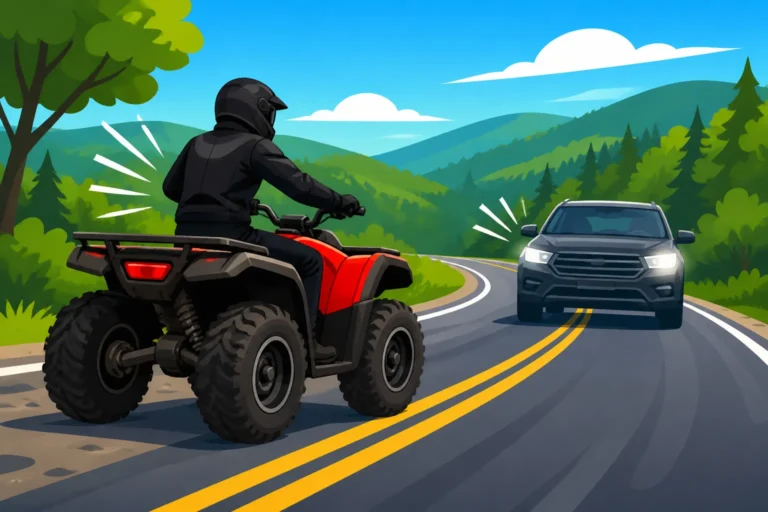
For public roads in West Virginia that are confirmed to be legally without a center line (often certain county routes, or unimproved roads), the general operating principle for ATVs and UTVs is to stay as far to the right as safely possible. This means hugging the shoulder or the very edge of the usable roadway. Think of it as always leaving maximum clearance for oncoming traffic, even if you don't anticipate any. This rule is designed for common-sense safety, especially on narrow, winding roads where visibility might be limited. It’s also crucial to remember that speed limits still apply, and in the case of non-SPV ATVs, you're still bound by the 25 mph maximum. [West Virginia's ATV Speed Limit on a Public Road] clarifies these limits.
Crossing Roads with a Center Line: The Exception
Even if you're primarily riding on roads without center lines, you'll inevitably need to cross or briefly use a road that does have one to connect to another trail or reach a destination. This is where the 10-mile, 25 mph rule truly comes into play for non-SPV machines. You are generally permitted to cross roads with a center line or use a section of such a road for up to 10 miles, provided the speed limit is 55 mph or less, and you maintain the 25 mph speed cap. This allowance is crucial for riders navigating the complex West Virginia landscape, allowing them to bridge gaps between trail systems. For example, if you're on a county road without a center line and need to get to another trail system on the other side of a state route (which definitely has a center line), you can use that 10-mile window. This kind of maneuver is essential for full enjoyment of areas like the Hatfield-McCoy Trails. More specific advice on this can be found in [Crossing a West Virginia Highway on an ATV].
Equip Your Machine for Safety, Regardless of Road Type
Regardless of whether a road has a center line or not, when you venture onto any public thoroughfare, safety equipment becomes even more critical. You are sharing the road with other vehicles, and visibility is key. Even on dimly lit rural roads, you need to be seen.
Here's a quick rundown of essential equipment:
- Headlights and Taillights: Absolutely vital, especially if you're riding near dusk or dawn. Make sure they're functioning properly and visible from a distance.
- Brake Lights: These are non-negotiable for signaling your intentions to anyone behind you.
- Rear-View Mirrors: At least one mirror is usually required, and having two is even better for situational awareness.
- Horn: A working horn is crucial for signaling your presence or alerting others to potential hazards.
- Turn Signals: While not always mandatory for non-SPV machines on all public roads, they are highly recommended for safety and clear communication, especially when making turns or changing lanes even on narrow roads. Many riders opt for aftermarket accessories from companies like SuperATV to ensure their machines are well-equipped for any road section, providing robust lighting kits, mirrors, and horns that meet or exceed safety expectations.
Ensuring your machine is well-equipped is not just about avoiding a ticket; it's about protecting yourself and others. You can learn more about [Equipment West Virginia Requires on a Road Ride] and [Lights Required After Dark in West Virginia].
Special Purpose Vehicles (SPVs) and the 20-Mile Centerline Rule
The conversation about center lines on West Virginia roads takes a very different turn when you introduce the concept of a Street-Legal Special Purpose Vehicle (SPV). This designation was created precisely to give UTV and certain ATV owners more flexibility when it comes to road riding, especially for connecting the vast trail systems that crisscross the state. Many riders initially get an SPV plate thinking it's a magic bullet for all road rules, but it has its own set of specific regulations.
What is an SPV and How Does it Differ?
A Street-Legal Special Purpose Vehicle (SPV) is a unique vehicle classification in West Virginia. It's designed specifically for UTVs and some larger ATVs that meet certain safety and equipment requirements to be operated on public roads. Unlike a standard ATV or UTV, which has very limited road access, an SPV is essentially a "street-legal" version of your off-road machine. To qualify, your vehicle must be inspected and equipped with things like working headlights, taillights, brake lights, turn signals, a horn, rear-view mirrors, a windshield, and DOT-approved tires. It's a much more rigorous setup than what's needed for a typical off-road machine, and it requires a special plate and registration from the DMV. This distinction is paramount to understanding expanded road access. [West Virginia's Street-Legal Special Purpose Vehicle Plate] provides comprehensive information on this topic.
The SPV's 20-Mile Centerline Privilege
Here's the key differentiator that makes the SPV plate so appealing, and it directly relates to roads with center lines: If your UTV or ATV is properly registered as an SPV, you gain the privilege of riding on a public road or highway with a speed limit of 55 mph or less for up to 20 miles, even if that road has a painted center line. This is double the distance allowed for non-SPV machines and significantly broadens your ability to link trails and access services. For instance, if you're riding a long trail system like the Hatfield-McCoy, you might need to use a paved state route to get from one trailhead to another. With an SPV plate, you have that 20-mile buffer, making long-distance trail system exploration much more practical. However, you must still adhere to the posted speed limit, or 25 mph if no speed limit is posted, or 55 mph if the road's speed limit is above 55 mph, whichever is less. For a deep dive into this specific allowance, see [West Virginia's 20-Mile Centerline Limit for an SPV].
Why an SPV Plate Changes the Game (and Its Limits)
The SPV plate truly is a game-changer for serious West Virginia riders who want to maximize their trail access without the constant worry of illegal road riding. It significantly reduces the frustration of having to trailer your machine for short distances between trails or into towns. Imagine riding directly from the Hatfield-McCoy trails in Gilbert to a restaurant in Man, crossing a state route in the process – an SPV plate makes that a real possibility within the 20-mile limit. You can use products from brands like SuperATV to help meet the necessary equipment requirements for an SPV conversion, making it easier to add those critical safety features.
However, it's vital to remember that an SPV plate doesn't turn your UTV into a regular car. There are still limits:
- Speed Limit: You cannot exceed the posted speed limit, and you still have a maximum speed of 55 mph on any road where the speed limit is higher than that. The 25 mph cap still applies if no speed limit is posted.
- Road Types: You're generally limited to roads with a speed limit of 55 mph or less. Divided highways and interstates are typically off-limits, regardless of your SPV status.
- Equipment Maintenance: All the equipment that made your vehicle an SPV must remain functional and properly maintained.
Understanding these distinctions is key to fully enjoying West Virginia's riding opportunities while staying within legal boundaries.
| Feature | Non-SPV ATV/UTV Road Rules | Street-Legal SPV Road Rules |
|---|---|---|
| Road Type | Primarily roads without a legal center line (county roads, private, dirt/gravel). | Roads with or without a legal center line. |
| Center Line Rule | Generally prohibited on roads with center lines, except for specific crossings. | Permitted on roads with a center line. |
| Max Distance | Up to 10 miles for connecting trails or accessing services. | Up to 20 miles for connecting trails or accessing services. |
| Max Speed | 25 mph. | Posted speed limit (up to 55 mph), or 25 mph if no speed limit posted. |
| Speed Limit Cap | Can only use roads with a speed limit of 55 mph or less. | Can only use roads with a speed limit of 55 mph or less. |
| Required Equipment | Basic off-road safety gear (helmet, eye protection). | Extensive street-legal equipment (lights, signals, mirrors, horn, windshield, DOT tires). |
| Registration | Standard ATV/UTV title. | Special SPV plate and registration. |
| Primary Use | Off-road, minimal road travel. | Off-road with significantly expanded road travel capability. |
Disclaimer
This article is for general informational purposes only and does not constitute professional advice. Laws, prices and regulations vary by location and change over time. Consult a qualified professional for guidance on your specific situation.