Aftermarket Exhaust and West Virginia Road Legality
One of the most common headaches for ATV and UTV owners in West Virginia is trying to customize their machine for better performance and a richer sound, only to worry about whether those modifications will land them in hot water with the law, especially when riding on public roads. This guide aims to clear up the confusion around aftermarket exhaust systems and what it truly means to be road-legal in our beautiful mountain state.
The Sound of Speed: Why Aftermarket Exhausts Tempt Riders
There's no denying the appeal of an aftermarket exhaust. Whether you're chasing a few extra horsepower, a more aggressive engine note, or just want to shave some weight off your machine, upgrading your exhaust system is a popular modification. It can transform the riding experience, making your quad or side-by-side feel more responsive and sound more powerful.
However, this quest for performance and aesthetics often bumps up against legal realities, particularly when you take your machine beyond the designated trails and onto West Virginia's public roads. What sounds fantastic out in the deep woods might be considered excessive in a quiet residential area or even illegal on a state highway. Riders often feel caught between wanting to enjoy their hobby to the fullest and the fear of getting a citation for something they didn't realize was against the rules.
The Allure of Performance and Sound
Many stock ATV and UTV exhausts are designed with a balance of noise reduction, emissions compliance, and cost-effectiveness in mind. While they do the job, they often leave performance enthusiasts wanting more. Aftermarket exhausts are engineered to improve exhaust flow, which can lead to gains in horsepower and torque. This translates to quicker acceleration, better throttle response, and a more engaging ride, especially when tackling steep climbs or racing through open terrain.
Beyond the performance benefits, the sound is a huge draw. A deeper, more resonant exhaust note can make a machine feel more robust and exciting. For many riders, the distinct rumble or roar of a performance exhaust is part of the off-road experience itself. This personal touch allows riders to further customize their machine, reflecting their style and passion for the sport.
The Fine Line Between Thrill and Trouble
The challenge arises when these performance-oriented exhausts are used in environments where noise and emissions are regulated. What's perfectly acceptable on a private track or a remote trail system like Hatfield-McCoy might be entirely inappropriate and illegal when you're traversing a small town or riding a county road. The sheer volume of some aftermarket systems can be startling to residents and other motorists, leading to complaints and, subsequently, increased law enforcement attention.
This can create a significant dilemma for riders. They've invested time and money into an upgrade that enhances their riding, but suddenly find themselves questioning where they can actually enjoy it without risking a penalty. It's not just about the noise; some aftermarket exhausts also bypass catalytic converters or other emissions control devices, which can raise environmental concerns and run afoul of emissions standards, even if West Virginia doesn't have strict emissions testing for off-road vehicles.
West Virginia's Specifics: Noise, Spark Arrestors, and Road Rules
West Virginia, with its extensive network of trails and growing number of ATV-friendly towns, offers unique opportunities for riders. However, this accessibility also means that machines traditionally confined to off-road use are now, in many areas, sharing public roadways. This intermingling brings about the necessity for compliance with vehicle laws that might not be immediately obvious to an off-road enthusiast. Understanding the state's stance on noise, spark arrestors, and general equipment is key to keeping your ride legal and enjoyable.
Navigating these regulations can feel like a maze. You want to ride, but you also want to avoid fines or losing access to the very roads and trails you love. It's a balance between enjoying the freedom of the mountains and respecting the communities and laws that make that freedom possible.
General Road Vehicle Noise Regulations
While West Virginia doesn't have specific decibel limits tailored exclusively to ATVs and UTVs for every road situation, the general motor vehicle code for noise often applies. This means that if your aftermarket exhaust creates "excessive or unusual noise," it could be deemed illegal. This subjective language can be frustrating, as what one officer considers excessive, another might not. However, it gives law enforcement the discretion to cite you if your machine is significantly louder than a stock vehicle.
This is especially true for machines operating under [West Virginia's 10-Mile, 25 mph Road Rule] or those that have obtained a [West Virginia's Street-Legal Special Purpose Vehicle Plate]. When an ATV or UTV is granted access to public roads, it steps into a different regulatory framework. It's no longer just an off-road machine; it's a vehicle operating in the public sphere, and as such, it's expected to conform more closely to general vehicle standards. The spirit of these laws is to prevent noise pollution that disrupts communities and to ensure public safety.
Spark Arrestors and Muffler Requirements
Regardless of whether you're on a public road, a private trail, or deep in the Monongahela National Forest, one requirement that consistently comes up for ATVs and UTVs in West Virginia is the spark arrestor. This device is designed to prevent hot carbon particles from exiting the exhaust system and potentially starting a wildfire, a very real concern in our forested state. Many public lands and trail systems, including the Hatfield-McCoy Trails, explicitly require a properly functioning spark arrestor.
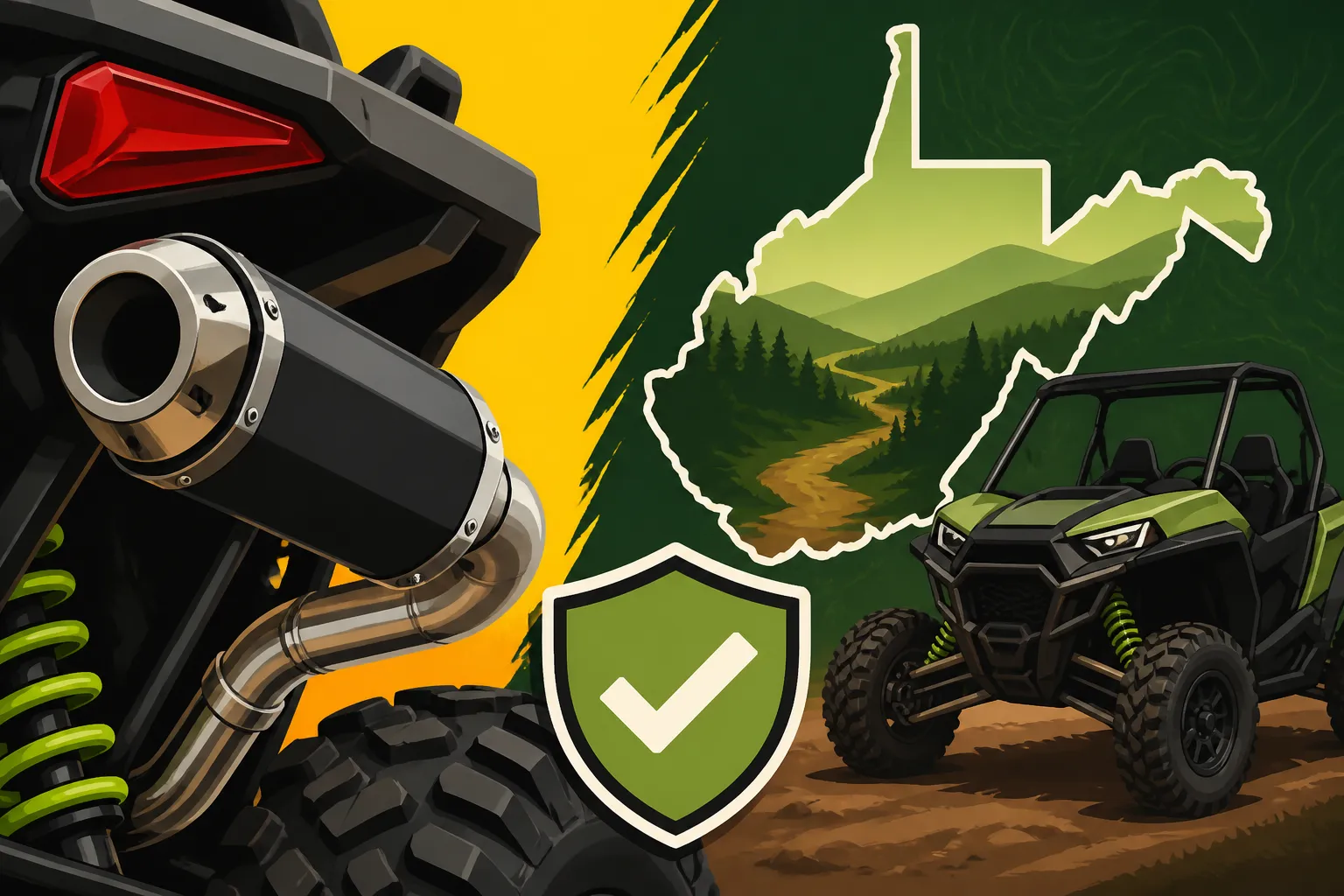
The spark arrestor is often integrated into the muffler system. If you install an aftermarket exhaust, you must ensure it includes a U.S. Forest Service approved spark arrestor. Removing or modifying this essential component can lead to fines, especially if you're riding on public land or a designated trail. You'll want to check for a stamp indicating SAE J350 or J1287 compliance, which signifies it meets spark arrestor standards. For more specific details, consider reviewing [Spark Arrester and Muffler Requirements in West Virginia]. Ignoring this can not only lead to a ticket but also pose a significant environmental risk.
Equipment Requirements for Street Legality
Beyond the muffler and spark arrestor, machines seeking street-legal status in West Virginia, particularly through the [Making a UTV Street Legal in West Virginia] process, must meet a host of other equipment requirements. While your exhaust might be the focus of its sound, it's just one piece of the puzzle. These machines are expected to have proper lighting, mirrors, turn signals, and in some cases, even a windshield and horn. The idea is to bring them up to a standard where they can safely share the road with traditional vehicles.
Each of these components contributes to the overall safety and compliance of the machine. An aftermarket exhaust, no matter how good it sounds, won't make your UTV street legal if you're missing brake lights or a horn. It's a comprehensive set of rules designed to integrate these vehicles safely into the public road system. The Department of Motor Vehicles has a checklist of items for [Equipment West Virginia Requires on a Road Ride] for Special Purpose Vehicles, and it's essential to consult this list thoroughly if you're aiming for full street legality.
Navigating the Aftermarket: Making Sure Your Choice is Compliant
So, you've decided an aftermarket exhaust is for you, but you also want to ensure you stay on the right side of West Virginia's road legality rules. This isn't just about avoiding a ticket; it's about being a responsible rider and respecting the communities that welcome us. The good news is that with a little research and careful selection, you can often find a balance between enhanced performance and compliance.
The market for ATV and UTV parts is vast, and not every product is designed with road legality in mind. Many are explicitly labeled "for off-road use only" or "for closed course competition." It's your responsibility as the owner to understand what those labels mean for your specific riding intentions, especially if those intentions include any time on public roads.
Deciphering Aftermarket Exhaust Labels and Specs
When you're shopping for an aftermarket exhaust, pay close attention to the product descriptions and any technical specifications provided by the manufacturer. Look for language that mentions compliance with specific noise standards or includes a spark arrestor. Some manufacturers, like SuperATV, which offers a wide range of accessories, might produce exhausts that cater to different needs, including those designed with some level of noise reduction compared to their full-race counterparts. However, always verify the specific model's claims against your state's requirements.
The presence of an SAE stamp (like SAE J350, J1287, or J2825 for noise levels) or a USFS (U.S. Forest Service) approval for a spark arrestor is a strong indicator of compliance for many public lands and trails. If a product description doesn't explicitly state these, it's worth reaching out to the manufacturer or the vendor for clarification. Remember, a lack of information often means it's not designed to be compliant with road or public land regulations.
| Exhaust Type / Feature | Typical Purpose | Road Legality Considerations (WV) |
|---|---|---|
| Stock Exhaust | Balance performance, noise, emissions | Generally compliant; designed for road/public land use. |
| Performance Aftermarket | Maximize power, aggressive sound | Often too loud for roads; may lack spark arrestor; "off-road use only." |
| Quiet Core Insert | Reduce noise for trails/roads | Can help bring a performance exhaust closer to legal limits for noise. |
| USFS Approved Spark Arrestor | Prevent wildfires | Mandatory for public lands & most road-legal applications. |
| Catalytic Converter | Reduce emissions | Not typically required for ATVs/UTVs in WV, but good for environment. |
Seeking Professional Advice and Local Ordinances
If you're still unsure about a specific exhaust system, don't hesitate to consult with a reputable ATV/UTV dealer or a mechanic specializing in these vehicles. They often have firsthand knowledge of what tends to pass muster in West Virginia and what doesn't. They might even have access to equipment that can measure decibel levels, giving you a clearer picture of your exhaust's output. For more insights on sound, you might find [West Virginia Muffler Rules for a Road Ride] helpful.
Additionally, remember that while state law provides a general framework, individual towns and counties might have their own specific noise ordinances. This is especially pertinent if you plan on riding through [West Virginia's ATV-Friendly Towns and What You Can Ride], such as Gilbert or Man. What's allowed on a remote county road might not be permitted on Main Street in a bustling trail town. A quick call to the local police department or town hall can clarify any specific local rules that could impact your ride.
The Consequences of Non-Compliance on West Virginia Roads
Nobody wants to deal with the stress of getting pulled over, facing fines, or having their riding privileges curtailed. But the reality is that ignoring West Virginia's regulations regarding aftermarket exhausts and road legality can lead to precisely these outcomes. It's not just about the money; it's about the time lost, the potential inconvenience, and the overall impact on the perception of ATV and UTV riders in our state.
Being informed and proactive is your best defense against these consequences. It allows you to make smart choices for your machine and ride with confidence, knowing you're doing your part to keep West Virginia's roads and trails accessible for everyone.
Facing Fines and Penalties
The most immediate consequence of riding with an illegal aftermarket exhaust on a West Virginia road is a citation. While I can't give specific figures, tickets for excessive noise or equipment violations can add up quickly. These aren't just minor inconveniences; they hit your wallet and can potentially appear on your driving record, depending on how they're classified. For a general understanding of what such incidents might cost, you can refer to [West Virginia ATV Ticket Costs].
Beyond the initial fine, persistent or egregious violations could lead to more severe penalties. Law enforcement has discretion, and if your machine is excessively loud and you're deemed to be operating recklessly, you could even face charges related to [West Virginia Penalties for Reckless Riding]. This escalation is rare for a first-time, minor noise infraction, but it underscores the importance of taking these regulations seriously.
Impact on Public Perception and Access
Every time an ATV or UTV with an overly loud exhaust roars through a quiet community or past homes, it contributes to a negative stereotype of off-road riders. This isn't fair to the vast majority of responsible riders, but it's a reality that can have far-reaching consequences. [Noise Complaints About ATVs in West Virginia] are a real thing, and they often lead to calls for stricter enforcement, or even worse, calls for restricting ATV access to certain roads or areas.
The trail towns in West Virginia, which rely heavily on ATV tourism, work hard to foster a positive relationship between riders and residents. When noise becomes a significant issue, it strains these relationships and could jeopardize the very access that makes West Virginia such a fantastic place to ride. Being a good neighbor, which includes ensuring your exhaust isn't overly disruptive, helps preserve the riding opportunities we all cherish.
Roadside Inspections and Modifications
If you're riding a machine that's been made street legal with a Special Purpose Vehicle plate, or if you're utilizing limited road access rules, you should expect that your machine's equipment could be subject to inspection. Law enforcement officers are trained to look for compliance with [West Virginia Inspection Rules for a Street-Legal Machine], and that absolutely includes your exhaust system. If your aftermarket exhaust is clearly not up to par, or if it's missing a required spark arrestor, you could be pulled over and cited.
In some cases, you might even be required to make immediate modifications or remove your machine from the road until it complies. This could mean a tow bill, a lot of hassle, and definitely ruining your day of riding. It's far better to ensure compliance before you ever hit the pavement, rather than dealing with the consequences on the side of a busy highway or in the middle of a trail town. Responsible riding, including ensuring your machine meets all applicable road regulations, is key to enjoying all that West Virginia has to offer without unnecessary stress.
Disclaimer
This article is for general informational purposes only and does not constitute professional advice. Laws, prices and regulations vary by location and change over time. Consult a qualified professional for guidance on your specific situation.