West Virginia ATV Rules at Railroad Crossings
Navigating the beautiful, winding roads and vast trail systems of West Virginia on your ATV or UTV is an exhilarating experience, but it also comes with a unique set of challenges, especially when you encounter railroad crossings. Many riders find themselves wondering about the specific rules and, more importantly, the safest way to tackle these intersections, given that off-road vehicles behave quite differently than cars on tracks. This guide will walk you through the often-unspoken complexities of West Virginia ATV rules at railroad crossings, helping you understand both the legal requirements and crucial safety protocols to ensure a smooth, safe ride.
The Unique Challenges of Railroad Crossings for ATV and UTV Riders in West Virginia
Riding an ATV or UTV across railroad tracks isn't quite the same as gliding over them in your pickup truck. There are distinct mechanical and handling characteristics of off-road machines that make these crossings particularly tricky, and unfortunately, many riders don't fully appreciate the potential hazards until they're right there. The concern isn't just about trains; it's about the tracks themselves and how they interact with your machine.
Why Railroad Tracks Are a Different Beast for Off-Road Machines
First, consider the tires. ATV and UTV tires, while excellent for gripping dirt, mud, and rocks, often have aggressive treads and a relatively narrow contact patch compared to car tires. This can make them unstable on the smooth, hard steel of a rail. Even worse, the gaps between the rails, known as the flangeway, can be just wide enough to catch a tire, especially on smaller ATVs or if you hit them at an awkward angle. Imagine hitting a steel-edged ditch at an angle – that's often what it feels like if you misjudge a railroad crossing. The rails themselves can also be slick, especially when wet or covered in frost, presenting a traction challenge that could lead to a loss of control.
Then there's the suspension. While an ATV or UTV suspension is designed to absorb big bumps and uneven terrain, a railroad crossing presents a series of very specific, linear obstacles. Hitting rails perpendicularly can jar the machine, while hitting them at an angle can cause the vehicle to slide or even high-side, throwing a rider off balance or causing a side-by-side to lean dangerously. The approach and departure angles of many UTVs, while good for trail obstacles, might still bottom out on unusually raised crossings if not approached with care. [West Virginia's Street-Legal Special Purpose Vehicle Plate] is a classification that allows some off-road vehicles on public roads, meaning these encounters become more common, not less.
The Legal Gray Areas and Real-World Risks
West Virginia law, like most states, tends to classify ATVs and UTVs operating on public roads as "motor vehicles" for certain purposes, especially concerning traffic laws. However, there aren't always specific statutes exclusively detailing "ATV rules at railroad crossings." This means that the general rules of the road for any motor vehicle at a railroad crossing usually apply to you, too. Ignorance of these laws is no excuse, and the penalties can be severe. More importantly, the risk is immense. A collision with a train is almost always catastrophic, and even if no train is present, an improper crossing can lead to a serious accident, overturning your machine, or throwing you from it.
Beyond the obvious train collision danger, there's the risk of getting stuck. If your ATV or UTV bottoms out, or a tire gets wedged in the flangeway, you could be immobilized directly on the tracks. This isn't just an inconvenience; it's a life-threatening situation if a train approaches. The vibrations and noise of an oncoming train are difficult to hear over an engine, especially in a closed-cab UTV, reducing precious reaction time. Additionally, the uneven, often gravelly terrain surrounding many railroad crossings can be loose and unpredictable, making controlled braking and acceleration difficult for off-road tires.
Understanding West Virginia's General Railroad Crossing Laws (and How They Apply to ATVs)
While you won't find a specific chapter titled "ATV Railroad Crossing Laws" in the West Virginia Code, the general statutes for motor vehicles absolutely apply to anyone operating an ATV or UTV on a public road or where a railroad intersects a trail or pathway open to the public. These laws are designed for universal safety, recognizing the immense danger posed by trains. It's not just about avoiding a ticket; it's about staying alive.
Stop, Look, and Listen: The Universal Rule
This isn't just a quaint saying; it's a legal requirement and a fundamental safety principle. West Virginia law (and common sense) dictates that when approaching a railroad crossing, you must exercise due care. This means reducing your speed, being prepared to stop, and actively looking and listening for an approaching train. Even if there are no flashing lights or crossing gates, a wise rider always assumes a train could be coming. The sheer momentum and size of a train mean it cannot stop quickly, and it always has the right-of-way.
For ATV and UTV riders, "look and listen" takes on an even greater importance. Your open-air machine might make it easier to hear, but engine noise, helmet use, and wind can obscure sounds. You need to actively scan both directions of the track. If your view is obstructed by trees, buildings, or the curve of the track, you must approach even more cautiously, perhaps even stopping, looking, and listening before proceeding. Think about it: a moment of caution is a tiny price to pay compared to a lifetime of regret or injury. [Equipment West Virginia Requires on a Road Ride] includes headlights and taillights, which are crucial for visibility, but they won't make a train see you any better than your eyes can see a train.
When a Crossing Signal Demands Your Full Attention
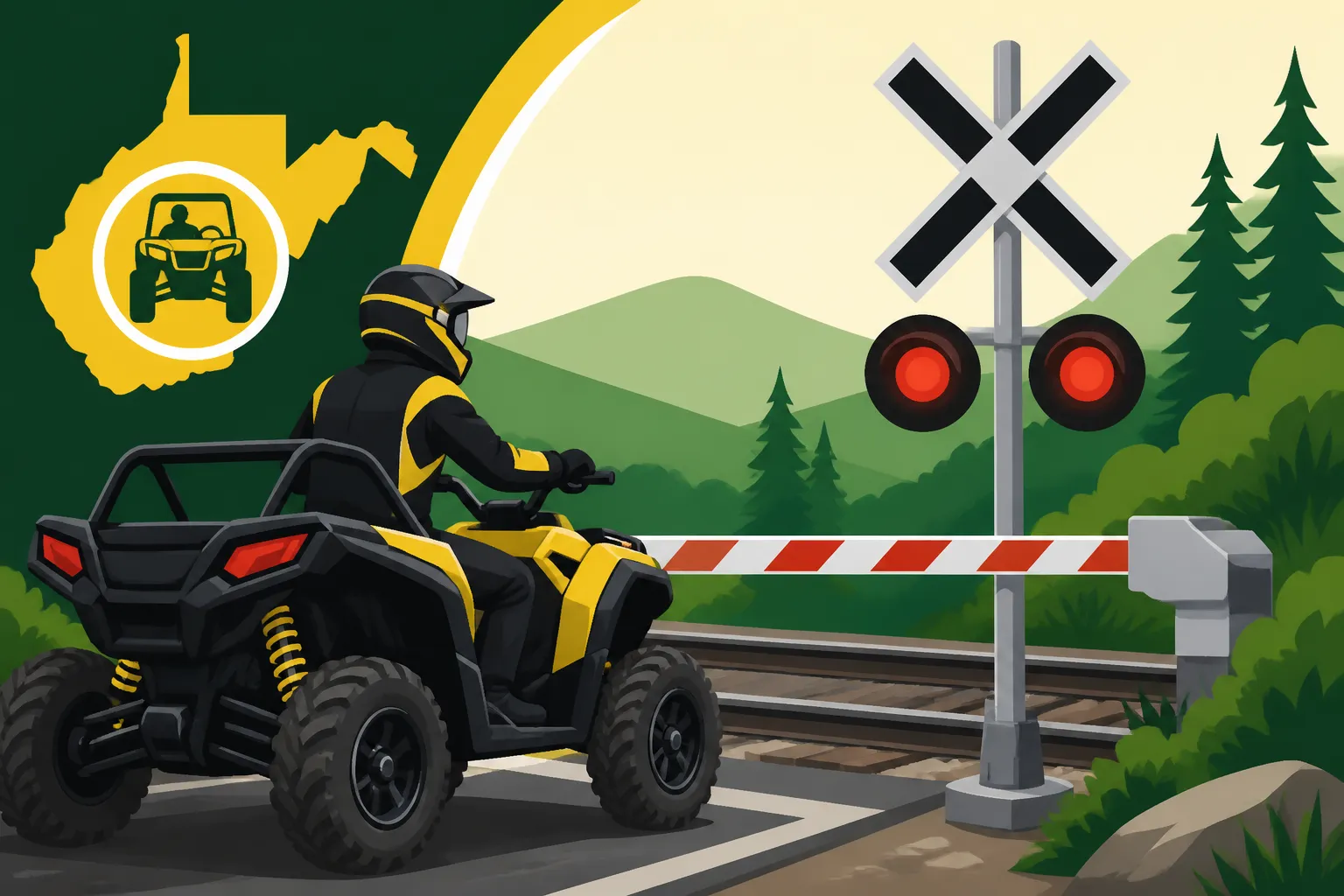
The law is crystal clear when it comes to active warning devices. If there are flashing red lights, a descending or fully lowered crossing gate, or a flagger signaling you to stop, you must stop. Period. It is illegal and incredibly dangerous to attempt to go around a lowered gate or to cross while lights are flashing. These signals are there for a reason, indicating that a train is either present, approaching, or occupying the crossing. Trying to beat a train is a gamble you will always lose.
The law typically requires you to stop within 15 to 50 feet of the nearest rail. This distance is important because it provides a safety buffer if a train approaches quickly or if there's any debris from the tracks. Never stop on the tracks. If you are operating a machine that falls under the [West Virginia's Street-Legal Special Purpose Vehicle Plate] designation, these rules are as applicable to you as they are to a car. Ignoring these signals can lead to severe penalties, including hefty fines, points on your license, and even reckless endangerment charges if your actions put others at risk. West Virginia takes railroad safety very seriously, as evidenced by the [Tickets West Virginia Deputies Write for Road Riding].
Penalties for Disregarding Railroad Crossing Laws
Ignoring railroad crossing laws, whether intentionally or through negligence, carries significant consequences in West Virginia. Just like with a car, you could face fines that vary depending on the severity of the offense. For instance, bypassing a lowered gate or flashing lights is a serious traffic infraction. These violations can also add points to your driver's license, which can lead to increased insurance premiums or even suspension if you accumulate too many.
Beyond fines and points, there's the potential for much more serious legal trouble. If your actions at a railroad crossing cause an accident, injury, or death, you could be charged with reckless driving, reckless endangerment, or even vehicular homicide. These are criminal charges that carry severe penalties, including substantial jail time. Imagine trying to explain to a judge why you thought a few seconds saved was worth risking your life and the lives of others. The legal system doesn't look kindly on such gambles. Furthermore, any accident involving a train, regardless of fault, will involve multiple law enforcement agencies and potentially federal investigators, making it a very complicated and stressful ordeal. For more on the consequences of risky behavior, consider [West Virginia Penalties for Reckless Riding].
Best Practices for Safe ATV and UTV Operation at Railroad Crossings
Knowing the law is one thing, but practicing safe techniques for off-road vehicles at railroad crossings is paramount. These machines handle differently, and what works for a truck might not work for a side-by-side or quad. Developing good habits and understanding the nuances of these specific crossings can literally be a lifesaver.
Approaching and Assessing the Crossing
As you approach a railroad crossing, reduce your speed well in advance. This gives you ample time to assess the situation. Look for any warning signs, lights, or gates. Critically, scan both directions of the track for an oncoming train. Don't just glance; actively turn your head and look. If your vision is obscured, slow down further, or even stop and listen carefully before proceeding. It's often helpful to lift your visor or turn down your UTV's radio for a moment to better hear any approaching train.
Next, assess the physical condition of the crossing itself. Are the tracks smooth and flush with the road, or are they raised and uneven? Is there loose gravel, mud, or debris that could affect traction? Are there steep approach or departure angles that could cause your machine to bottom out? Pay close attention to the flangeway gaps – the spaces on either side of the rail. These gaps are often designed for train wheels, not ATV tires, and can be wide enough to catch a wheel. If you spot a rough crossing, plan your path accordingly. Sometimes, crossing slightly off-center can help avoid the deepest ruts. Many riders install durable aftermarket parts from companies like SuperATV on their machines, like heavy-duty A-arms or skid plates, which can provide some protection against bottoming out, but they are no substitute for careful driving.
Crossing Technique for Off-Road Vehicles
Once you've stopped, looked, and listened, and determined the crossing is clear and safe, choose your crossing angle. The safest way to cross railroad tracks on an ATV or UTV is typically as perpendicular as possible (at a 90-degree angle). This minimizes the chance of your tires getting caught in the flangeway or sliding along the rail. Avoid crossing at a sharp angle, as this dramatically increases the risk of a tire getting stuck or sliding uncontrollably.
Engage a low gear and maintain a slow, steady speed as you cross. Avoid sudden acceleration or braking while on the tracks, as this can cause a loss of traction or stability. Keep your hands firmly on the handlebars (for ATVs) or the steering wheel (for UTVs) and your feet on the pegs or floorboards. Be prepared for bumps and jostling. If you're on a multi-rider machine, ensure all passengers are aware of the crossing and are holding on securely. For those riding larger side-by-sides, especially those with modified suspensions or wider stances, ensure your chosen path accommodates your machine's dimensions. Installing a quality horn, perhaps from SuperATV, is also a good idea for any machine you ride on or near roads, providing another layer of safety. [Mirrors and Horns on a Street-Legal Build] are essential for these situations.
What to Do in an Emergency Situation
Even with the best preparation, emergencies can happen. If your ATV or UTV stalls or gets stuck on the tracks as a train approaches, the absolute first priority is to get yourself and any passengers to safety, far away from the tracks and the path of the train. Do not try to move the machine; your life is infinitely more valuable than your quad or side-by-side. Once everyone is clear, immediately contact emergency services (911) and the railroad company if possible. Most railroad crossings have an emergency notification sign with a crossing number and a phone number to report issues. Providing this information quickly can allow the railroad to warn the train crew.
If you somehow become stuck when no train is in sight, try to free your machine cautiously. If you can't, mark the crossing with reflective gear or flags if you have them, and again, contact emergency services. Never assume no train will come; always prioritize getting to a safe distance from the tracks. Having a basic first aid kit and communication device on your machine, as suggested for general trail riding, is also critical for [West Virginia ATV Accident Reporting Rules].
Street-Legal Status and Railroad Crossings: Does It Change Anything?
With the increasing popularity of making UTVs and ATVs street-legal in West Virginia, riders are encountering railroad crossings on public roads more frequently. While having a street-legal designation grants you certain privileges, it fundamentally changes very little about the inherent dangers and required precautions at railroad crossings.
SPV Plates and Public Road Rights
If your ATV or UTV has a West Virginia [West Virginia's Street-Legal Special Purpose Vehicle Plate], it means your machine has met certain equipment requirements (like lights, horn, mirrors, and sometimes a windshield) and is legally allowed to operate on many public roads within specific limitations, such as the [West Virginia's 10-Mile, 25 mph Road Rule] and the 20-mile centerline rule. This means you will naturally encounter more railroad crossings than someone who strictly rides trails.
However, having an SPV plate does not grant you any special immunity or privilege at railroad crossings. You are still subject to all the same laws as any other motor vehicle, including stopping for trains, flashing lights, and lowered gates. Your machine might have better tires or more visible lighting, perhaps even an upgraded LED light bar from SuperATV, but the physics of a train versus an off-road vehicle remain unchanged. The responsibility for safety at these crossings falls entirely on the operator, regardless of what kind of plate is on your bumper.
The Fundamental Safety Rules Remain the Same
Even if your machine is street-legal and fully equipped, the core principles of safe railroad crossing operation are exactly the same: stop, look, listen, and cross perpendicularly when clear. In fact, because you're on a public road, the likelihood of encountering vehicle traffic alongside you might be higher, requiring even more situational awareness. Do not let the confidence of being "street-legal" lull you into a false sense of security or encourage risky behavior.
Your street-legal machine may have turn signals and brake lights, which are important for communicating with other vehicles, but they do nothing to protect you from a train. The same applies to [West Virginia Helmet Rules for Riders Under 18] – a helmet protects you in a crash, but avoiding a crash with a train is the primary goal. Always maintain a heightened sense of caution and respect for railroad tracks, whether you're on a small ATV, a large UTV, or even a modified machine with specialized SuperATV parts designed for aggressive terrain. The consequences of error at a railroad crossing are simply too high to take lightly.
Disclaimer
This article is for general informational purposes only and does not constitute professional advice. Laws, prices and regulations vary by location and change over time. Consult a qualified professional for guidance on your specific situation.