West Virginia ATV Ticket Costs
Many of us have been out enjoying the beautiful West Virginia trails or maybe just cruising down a designated road section, only to have that fun abruptly end with the flash of blue lights and the dreaded sight of a deputy holding a ticket book. It's a real bummer, and beyond the immediate frustration, the looming question is always: "How much is this going to cost me?" This guide is here to shed some light on the various types of ATV and UTV tickets you might encounter in West Virginia and, more importantly, what kind of financial hit and other consequences you might face.
Understanding West Virginia ATV Violations
Getting an ATV or UTV ticket in West Virginia isn't just about bad luck; it's usually about violating a specific rule or regulation designed for safety, property protection, or trail management. Knowing what these common violations are can help you avoid them in the first place, or at least understand the situation if you do find yourself with a citation.
Common Offenses on Roads and Trails
One of the biggest areas where riders get into trouble is operating their machines where they aren't permitted. West Virginia has done a fantastic job creating world-class trail systems like the Hatfield-McCoy, but the rules for road use are very particular. You can't just take your quad on any old public road. Often, folks get stopped when they're using state highways or non-designated county roads as shortcuts between trail sections or to get to a local store. These violations typically stem from misunderstanding or ignoring specific restrictions, such as [West Virginia's 10-Mile, 25 mph Road Rule] that applies to limited road crossings. If you're spotted trying to get to a gas station in a town that isn't officially ATV-friendly, you might be looking at a citation.
Another frequent issue arises from lacking the proper permits for managed trail systems. If you're planning a trip to the Hatfield-McCoy Trails, you absolutely need a [West Virginia's Hatfield-McCoy Trail Permit Explained]. It's a small fee that helps maintain those amazing trails, but forgetting it or trying to ride without one can lead to a ticket from a trail ranger or local law enforcement. It's a common mistake, especially for out-of-state riders or new residents who might be unfamiliar with specific requirements, such as ensuring their machine's title is correctly updated if they've recently moved to the state. Always ensure your paperwork, including your permit, is in order before you hit the trails.
Age and supervision rules are also strictly enforced, especially when it comes to youth riders. West Virginia has specific guidelines about who can operate an ATV or UTV and under what conditions. If a rider under the age of 16 is caught operating a machine without direct adult supervision or on a vehicle that exceeds the allowed [Youth ATV Size Rules for West Virginia Families], their parents or legal guardians can face a ticket. These rules apply broadly, whether you're on a trail system or even on private land with public access points. It's not just about compliance; it's about keeping our youngest riders safe.
Specific Violations Related to Equipment and Safety
Safety equipment is another area where tickets are frequently issued. In West Virginia, if you're under 18, wearing an approved helmet is mandatory when riding an ATV or UTV on public land or designated trails. Even for adults, while not always legally required on every piece of private land, it’s heavily encouraged. If you're caught without the necessary [Helmet and Eye Protection Rules in West Virginia] for your age, you'll likely receive a citation. This also extends to eye protection, which is crucial for visibility and preventing injuries from dust, debris, or insects. Many riders might remember their helmet but forget their goggles, which can still lead to a ticket.
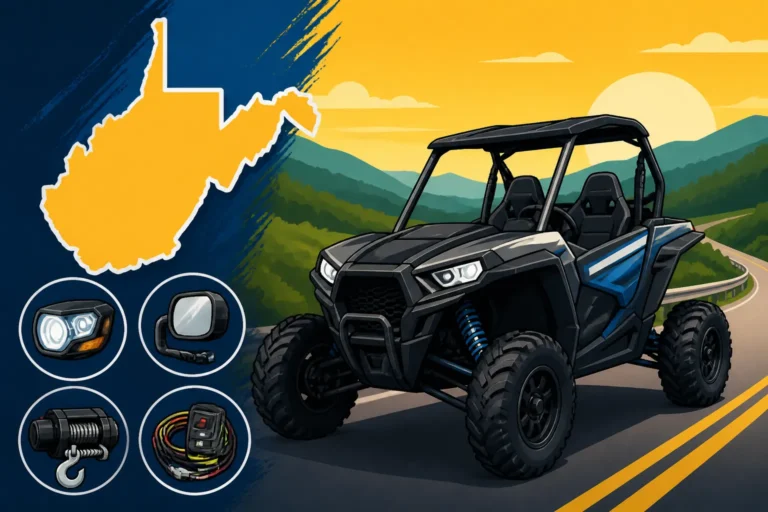
When it comes to utilizing the limited road access for ATVs and UTVs in West Virginia, your machine must meet specific equipment requirements. This means having functioning headlights, taillights, brake lights, and in many cases, mirrors and a horn. Most off-road machines don't come factory-equipped with all these street-legal components. Attempting to ride your stock machine on a public road, even for a short crossing, without the necessary [Equipment West Virginia Requires on a Road Ride] can easily result in a ticket. It's why many riders turn to aftermarket companies like SuperATV to acquire conversion kits that ensure their UTV meets these crucial safety and legal standards, making rides safer and fully compliant.
Lastly, spark arresters and noise violations are common issues. Given West Virginia's beautiful, forested landscape, preventing wildfires is a top priority, and functioning spark arresters are non-negotiable. Operating without one is a fire hazard and a ticketable offense. Furthermore, excessive noise from aftermarket exhausts can lead to complaints, especially in residential areas or near trail towns. These [West Virginia Noise Complaints About ATVs] can result in fines. It’s all about respecting the environment and the peace of mind of residents near popular riding areas.
Trespassing and Private Land Issues
Trespassing is a serious issue that often results in some of the most expensive tickets and complicated legal situations. Many riders mistakenly assume that any unmarked trail or open-looking land is fair game, but that's rarely the case. West Virginia landowners are generally very protective of their property, and riding on [Riding on Posted Land in West Virginia] without explicit permission is a direct violation. Not only can this lead to significant fines, but in some instances, it can even result in your ATV or UTV being impounded. Always double-check maps, look for signage, and when in doubt, get permission.
Even within managed trail systems like the Hatfield-McCoy, there can be areas designated as restricted. These areas might be closed due to ongoing logging operations, environmental protection zones, or trail maintenance. Ignoring [Gates, Signs and Barriers on the Trails] that indicate a closed area is a violation of the trail rules and can lead to a ticket from a trail ranger or local law enforcement. These restrictions are put in place for your safety and the longevity of the trail system, so respecting them is paramount.
Finally, riding beyond marked trail boundaries, often referred to as "trail blazing" or "creating new trails," is also a ticketable offense. Veering off the designated path and [Riding Off a Marked Trail] can cause significant environmental damage, including erosion and disruption to local ecosystems. Trail rangers actively patrol for this type of behavior because it undermines the sustainable management of the trail system and can lead to trail closures if not addressed. Always stick to the clearly marked and approved trails.
The Financial Bite: Ticket Costs and Fines
Let's face it, one of the biggest anxieties after receiving an ATV ticket is wondering exactly how much it's going to hit your wallet. The actual dollar amount can vary wildly depending on the severity of the offense, the specific location, and whether there are any prior infractions. It's rarely just the number printed on the ticket; often, other fees sneak in.
Average Ranges for Minor Infractions
For less severe violations, such as riding on a minimally restricted road section or a minor equipment issue, the fines typically fall into the lower hundreds. For example, if you're caught exceeding [West Virginia's 10-Mile, 25 mph Road Rule] by a small margin, or perhaps your machine is missing a required mirror for road use, the base fine might be in the $100 to $250 range. These types of tickets are often categorized similarly to minor traffic violations for automobiles. While certainly an inconvenience, they generally don't carry the severe long-term repercussions of more serious offenses.
However, if you're caught riding on the Hatfield-McCoy system without a valid permit, the fines can be more substantial. Trail rangers are vigilant, and they will check for permits. While specific figures can fluctuate, these citations generally carry a higher penalty than a simple road violation because they undermine the operational funding and regulatory framework that keeps these popular trails open and maintained. It serves as a strong deterrent to ensure everyone contributes to the system's upkeep. Think of it as a penalty for using a service without paying the required user fee.
Safety equipment non-compliance, such as a helmet violation for a minor or missing eye protection, also usually results in a fine within the lower hundreds. These laws are critical for rider safety, so enforcement tends to be consistent. It's a reminder that these aren't just suggestions; they are legal requirements designed to protect you and your passengers from serious injury. The cost of a ticket often far outweighs the cost of simply buying and wearing the proper gear.
Higher Penalties for Serious Offenses
When we talk about serious offenses, the financial penalties — and indeed, all consequences — escalate dramatically. Operating an ATV or UTV recklessly, endangering others, or, most severely, driving under the influence (DUI) carries extremely high fines, often in the thousands of dollars. An [A DUI on an ATV in West Virginia] is treated with the same gravity as a DUI in a standard vehicle, meaning not just massive fines but also potential jail time, suspension of your driver's license, and a permanent mark on your criminal record. This isn't merely an ATV ticket; it's a criminal offense with life-altering repercussions.
If your ATV ticket involves serious trespassing that leads to property damage, or if you're caught riding in environmentally sensitive areas that are explicitly restricted, the fines can quickly soar into the hundreds or even thousands. Beyond the initial fine, you could also be held liable for restitution to the landowner for damages or for the costs of environmental remediation. This is where a simple joyride can turn into a complex and very expensive legal battle, far exceeding the cost of any minor infraction.
Moreover, repeat offenses almost always lead to increasingly steeper penalties. If you've accumulated multiple tickets for similar ATV violations, courts and law enforcement are likely to impose higher fines and more stringent consequences. You're no longer seen as an accidental offender but as someone willfully disregarding the rules, moving your situation out of the "minor infraction" category and into a much more serious realm. This progressive penalty structure is designed to discourage habitual non-compliance.
Court Costs and Administrative Fees
What many riders overlook is that the fine amount printed on your citation is often just the tip of the iceberg. When you pay an ATV ticket in West Virginia, particularly if it involves processing through a magistrate's office or a court appearance, there are almost always additional court costs and administrative fees tacked on. These fees are rarely detailed on the initial ticket but become apparent when you go to settle up. These can easily add an extra $50 to $150, or even more, to your total bill, effectively turning a $150 base fine into a $300 payment. It’s a crucial detail that catches many off guard.
If you choose to contest an ATV ticket in court, which is absolutely your right, you should be prepared for potential legal fees if you decide to hire an attorney. While a lawyer might be able to negotiate a reduced fine or even get the ticket dismissed, their professional services come at a cost. This decision involves weighing the initial fine against the expense of legal representation, a choice often justified for serious charges like DUI or reckless endangerment, where the stakes are much higher than a minor parking violation.
In more severe cases, or if you're caught operating an unregistered or untitled machine in West Virginia where a title is required (e.g., for ATVs sold after 1989), your ATV or UTV could be impounded. Reclaiming your machine from impound can involve towing fees, daily storage fees that quickly accumulate, and administrative release fees. These costs can rapidly add up to hundreds of dollars, sometimes even exceeding the market value of an older machine. It's a very real and significant financial consequence that can hit your budget hard.
Beyond the Fine: Other Consequences of an ATV Ticket
While the financial sting of an ATV ticket is often the first thing on a rider's mind, the repercussions can extend far beyond the immediate fine. An ATV ticket in West Virginia can have lasting impacts on your riding privileges, your ability to insure your machine, and even your personal freedom.
Impact on Riding Privileges and Trail Access
One of the most disheartening consequences for avid riders is the potential loss of access to West Virginia's acclaimed trail systems. If you commit a serious infraction on a managed trail, particularly if it's a repeat violation or involves egregious behavior such as extreme recklessness or significant environmental damage, you could face [Losing West Virginia Trail Access After a Citation]. This means your Hatfield-McCoy permit could be revoked, or you could be banned from the trails for a specified period. For many, losing the ability to ride those fantastic trails is a far more severe punishment than any monetary fine.
For very serious offenses, especially those linked to reckless operation or a DUI on your ATV, your regular driver's license could be suspended. This isn't just about your ability to drive your car; it impacts your legal right to operate any motorized vehicle, including ATVs and UTVs, on public roads and trails where a license is required. [Driver's License Rules for West Virginia Road Riding] are quite clear, and violating them can have broad implications beyond just your off-road adventures.
While less common for minor infractions, a history of serious ATV violations could potentially complicate future attempts to obtain permits or licenses, particularly if you ever consider professional activities involving ATVs, such as guiding or commercial services. It creates a negative record that could be considered in such applications.
Potential for Vehicle Impoundment
Vehicle impoundment is a very real threat for certain ATV violations. Beyond what we discussed regarding unregistered machines, your ATV or UTV can be impounded for severe infractions such as reckless operation, riding while intoxicated, or repeated, blatant trespassing. Law enforcement might deem your vehicle a public nuisance or a safety hazard. This can also happen if you're operating a heavily modified machine that doesn't meet safety standards, even if components like those from SuperATV were used for enhancement.
The process and cost of recovering an impounded vehicle can be significant. You'll need to demonstrate clear [Proof of Ownership for a West Virginia ATV Title], pay all outstanding fines related to the violation, and then cover the towing and daily storage fees. These storage fees, in particular, can accumulate rapidly, turning an already difficult situation into a major financial burden that might, in some cases, exceed the value of an older machine. It's a punitive measure that adds considerable stress and expense.
In the most extreme circumstances, especially involving multiple severe offenses or criminal activity where the ATV was a tool, the vehicle itself could be subject to forfeiture by the state. This means you could lose ownership of your machine entirely, with no compensation. While this is a rare outcome for minor tickets, it serves as a stark warning for severe and habitual violations.
Insurance Implications
An ATV ticket, much like a traffic ticket for your car, can have repercussions on your insurance. Moving violations or serious safety infractions can lead to increased premiums. Insurance providers view these tickets as indicators of higher risk, and they adjust your rates accordingly. Even if you rely on limited coverage from [Does Homeowners Insurance Cover an ATV in West Virginia?], a dedicated ATV policy will almost certainly see a hike in cost after a citation.
If you accumulate several serious tickets, you might even find it challenging to secure standard [West Virginia ATV Liability Coverage Limits] from traditional insurers. You could be forced into higher-risk insurance pools, or in extreme cases, be denied coverage altogether. This can make it difficult to legally operate your machine, especially if you plan to ride in areas or on public roads where insurance is a mandatory requirement.
In a worst-case scenario, if you are involved in an accident while actively committing a ticketable offense (e.g., riding without a helmet where one is required, or operating recklessly), your insurance company could potentially deny coverage for damages or injuries. They might argue that you were engaging in illegal activity that violated the terms of your policy. This could leave you personally responsible for substantial medical bills, property damage costs, and other liabilities, making a bad situation exponentially worse.
What to Do When You Get an ATV Ticket
Getting an ATV ticket is never a pleasant experience, but how you react and proceed afterward can significantly impact the outcome. Don't let frustration cloud your judgment; instead, take a strategic approach.
Reviewing the Citation Carefully
The very first step is to calmly and thoroughly read the ticket you've been given. What exactly are you being cited for? Is it trespassing, a helmet violation, operating on a specific [West Virginia Road Rules Riders Get Wrong] section, or something else entirely? Ensure you understand the specific statute or ordinance cited on the ticket. Sometimes, an officer might inadvertently make a mistake in documenting the charge, which could be grounds for contesting it later.
Next, meticulously check the citation for any inaccuracies. Is your name, address, or date of birth spelled correctly? Are the date, time, and precise location of the alleged offense accurate? Is the description of your ATV correct, including its make, model, and VIN? While minor clerical errors might not automatically invalidate a ticket, significant factual inaccuracies could be very important if you decide to fight the charge in court. Documenting these details immediately can be helpful.
Finally, pay very close attention to all deadlines and instructions printed on the ticket. This includes the due date for payment, if you choose that option, or the date and time for any mandatory court appearance. Missing these critical deadlines can lead to much more severe consequences, such as additional late fees, default judgments against you, or even warrants for your arrest. The ticket should clearly outline the [West Virginia ATV Ticket Costs] and the procedural steps you need to take.
Paying the Fine Versus Contesting It
Deciding whether to pay an ATV ticket or contest it is a personal choice that depends on the specifics of your situation. If the infraction is minor, the evidence is clearly against you, and the fine is manageable, simply paying the fine might be the easiest and most practical path. This approach avoids the time commitment of court appearances, potential court costs, and any legal fees. For a straightforward [West Virginia ATV Ticket Costs] for a minor offense, it often feels like the path of least resistance. However, be aware that paying the fine is generally considered an admission of guilt.
You should seriously consider contesting a ticket if you genuinely believe you were wrongly cited, if there's a significant factual error on the ticket itself, or if the potential consequences are severe (such as a hefty fine, potential license suspension, or implications for your record). For instance, if you were operating a [West Virginia Street-Legal Special Purpose Vehicle Plate] and believed you were fully compliant with all state laws, but the officer disagreed, you might have a case. Perhaps the officer misunderstood aspects of the [West Virginia's 20-Mile Centerline Limit for an SPV] or other specific SPV rules. [Fighting an ATV Ticket in West Virginia] can be complex, but it is your fundamental right to present your side of the story and challenge the accusation.
If you opt to contest the ticket, start gathering any supporting evidence you have immediately. This could include photographs of the location where you were cited, documentation proving your ATV's equipment meets requirements (maybe you installed a full SuperATV kit for street legality), witness statements, or any documents proving the validity of your permits. The more prepared and organized you are with evidence, the better your chances of a favorable outcome in court.
Seeking Legal Counsel
For any serious ATV ticket that carries potential criminal charges (such as a DUI), extremely significant fines, or the possibility of license suspension, seeking legal counsel is highly advisable, if not essential. An attorney experienced in traffic or ATV law in West Virginia can provide invaluable guidance on your rights, analyze the specifics of your case, and advise you on the best course of action. They can also represent you in court, which is particularly beneficial when navigating complex regulations like [West Virginia ATV Road Rules for Young Riders] or other nuanced laws.
A lawyer can also help you understand and navigate the intricacies of the West Virginia legal system, which can be daunting for someone unfamiliar with it. They can explain the local magistrate court procedures, discuss potential plea bargains, and prepare you for what to expect during a hearing. Often, they can identify legal defenses or mitigating circumstances that you, as a layperson, might not even be aware of, potentially leading to a dismissal or a reduction of charges.
While hiring a lawyer involves a financial cost, the long-term benefits of avoiding a criminal conviction, extremely high fines, a suspended license, or a negative impact on your driving record often far outweigh the upfront legal fees, especially for more severe violations. Consider the potential impact a conviction could have on your insurance rates, your ability to legally drive, and your overall enjoyment of future ATV adventures in West Virginia.
| Violation Type | Typical Fine Range (Estimated, Varies) | Additional Costs (Court/Admin/Towing) | Potential Other Consequences |
|---|---|---|---|
| Riding on Prohibited Road | $100 – $300 | $50 – $150 | |
| No Hatfield-McCoy Trail Permit | $150 – $500 | $50 – $100 | Trail access suspension |
| Helmet/Eye Protection (Under 18) | $100 – $250 | $50 – $100 | Parental responsibility, safety course requirement |
| No Proper Road Equipment (e.g., lights) | $100 – $250 | $50 – $100 | |
| Trespassing on Private Land | $200 – $1000 | $100 – $300 | Vehicle impoundment, property damage liability |
| Reckless Operation | $500 – $2000+ | $200 – $500+ | License suspension, vehicle impoundment, increased insurance |
| DUI on ATV | $1000 – $5000+ | $500 – $1500+ | Criminal record, jail time, license revocation, vehicle forfeiture |
Remember, these are estimated ranges and actual costs can vary greatly depending on the specific county, the magistrate, the officer's discretion, and the circumstances of the violation. Always check the ticket itself for the precise charge and fine.
Disclaimer
This article is for general informational purposes only and does not constitute professional advice. Laws, prices and regulations vary by location and change over time. Consult a qualified professional for guidance on your specific situation.